
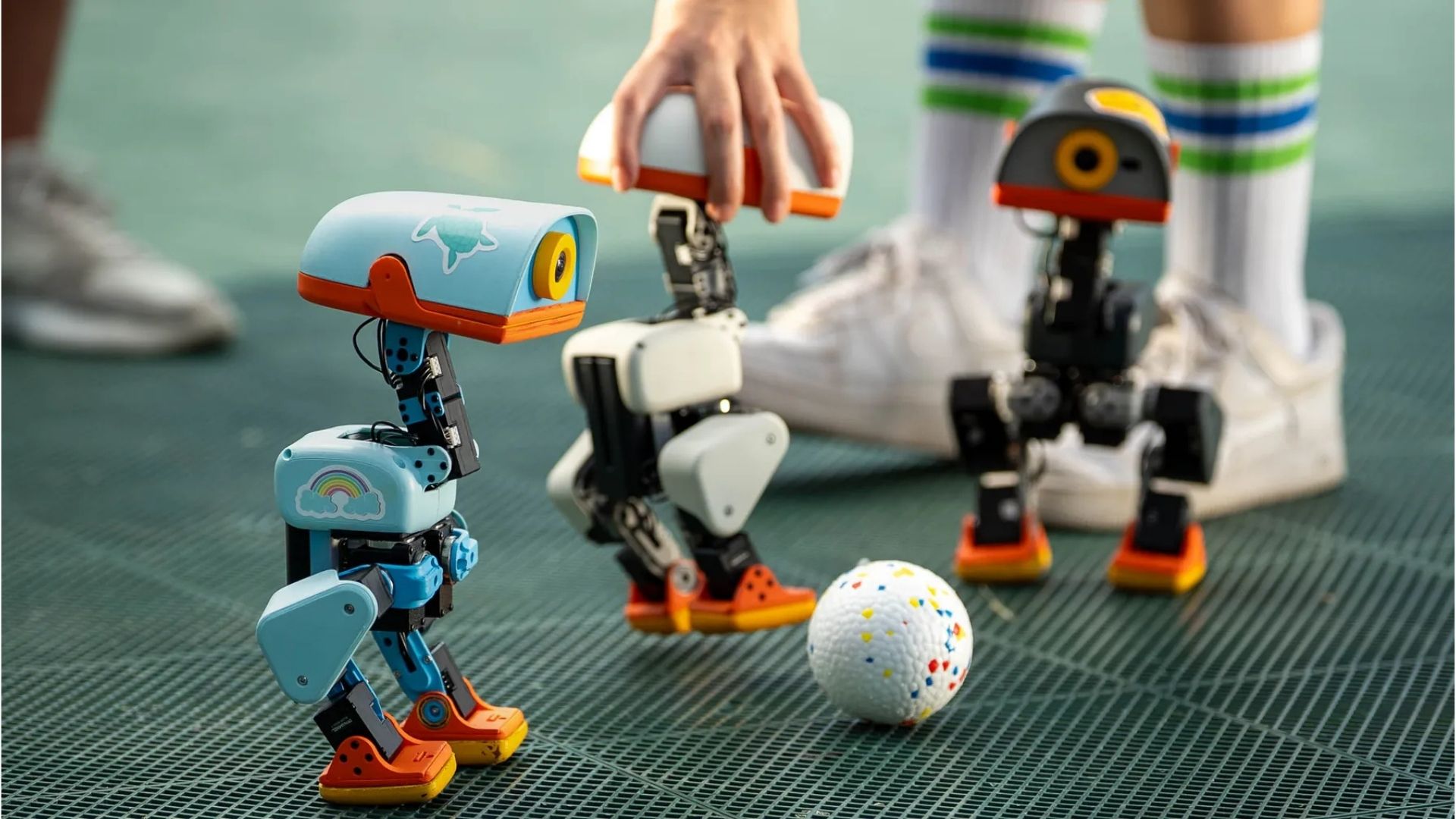
Hugging Face has unveiled the Microduck, a small open-source robot designed to make physical AI more accessible to developers and researchers. Developed with French robotics company Pollen Robotics, the duck-shaped robot is priced at $399 and is expected to begin shipping before Christmas. The Microduck can be programmed and trained by developers, with its software, simulation tools and reinforcement-learning stack made available for experimentation and further development. The launch adds another low-cost hardware platform to Hugging Face’s growing robotics efforts, as the company seeks to bring open-source AI beyond software and into physical machines. Tiny robot learns Microduck is a compact bipedal robot designed to give researchers, developers and students an accessible platform for experimenting with physical AI, reinforcement learning and robot control. Standing 25 centimeters (about 9.8 inches) tall and weighing less than 800 grams (1.8 pounds), Microduck packs 15 motors, a camera, a small depth sensor and two inertial measurement units (IMUs). Its articulated beak can also pick up objects, allowing the robot to combine locomotion with simple manipulation tasks. The robot can walk, sit, crouch and recover from many common falls. It can also roller-skate, demonstrating the range of movement behaviors that can be developed on the platform. Unlike conventional desktop robots that focus primarily on human-robot interaction, Microduck has been designed around physical action. Pollen Robotics says the platform is intended to let developers explore how robots learn movements, test behaviors in simulation and then transfer those behaviors to physical hardware. This makes reinforcement learning a central part of the system. Robots can learn by repeatedly attempting actions, failing and adjusting their behavior. On larger robots, this process can be expensive and potentially dangerous. Microduck’s small size and low weight make experimentation easier to conduct on a desk, in a classroom or in a home environment. The robot is also designed to recover from many falls, reducing the need for users to reset it manually after every failed experiment. Robot training simplified Microduck comes with pre-trained behaviors so users can begin experimenting without first building their own control systems. It can be controlled with a gamepad, follow a laser dot, perform different movements and respond to its surroundings. However, the pre-installed behaviors are only intended as a starting point. Pollen Robotics is positioning Microduck as an open development platform, with software covering robot control, simulation, reinforcement learning and sim-to-real deployment. The company’s open-source Microduck repository provides the software development kit and robot software. In contrast, a separate Microduck RL repository contains tools for reinforcement learning and transferring learned behaviors from simulation to the physical robot. The sim-to-real capability is particularly important for robotics research. Training behaviors directly on physical machines can require significant time and hardware access. Simulation lets developers test and refine behaviors digitally before deploying them on a real robot, although reliably transferring those behaviors between simulated and physical environments remains a major challenge in robotics. Pollen Robotics also sees Microduck as a platform for multi-robot experiments. Multiple robots can be used to explore behaviors such as racing, football, and interaction between machines, potentially allowing developers to investigate multi-agent robotics without requiring expensive full-sized robots. The company says the broader goal is to make physical AI development more accessible. By combining inexpensive hardware with open-source software, simulation and reinforcement-learning tools, Microduck is intended to provide a practical way to experiment with how AI systems can learn physical skills. Microduck is currently available for pre-order for $399 before taxes and shipping. It comes in Cream, Graphite, Lavender, and Sky color options, with first deliveries targeted before Christmas 2026 in North America, Europe, and the UK. Get the latest in engineering, tech, space & science - delivered daily to your inbox.Jijo is an automotive and business journalist based in India. Armed with a BA in History (Honors) from St. Stephen's College, Delhi University, and a PG diploma in Journalism from the Indian Institute of Mass Communication, Delhi, he has worked for news agencies, national newspapers, and automotive magazines. In his spare time, he likes to go off-roading, engage in political discourse, travel, and teach languages.
Video: Hugging Face unveils tiny duck-shaped robot that can walk, learn, skate
Full Article
Original Source
Read the full article at Interestingengineering →KhanList aggregates and links to publicly available news content. We do not host full articles from third-party sources. Always verify important information with original sources.