
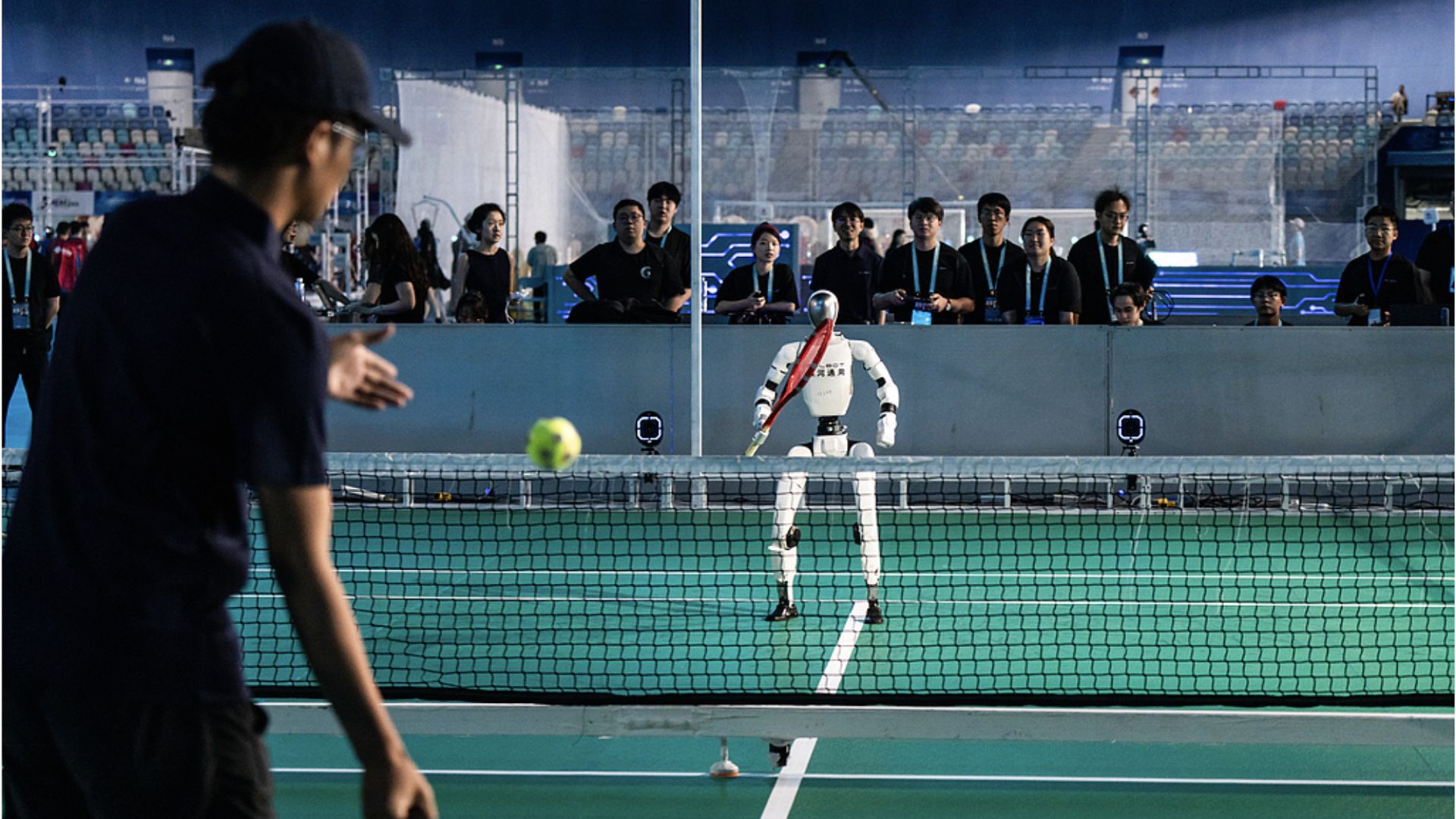
Humanoid robots from China have completed more than 100 consecutive rallies in what the company described as the world’s first live autonomous humanoid robot tennis match. The robots developed by Galbot competed against human athletes during the opening ceremony of the Second World Humanoid Robot Games (WHRG) in Beijing, demonstrating their ability to perceive the game, make real-time decisions and move independently around the court. The humanoid robots handled fast-moving interactions and responded autonomously in a real-world sporting environment without direct human control. Humanoid robots are facing a slew of new challenges at Beijing’s second WHRG, featuring 2,056 machines from 666 teams across 16 countries and new events. Robots take court The second edition of WHRG, which has commenced in Beijing, has showcased a new test for humanoid robots, with Galbot machines competing against human athletes in an autonomous tennis match during the event’s opening ceremony. Galbot said its humanoid robots completed more than 100 consecutive rallies, setting a record for humanoid robot tennis. The demonstration highlighted the growing focus of the games on testing robots in dynamic, real-world environments rather than limiting them to controlled laboratory tasks. During the match, the robots autonomously tracked fast-moving tennis balls, positioned themselves on the court and executed serves, forehands, backhands, returns and recovery shots. They also adapted their movements as rallies developed, requiring the machines to combine visual perception, decision-making and whole-body coordination. The robots additionally competed in doubles alongside human tennis players, adjusting their positioning and movements to changing game situations. In some exchanges, the robots recovered their balance after losing stability and continued playing. According to experts, the Galbot match reflects the broader ambition of the Beijing event: moving humanoid robots beyond demonstrations of individual skills and testing whether they can perceive, make decisions and act continuously in complex environments. Humanoid games evolve The technology behind the demonstrations is LATENT (Learning Athletic Humanoid Tennis Skills from Imperfect Human Motion Data), a new AI framework developed by Galbot designed to help humanoid robots learn complex tennis skills from imperfect human motion data. LATENT breaks tennis movements into smaller, reusable motion primitives, including forehand and backhand strokes, lateral shuffles and crossover steps. This allows the system to learn individual movements and combine them into more complex actions. According to Galbot, a key feature of LATENT is its ability to work with “quasi-realistic” human motion data rather than relying on highly precise motion-capture datasets. In an early study, researchers collected about five hours of primitive tennis movements from amateur players using a compact motion-capture setup. The system then organizes these imperfect demonstrations into a latent action space that robots can interpret and refine. Reinforcement learning and large-scale simulation are used to train the system to select and combine movements in response to changing game conditions. This enables the robot to adjust its actions based on factors such as the incoming ball while maintaining coordinated and natural movement patterns. According to Galbot, the approach aims to overcome a major challenge in robotic learning: teaching machines fast, precise, and dynamic skills without requiring large amounts of perfectly recorded human demonstrations. By converting relatively noisy human movement data into reusable action primitives, LATENT could provide a more efficient pathway for training robots in complex physical tasks.Get the latest in engineering, tech, space & science - delivered daily to your inbox.Jijo is an automotive and business journalist based in India. Armed with a BA in History (Honors) from St. Stephen's College, Delhi University, and a PG diploma in Journalism from the Indian Institute of Mass Communication, Delhi, he has worked for news agencies, national newspapers, and automotive magazines. In his spare time, he likes to go off-roading, engage in political discourse, travel, and teach languages.
Video: Galbot humanoid robot completes 100+ rallies in live autonomous tennis match
Full Article
Original Source
Read the full article at Interestingengineering →KhanList aggregates and links to publicly available news content. We do not host full articles from third-party sources. Always verify important information with original sources.