
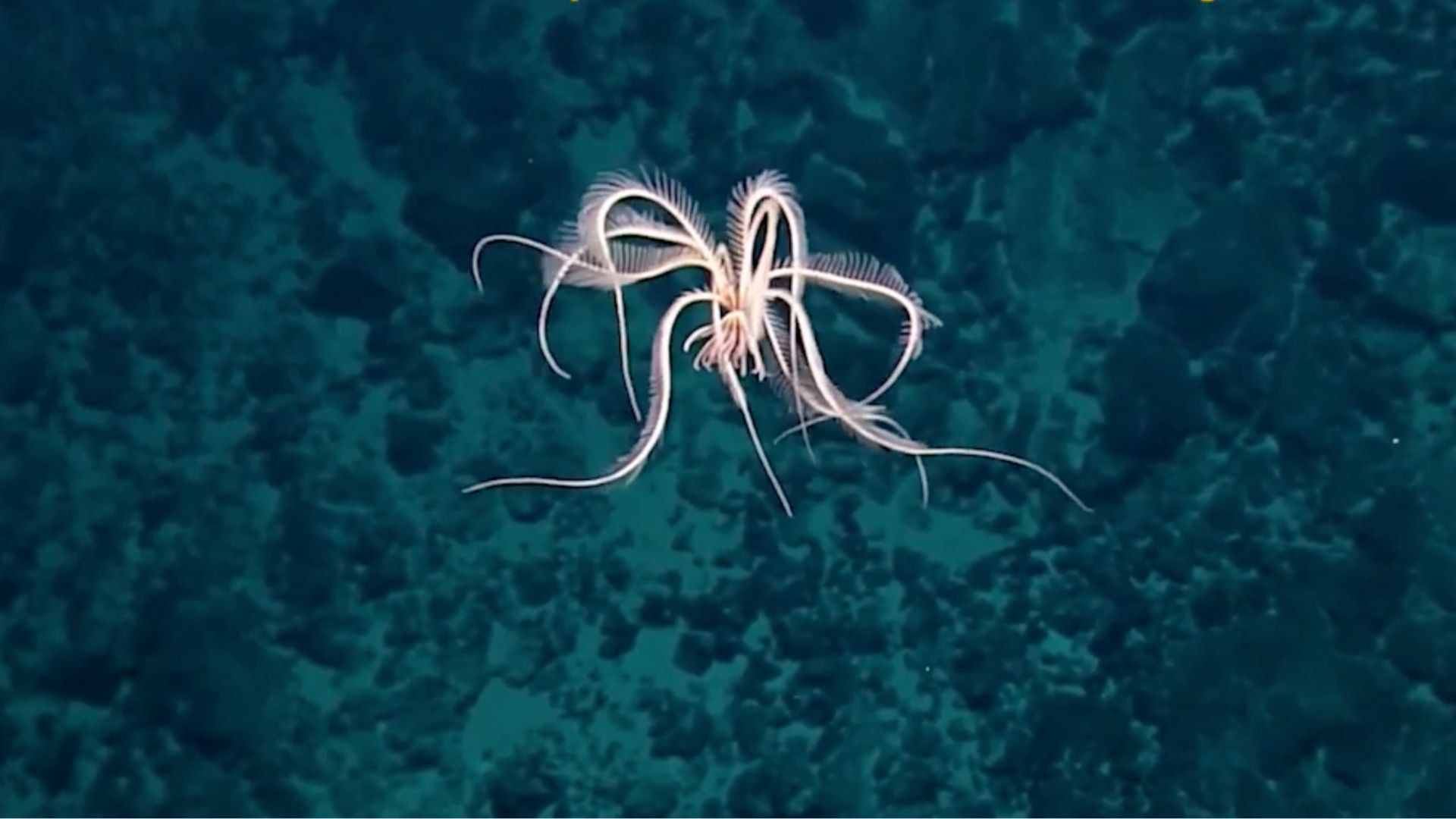
Researchers at North Carolina State University have developed a soft underwater robot inspired by feather stars, a type of marine invertebrate. The robot can move in three dimensions, including forward and backward, up and down, and rotation around its axis. It achieves this range of motion using only two actuators, compared with the six typically required for similar three-dimensional movement. The design uses “mechanical intelligence,” relying on the robot’s structure and interactions with water to reduce the amount of control input needed. Researchers at North Carolina State University have developed a soft underwater robot that achieves three-dimensional movement using just two actuators, reducing the mechanical complexity normally required for this level of maneuverability. Inspired by feather stars, marine invertebrates that can move in different directions and hover by coordinating their limbs, the robot uses four elastic wings arranged around a central disk. The wings are monostable, meaning they can bend under actuation but naturally return to their original position when the force is removed. This mechanical design allows the robot to generate several types of motion without requiring a separate actuator for each direction. According to the NCSU team, the system is based on the principle of “mechanical intelligence,” in which a robot’s physical structure helps determine its behavior and reduces the amount of control input required from computers or human operators. Conventional systems capable of comparable three-dimensional movement would typically require at least six actuators. “One exciting aspect of this work is that it demonstrates how we can create robotic devices with an incredible range of motion using a minimum number of actuators, by taking advantage of intelligent design techniques,” said Jie Yin, corresponding author of the study and a professor of mechanical and aerospace engineering at NCSU, in a statement. Switches movement modes The robot’s two actuators are housed in its central disk and control all four wings. When both actuators are activated, the wings snap downward. Once the actuators are switched off, the elastic wings return upward. Repeating this cycle rapidly makes the robot flap its wings and move upward through the water. When the wings flap more slowly, the robot can maintain its position and hover, a movement the researchers call “jellyfish mode.” The same hardware can produce horizontal movement by changing how the actuators are controlled. Activating only one actuator causes a wing to flutter like a tailfin, pushing the robot forward or backward. The researchers refer to this as “fish mode.” The robot can also rotate around its central axis. By rapidly alternating between the two actuators, the researchers generate asymmetric wing movements that cause the robot to spin. This “rotor mode” provides directional control, allowing the robot to steer while underwater. Together, the three movement modes give the soft robot control over vertical, horizontal, and rotational motion. The researchers demonstrated the system exploring underwater environments with a camera and lifting objects either individually or in coordination with other robots. The design builds on earlier work by the team involving a manta ray-inspired aquatic robot that could move rapidly through water but lacked comparable three-dimensional maneuverability. Instead of adding more motors and complex mechanisms, the researchers sought to obtain additional movement capabilities through the robot’s physical structure.The team noted that the compact design could provide a platform for underwater robotic applications where maneuverability and mechanical simplicity are important. Future work will focus on developing a fully wireless version and exploring potential applications in collaboration with researchers from other fields.Get the latest in engineering, tech, space & science - delivered daily to your inbox.Jijo is an automotive and business journalist based in India. Armed with a BA in History (Honors) from St. Stephen's College, Delhi University, and a PG diploma in Journalism from the Indian Institute of Mass Communication, Delhi, he has worked for news agencies, national newspapers, and automotive magazines. In his spare time, he likes to go off-roading, engage in political discourse, travel, and teach languages.
Video: Feather star-inspired robot moves underwater with just two actuators
Full Article
Original Source
Read the full article at Interestingengineering →KhanList aggregates and links to publicly available news content. We do not host full articles from third-party sources. Always verify important information with original sources.