
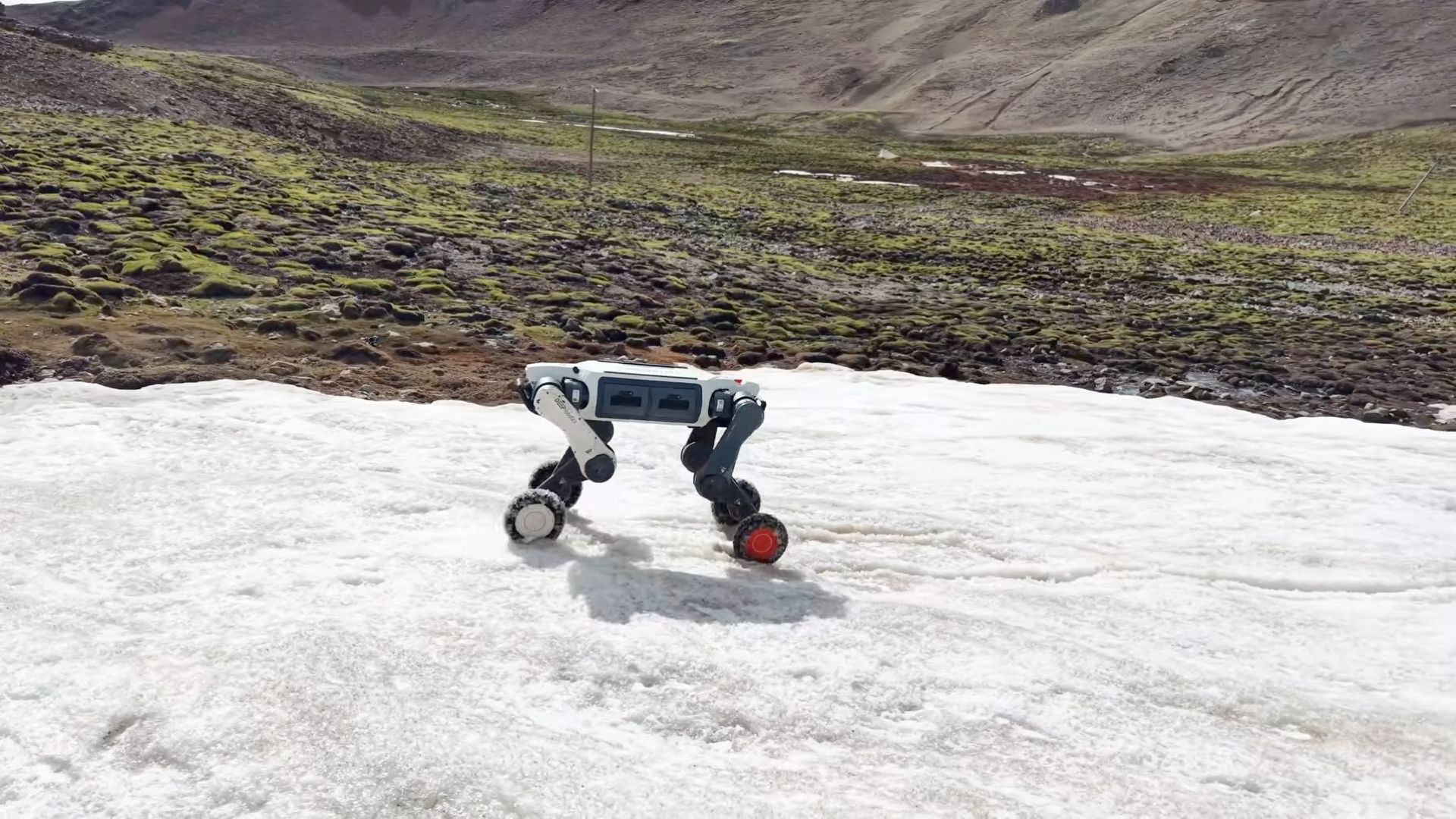
DEEP Robotics’ intelligent robots are helping researchers observe Tibetan antelopes in the high-altitude Serling Tso Nature Reserve in China. Located at an average elevation of 4,700 meters (around 15,420 feet), the reserve becomes a key observation site between July and September, when large herds return with newborn calves during the annual migration season. The robots captured footage of the animals migrating, nursing, and foraging around Cuo’e Lake, providing researchers with visual data that could support wildlife behavior. Recently, Deep Robotics’ DR02 humanoid showcased enhanced mobility, running on grass, jumping obstacles, climbing stairs, and operating near hazardous electrical infrastructure for industrial applications. Robots aid wildlife At an average elevation of about 4,700 meters, China’s Serling Tso Nature Reserve provides an important habitat for Tibetan antelopes. From July through September, large herds return to the region with newborn calves, creating an ideal period for researchers to study migration, nursing and feeding behavior. During this year’s migration season, DEEP Robotics deployed its robots around Cuo’e Lake to support wildlife research and ecological conservation. The machines captured natural footage of Tibetan antelopes while minimizing human interference, providing researchers with valuable visual data for long-term population and behavioral studies. DEEP Robotics has previously used robotic systems for high-altitude wildlife observation. In 2025, its X30 quadruped robot operated in the Hoh Xil region at an elevation of around 4,800 meters (around 15,750 feet). Its biomimetic design helped it blend into the environment and reduce disturbance to animals. This year, the company deployed its Lynx M20 wheeled-legged robot in the Serling Tso Reserve, primarily for close-range visual documentation. The robot was required to operate across soft meadows, uneven permafrost and scattered gravel, where conventional equipment can struggle with stability. Cold temperatures, rain, snow and other harsh weather conditions further complicate fieldwork, highlighting the potential of rugged robotic platforms for scientific observation in extreme environments. Lynx M20 advances DEEP Robotics’ Lynx M20 wheeled-legged robot is being used to support ecological research in the challenging high-altitude environment in Serling Tso Nature Reserve. Designed for all-terrain operation, the Lynx M20 combines the speed of wheeled movement with the obstacle-crossing ability of legged locomotion. Its IP66 protection rating helps shield the robot from dust and water, while its operating temperature range of -20°C (-4°F) to 55°C (131°F) allows it to function in unpredictable plateau conditions. The robot is also equipped with LiDAR and depth cameras that enable it to perceive changes in terrain, including meadows, uneven permafrost and gravel slopes. Using this environmental data, the system can adjust its posture and movement in real time, helping it maintain stability while navigating difficult ground. A key advantage is its low-interference operation. Tibetan antelopes are highly sensitive to unfamiliar sounds and movements, making conventional close-range observation difficult. The Lynx M20’s relatively quiet movement allows researchers to approach herds with less disturbance and remotely document behaviors such as migration, grazing, and nursing.Researchers observed the robot approaching a herd near Cuo’e Lake without causing the animals to flee. According to DEEP, the exercise demonstrates how increasingly capable mobile robots can extend scientific monitoring into remote and extreme environments.Recommended ArticlesGet the latest in engineering, tech, space & science - delivered daily to your inbox.Jijo is an automotive and business journalist based in India. Armed with a BA in History (Honors) from St. Stephen's College, Delhi University, and a PG diploma in Journalism from the Indian Institute of Mass Communication, Delhi, he has worked for news agencies, national newspapers, and automotive magazines. In his spare time, he likes to go off-roading, engage in political discourse, travel, and teach languages.
Video: Chinese robot dog tracks Tibetan antelopes at 15,420 feet in harsh terrain
Full Article
Original Source
Read the full article at Interestingengineering →KhanList aggregates and links to publicly available news content. We do not host full articles from third-party sources. Always verify important information with original sources.