
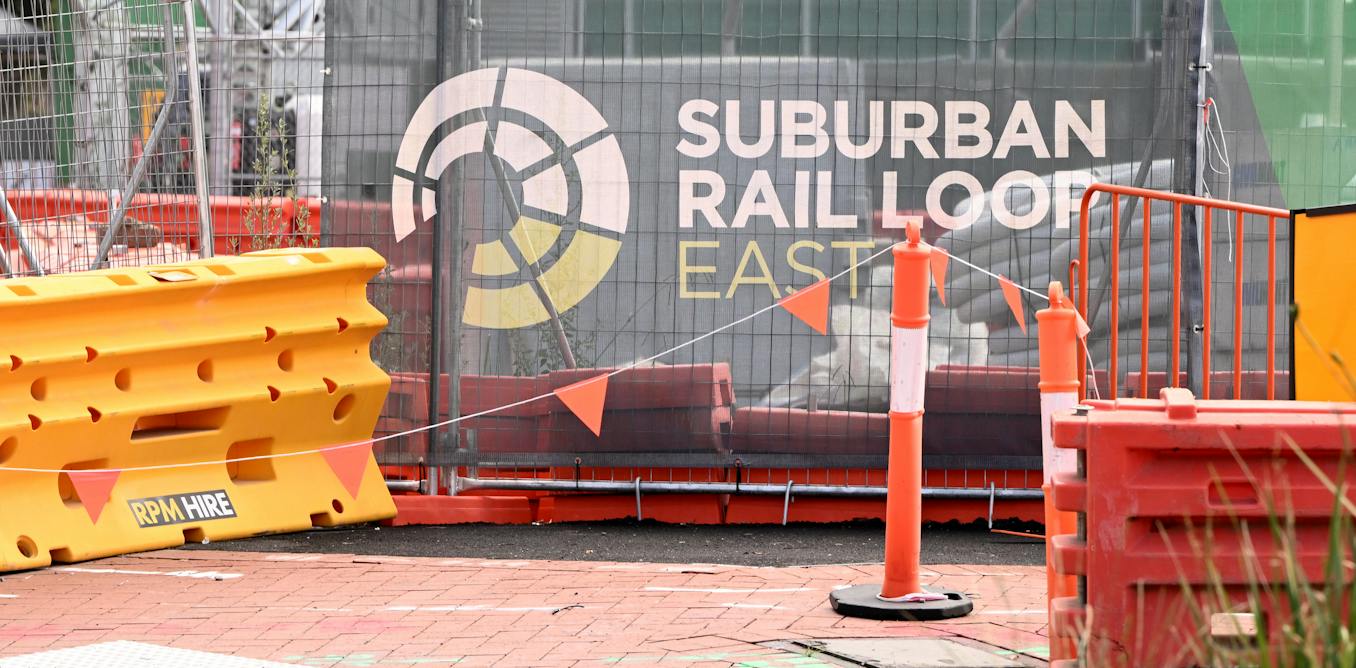
The next Victorian state government needs to prioritise budget repair by deferring or revising major infrastructure projects where costs have blown out by tens of billions of dollars. That’s the overwhelming conclusion from a survey of Australia’s leading academic and business economists conducted by the Economic Society and The Conversation ahead of the state election on November 28. Several are former government advisers. Of the 31 economists polled, 16 named “defer, rescope or cancel major infrastructure projects” as their first or second priority for the incoming government to fix the budget. Here’s what they recommend. Mounting state debt Victoria’s finances have deteriorated over the past decade. State net debt now stands at A$161 billion in 2025-26 – more than New South Wales and Queensland combined. Much of the increase has been due to government borrowing to finance its “Big Build” infrastructure projects. These are over 100 major road, rail and transport projects worth almost A$150 billion to serve the state’s growing population. A recent Resolve survey of voters found economic and financial management was the top priority for a third of them, ahead of crime and housing issues. Janine Dixon, director of the Centre of Policy Studies at Victoria University, told The Conversation that to address essential spending, governments have no choice but to go into debt. But she added: “The Victorian government appears to have overcommitted on infrastructure projects and can slow down the rate of infrastructure development to keep debt at a manageable level.” The head of the Tax and Transfer Policy Institute at ANU, Bob Breunig, put it more bluntly: “They have to cut expenditure and decide what is really needed and what isn’t.” Still, not all economists agreed with this view of the infrastructure spending, pointing to forecasts of surging population growth over coming decades. Construction work to expand the Eastern Freeway has been going on for years. James Ross/AAP Economist Julie Toth said the incoming government’s most important, immediate responsibilities are to ensure “that public services and infrastructure keep pace with Victoria’s growing population and evolving demographics”. Melbourne is the nation’s fastest-growing city, with the population rising from 3.5 million in 2001 to 5.4 million in June 2025. It’s forecast to rise to nine million by 2050. The next priority is to reform stamp duty As interest rates go up, the interest bill on Victoria’s debt is forecast to reach $8.9 billion this financial year. This adds to the debt load and limits future spending options. The Economic Society-Conversation survey offered a menu of options for improving the state’s budget position. The next most popular recommendation involves substantial tax reform: accelerating the transition from reliance on stamp duty to land taxes. Twelve economists put it as their first or second priority. Stamp duty on property sales has been criticised for years. It distorts the market by discouraging mobility, such as downsizing when families grow up or moving for a new job. Melbourne’s population already exceeds five million. Thomas Pavitte/Unsplash Macquarie University head of economics Lisa Magnani said moving to a broad-based land tax would help stabilise the state’s revenues. Downturns in the property market and a decline in transactions have led to a sharp fall in state revenues from stamp duty. For Victoria, this is forecast to amount to $1.3 billion a year, according to the most recent fiscal update. “It is arguably a fairly distributed burden to those landowners who have benefited the most from recent rising land values,” Magnani said. She also cited studies from the Grattan Institute that show a property tax provides more stable revenues and removes the disincentive for people to move house. Stronger fiscal rules are needed Five economists advocated for binding fiscal rules, such as caps on spending or debt, to hold the government to account. There have been long-standing calls for stronger budget rules at the federal level. Read more: No one holds the government to account on spending. We need a budget watchdog that can bite Among the other options canvassed to improve Victoria’s finances were reducing public service headcount and restraining wage growth in the public sector. A wide-ranging report commissioned by the state government found the public sector workforce has grown by 20% since 2019, or more than 54,000 people. Over the same period, executive numbers rose by 52%. UNSW economist Gigi Foster said: “Whatever is done should focus on reducing the total outlay of the government, rather than increasing the income the government collects. "The guiding principle should be that government is now full of administrative bloat (some caused by its own red tape) and doing a lot of things that communities and markets used to do.” One of the surveyed economists argued that restoring fiscal responsibility, returning to a surplus and cutting state debt would also help to restore voters’ confidence in government more broadly. “In the special circumstances of Victoria today, these two options (reducing public service headcount and restraining public sector wage growth) deserve the highest priority,” says independent economist Rana Roy. “They deserve this by their own merit and as a means of restoring public trust in the state itself.”
Victoria’s next government needs to delay or cancel big build projects, top economists warn
Full Article
Original Source
Read the full article at Theconversation →KhanList aggregates and links to publicly available news content. We do not host full articles from third-party sources. Always verify important information with original sources.