
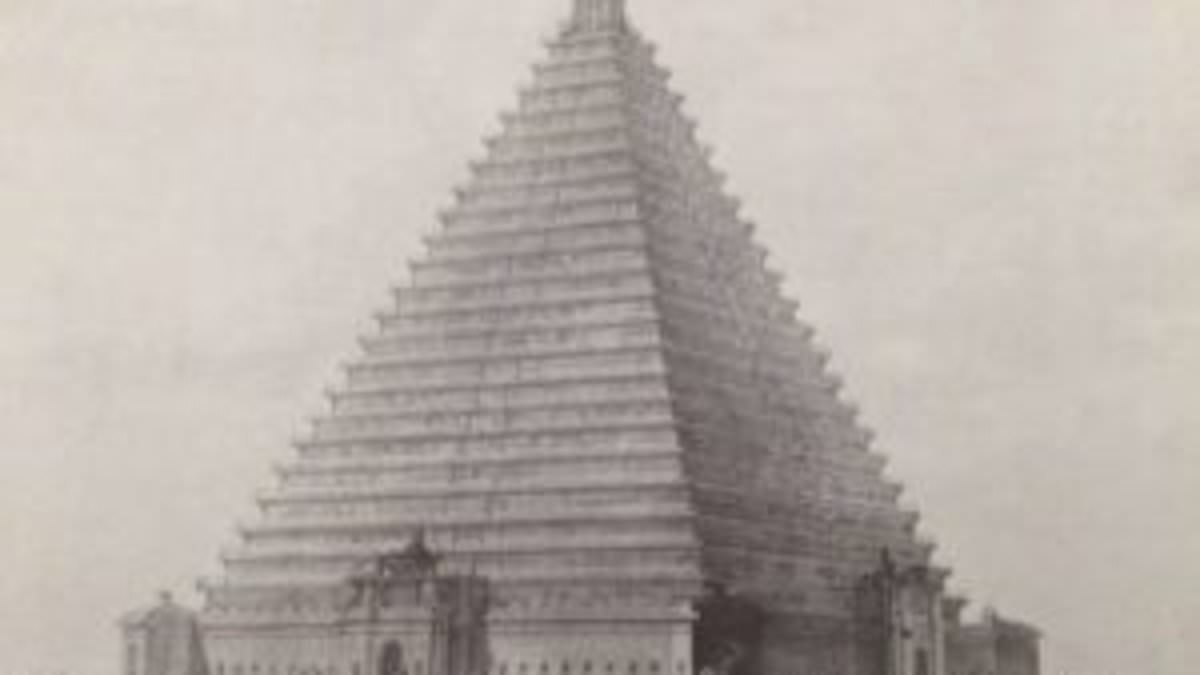
See more Daily Mail on Google - save us as a Preferred Source Published: 11:48 EDT, 29 August 2026 | Updated: 11:57 EDT, 29 August 2026 As London's councils run out of space to bury the dead, a centuries-old idea for a giant pyramid four times the height of St Paul's could be resurrected.Seventeen local authorities will have nowhere to bury their deceased residents by 2040, a new audit by City Hall revealed earlier this month.Three boroughs – Camden, Hackney and Tower Hamlets – have already reached capacity.Meanwhile the capital has an aging population. ONS data predicts the proportion of those aged 65 and over in London will reach just over 40 per cent by 2040.The Greater London Authority has advised local councils to re-use graves over 100 years old and increase grave depths to allow multiple burials in one plot.There have also been suggestions to use 'grey belt' or low-quality green belt to alleviate the shortage.But historians are now pointing to another solution touted by architect Thomas Wilson almost 200 years ago.His audacious plan, which never came to fruition, was put forward as London's population rapidly expanded in the wake of the industrial revolution. Thomas Wilson's vision was to save on space by stacking the dead vertically and constructing a giant 94-storey pyramid in Primrose Hill, north London Wilson said the pyramid would teach 'the living to die, and the dying to live for ever'Small parish churchyards were dangerously overflowing and there was a real risk of unburied corpses creating a health hazard in the capital. Wilson's vision was to save on space by stacking the dead vertically and constructing a giant 94-storey pyramid in Primrose Hill, north London.While the footprint of the design would cover 18 acres, in practical terms the pyramid would create a capacity of more than 1,000 acres.Inside, the pyramid would have room for five million deceased Londoners within a honeycomb-like network of 215,219 individual catacomb vaults.Mourners could access their loved ones by climbing ramps provided on each level leading to the next storey. And while it provided a practical solution of where to bury the dead, the pyramid itself would also have aesthetic appeal. Tapping into the Victorian obsession with ancient Egypt, adorned in granite and topped with an obelisk, Wilson intended the pyramid would become one of the capital's most iconic landmarks. There was even a financial incentive to the plan.The architect estimated that at £50 per vault and 40,000 burials per year, the investors of the Pyramid General Cemetery Company could make up to £10,000,000 - a sum equivalent to almost £150million in today's money.Wilson wrote of his plan: 'Whether inside or out the pyramid would beguile the hours of the curious and impress feelings of solemn awe and admiration upon every beholder.' Seventeen local authorities will have nowhere to bury their deceased residents by 2040, a new audit by City Hall revealed earlier this monthHe said it would be 'practical, economical and remunerative', and would 'go far towards completing the glory of London...teaching the living to die, and the dying to live for ever'. But not everyone was in favour of a great pyramid of the dead in London. In 1828, the Literary Gazette called the project 'a monstrous piece of folly' and many failed to be swayed by Wilson's vision.Parliament instead adopted the more traditional suggestion of suburban 'garden cemeteries', such as the ones in Highgate and Kensal Green. Wilson's idea meanwhile was buried - but as councils grapple with a cemetery shortage it could well be considered again nearly 200 years later.
Victorian plans for 90-storey high Great Pyramid of London that could hold 5million dead are remembered as burial space runs out in the capital
Full Article
Original Source
Read the full article at Dailymail →KhanList aggregates and links to publicly available news content. We do not host full articles from third-party sources. Always verify important information with original sources.