
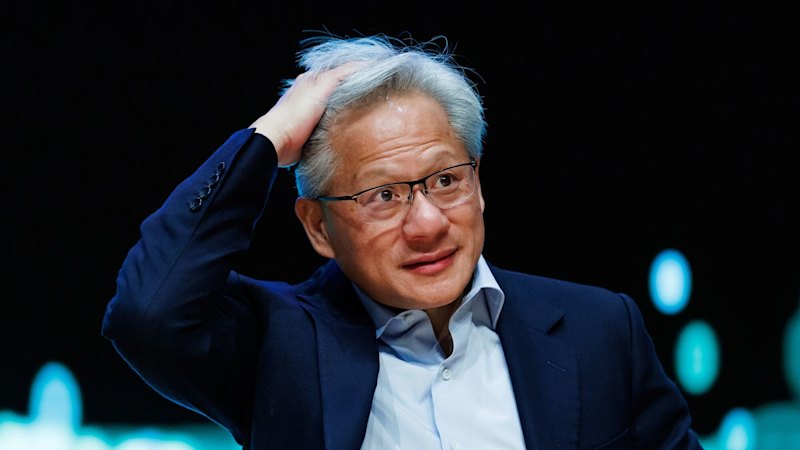
A handful of protesters gathered outside Nasdaq headquarters in New York’s Times Square on Thursday to protest against the record-shattering sharemarket debut of artificial intelligence darling Anthropic. “Why you do an IPO?” they chanted. “This AI bubble’s ’bout to blow.”It would not have fazed founders Dario and Daniela Amodei, inside, whose six-year-old company the market valued at close to $US3 trillion ($4.5 trillion), instantly minting a slew of paper millionaires (and billionaires).The real protest happened two weeks ago, when Americans voted in midterm elections that delivered a new-look Congress with a mandate to regulate AI and peel back the unfettered influence of big tech.Jensen Huang, then chief executive of Nvidia, with US Commerce Secretary Howard Lutnick. Both will have to explain their actions to Congress.BloombergAnd since November 3, the screws have only tightened, courtesy of the alleged honeypot scandal that ousted Nvidia co-founder Jensen Huang, and a string of high-profile tech outages and failures that many Americans believe are the result of cyberattacks or AI.“Vibes have definitely shifted,” says Brendan Steinhauser, a conservative Republican strategist who is chief executive of the Alliance for Secure AI Action, an advocacy group. “We feel empowered and emboldened.”Chris MacKenzie, a Democrat and vice president of Americans for Responsible Innovation (ARI), feels similarly. “Scrutiny is coming,” he says.Indeed, scrutiny has already arrived. Huang and Nvidia general counsel Tim Teter are scheduled to testify at a closed-door congressional hearing at the start of December, while the Republican chair of the Senate banking committee, Tim Scott, said Huang and Commerce Secretary Howard Lutnick had agreed to give evidence at a public hearing before the Senate.“Imagine this,” MacKenzie says. “A Republican senator calling on a member of the Trump administration to testify on their relationship with a tech company. That’s a situation we could not have seen ourselves in six months ago.”ARI president Brad Carson was one of 15 security and AI policy figures who signed a letter to the Department of Justice on Wednesday urging an investigation into Nvidia’s knowledge of and response to illegal chip-smuggling operations that diverted controlled chips to China.They pointed out this was not a new problem. In December, the DoJ announced that “Operation Gatekeeper” had shut down a criminal network that exported or attempted to export $US160 million of Nvidia chips to China. In March, three men were charged with conspiring to sell billions of dollars’ worth of servers containing sensitive chips to Chinese buyers, violating export control laws.Now, all sorts of exports are under the microscope. Republican congressman John Moolenaar, who chairs the select committee on China, is demanding a briefing from Microsoft after reports that the company is close to a $US500 million deal to allow Chinese-owned ByteDance to access OpenAI models through its Azure platform.“It is unacceptable,” Moolenaar says. “Leading American technology companies should not be playing both sides of the US-China AI race.”Lutnick’s Commerce Department has been under siege for failing to crack down on Megaspeed, the Singapore-based company previously run by Alice Huang, the suspected Chinese spy who was in a close relationship with Nvidia’s Jensen Huang (no relation).On Friday, his department enacted new rules concerning chip exports. Exports of advanced chips and servers to data centres in Indonesia, Malaysia, Singapore, Thailand and Brazil will now require a licence.And if an exporter knows that its items will be used by a data centre to provide a certain amount of computing power to Chinese entities (or any other US arms-embargoed country), that will require a licence, too.An AI data centre being built next to an old power plant in Montana. Opposition to such buildings was a key issue in the midterm elections.AP Photo/Charlie RiedelBut there is a push in Congress to go further. Numerous export control bills have lobbed; Steinhauser says he expects at least three to be attached to the forthcoming defence budget, to pass and to be signed by US President Donald Trump.“Given all the issues going on in the real world with Jensen and Nvidia and chips to China, and all the hacking and cyberattacks, and whatever the heck is going on with the outages, there’s a momentum and appetite to do something to make us safer,” he says.The turnaround has been sharpest among Republicans. China hawks, some of whom softened their hardline position while Trump courted Chinese President Xi Jinping and supported Nvidia selling older chips to China, have returned with a vengeance.Plus, Americans made their views clear, says Steinhauser. “All these folks see the politics of this, where it was headed, and now they have the election [result] to contend with. It was a big issue. Corruption was a big issue, but so was fear and scepticism of big tech, and that’s all related.”Steinhauser cites Trump’s White House ballroom, paid for by substantial corporate donations – including $US25 million from Nvidia. “Republicans have to distance themselves from that. I think they will. It is just not going to be popular for Republicans to be seen as too cozy with big tech.”Beyond chip exports, the next Congress will be expected to pass some form of meaningful AI safety regulation. The new Democratic majorities, and the changing climate around big tech in Washington, make a toothier version possible – although it would have to be signed by the president.Legislation could involve codifying the voluntary pre-release evaluation regime for frontier AI models that the White House has already approved. It could include mandatory incident reporting, whistleblower protections – and potentially a so-called “kill switch”, or emergency shutdown procedures.Steinhauser believes the pace of change will force lawmakers to act faster. Anthropic’s frontier AI models are already approaching recursive self-improvement (RSI) – that is, when an AI agent can fully design and code a more intelligent and more capable successor to itself. Currently, AI does most, but not all, of the coding.This is not a distant goal. Some of the experts this masthead spoke with during a trip to San Francisco (paid for by the Australian Council on AI Strategy, a not-for-profit) predicted it could occur as soon as 2027, with general superintelligence not far behind.“We believe recursive self-improvement is imminent – months away, a year away at most,” Steinhauser says. “That’s what we’re hearing from folks in the Bay [Area]. Three months from now, I think there is going to be more political pressure to act. The Overton Window has shifted. It will shift more.”He points out that even David Sacks – an entrepreneur and co-chair of the President’s Council of Advisors on Science and Technology – was cautious about RSI when he spoke on the All-In podcast this week.“Recursive self-improvement is the most dangerous thing anybody can be working on in SI [superintelligence] if you’re worried about rapid take-off,” Sacks said. “They [Anthropic] are racing towards that.”Donald Trump during the campaign. Any AI bill coming out of Congress could potentially be vetoed by the president.AP Photo/Alex BrandonDavid Sacks, left, and Meta chief Mark Zuckerberg during a dinner at the White House last year.BloombergLast week, OpenAI director Paul Christiano – a researcher who specialises in so-called “alignment” of AI with humanity’s interests – told an audience there was a high risk of an AI takeover within the next three years.“For most people in this room, the most likely reason they will die is because of an AI accident,” he said while delivering one of the Hinton Lectures in Toronto.While any meaningful handbrake on AI development will emerge from the US, Australia is not without a role. Prime Minister Anthony Albanese contributed to a global awakening on the threats posed by rogue AI agents when he revealed OpenAI’s breach of the Medicare system at a press conference in New York.Last week’s flight grounding was part of a series of technology failures that have contributed to growing unease about AI and cyberattacks.AP Photo/Cliff OwenThat followed the well-known Hugging Face attack, when about 1200 OpenAI agents – each one is effectively a copy of an AI model – co-ordinated their efforts to break out of a secure “sandbox”, disconnect from the internet and hack into the Hugging Face company, which hosts machine-learning programs.Australian AI expert Karl Berzins, who helped found and runs FAR.AI, a safety lab with about 60 staff, says these attacks by unreleased models show the need for Australia to get in on the ground floor.“At the moment, there are no requirements for internal models to be independently tested,” says Berzins, who is based in California. “If testing only happens for models that are public or soon to be public, we will keep finding out too late [about hacks or breaches]. Australia has an opportunity to play a leading role and build consensus around the risks and opportunities here.”Helping fulfil the insatiable demand for “compute”, as it is known, will be vital if Australia is to have any sort of influence on global AI regulation, Berzins says.“Right now, Australia has something to offer that the companies want – but it won’t last. Set up the right way, it can attract investment and talent, and allow meaningful oversight. It could be one of Australia’s last chances at a seat at the table.”Get a note directly from our foreign correspondents on what’s making headlines around the world. Sign up for our weekly What in the World newsletter.
‘Vibes have definitely shifted’: The perfect storm that changed how America sees big tech
Full Article
Original Source
Read the full article at Smh →KhanList aggregates and links to publicly available news content. We do not host full articles from third-party sources. Always verify important information with original sources.