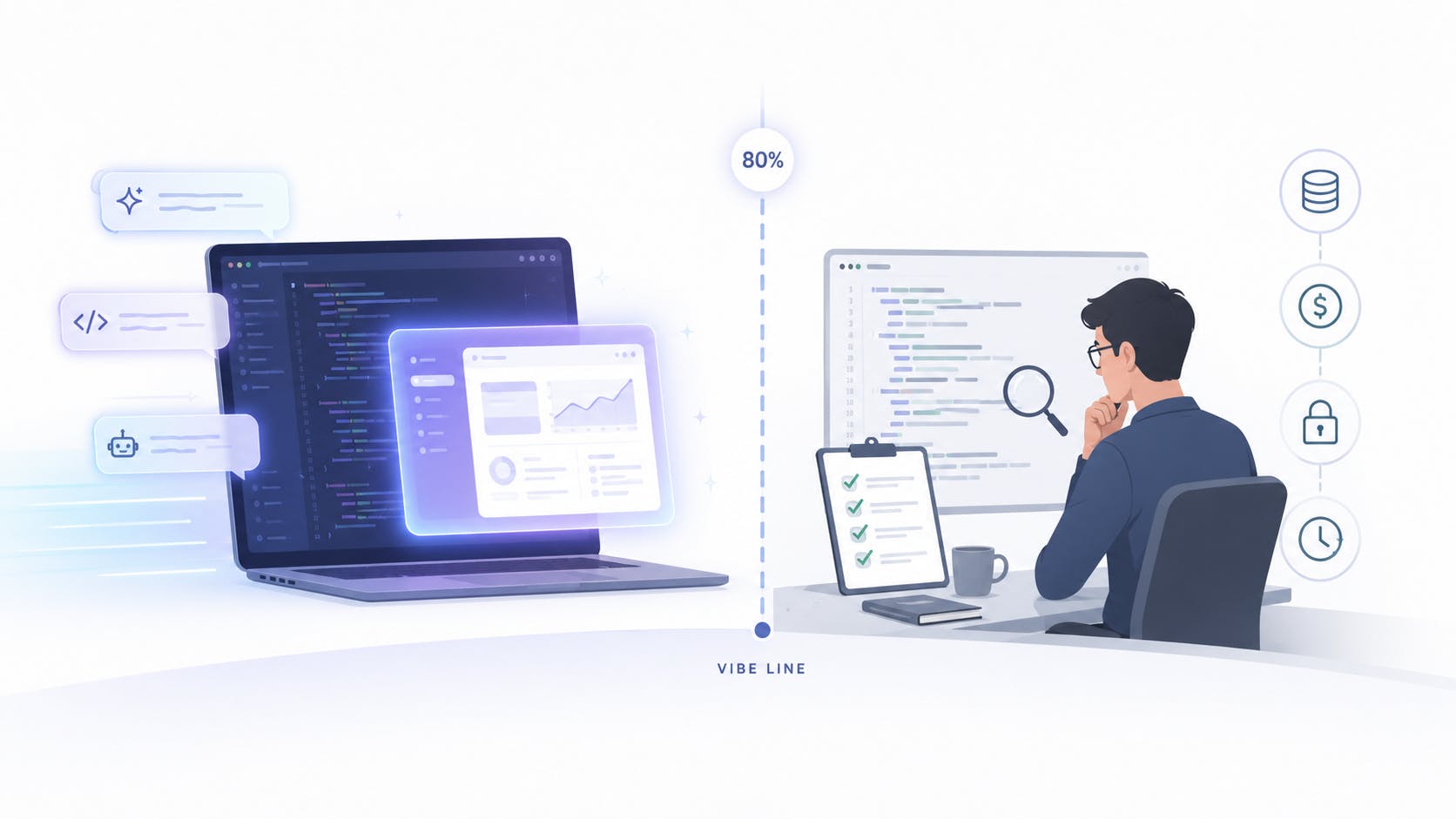
What vibe coding actually isStrip away the hype and vibe coding is simple: you describe the outcome in plain language, the AI writes the code, and you steer by feel instead of by spec. You're not reading every line. You're reacting to whether the thing works, then asking for the next change.That's a genuinely new way to build. For most of software history, you had to know how to make the computer do something before you could make it do it. Vibe coding removes that wall. You need to know what you want and whether the result looks right.Which is exactly why it's so powerful at the start of something — and so risky at the end.Vibe coding is a brilliant way to start and a terrible way to finish.Why the first 80% feels like magicEarly on, vibe coding wins on every axis that matters.You're exploring, so being fast beats being perfect. If the AI gets it slightly wrong, you see it immediately and correct it in the next sentence. Nothing is at stake yet — no real users, no real money, no data anyone will miss. A bug just means you try again.This is the sweet spot, and you should lean into it. Prototypes, throwaway scripts, weekend projects, learning a new framework, internal tools only you will ever touch — vibe away. The cost of being wrong is a few wasted minutes, and the speed is unbeatable.The mistake isn't vibe coding here. The mistake is not noticing when you've quietly crossed out of this zone.Why the last 20% is where it bitesThe trouble starts the moment your code touches something that can hurt someone if it's wrong.The AI writes code that looks finished. It runs. The demo works. But "it runs" and "it's correct" are different claims, and vibe coding only ever checks the first one. The bugs that survive are the ones you can't see by looking: the login check that passes for the wrong reasons, the calculation that's right for your test case and wrong for everyone else's, the database call that works until two people use it at once.None of those show up in the vibe. They show up in production, at the worst possible time, in front of the people you least wanted to see them.And there's a second trap: when something breaks in code you didn't really read, you can't fix it. You go back to the AI, it confidently changes three things, two of them unrelated, and now you're negotiating with a system you never understood in the first place. The speed that got you here is gone.The Vibe LineHere's the one tool worth remembering. Before you ship anything you vibe-coded, run it past four questions. I call the boundary they draw the Vibe Line.Ask yourselfIf the answer is yes…Does it touch customer data?Stop vibing. Read the code, or have someone who can.Does it touch money?Stop vibing. This needs tests, not vibes.Does it touch security or logins?Stop vibing. Confident-looking auth code is the most dangerous kind.Is it hard to undo?Stop vibing. Anything you can't roll back needs real review.If every answer is no, you're on the safe side of the line — keep going, keep it fast. If any answer is yes, you've crossed it, and the job changes. Not "stop using AI" — just stop trusting it blindly. Now you read the code, write a test, ask a human, add a way to undo it. The AI still writes; you just stop treating its output as finished because it looks finished.That's the whole discipline. Vibe on one side of the line. Engineer on the other. The people who get burned are the ones who never noticed they'd crossed it."So am I a fake engineer if I vibe code?"This is the fear underneath the whole debate, so let's say it plainly: no.Vibe coding isn't cheating, and it isn't beneath you. A working first draft in twenty minutes is a real advantage, whether you're a beginner shipping your first app or a staff engineer prototyping an idea before the meeting. The people who refuse to touch it out of pride are just slower.But the reverse is also true. Being able to generate code was never the hard part of engineering — deciding whether it's actually correct, safe, and worth trusting always was. Vibe coding hands you the easy 80% for free. That makes the remaining 20% — the judgment about when to stop — the entire value you add.The AI can write the code. Deciding when to stop trusting it is still your job.That's not a smaller job than before. In a world where anyone can generate a working demo, the person who knows where the Vibe Line is becomes more valuable, not less.The takeawayVibe coding is the best way we've ever had to start building software. It is not, on its own, a way to finish it.Use it without guilt for anything that can't hurt you — prototypes, scripts, learning, exploration. The moment your code touches customer data, money, security, or anything you can't undo, stop steering by feel and start engineering. Same AI, same speed, just with your eyes open.Everyone is vibe coding now. The ones who ship are the ones who know exactly when to stop. Cheers
Vibe Coding Gets You 80% There. This Is What the Other 20% Requires.
Full Article
Original Source
Read the full article at Hackernoon →KhanList aggregates and links to publicly available news content. We do not host full articles from third-party sources. Always verify important information with original sources.