
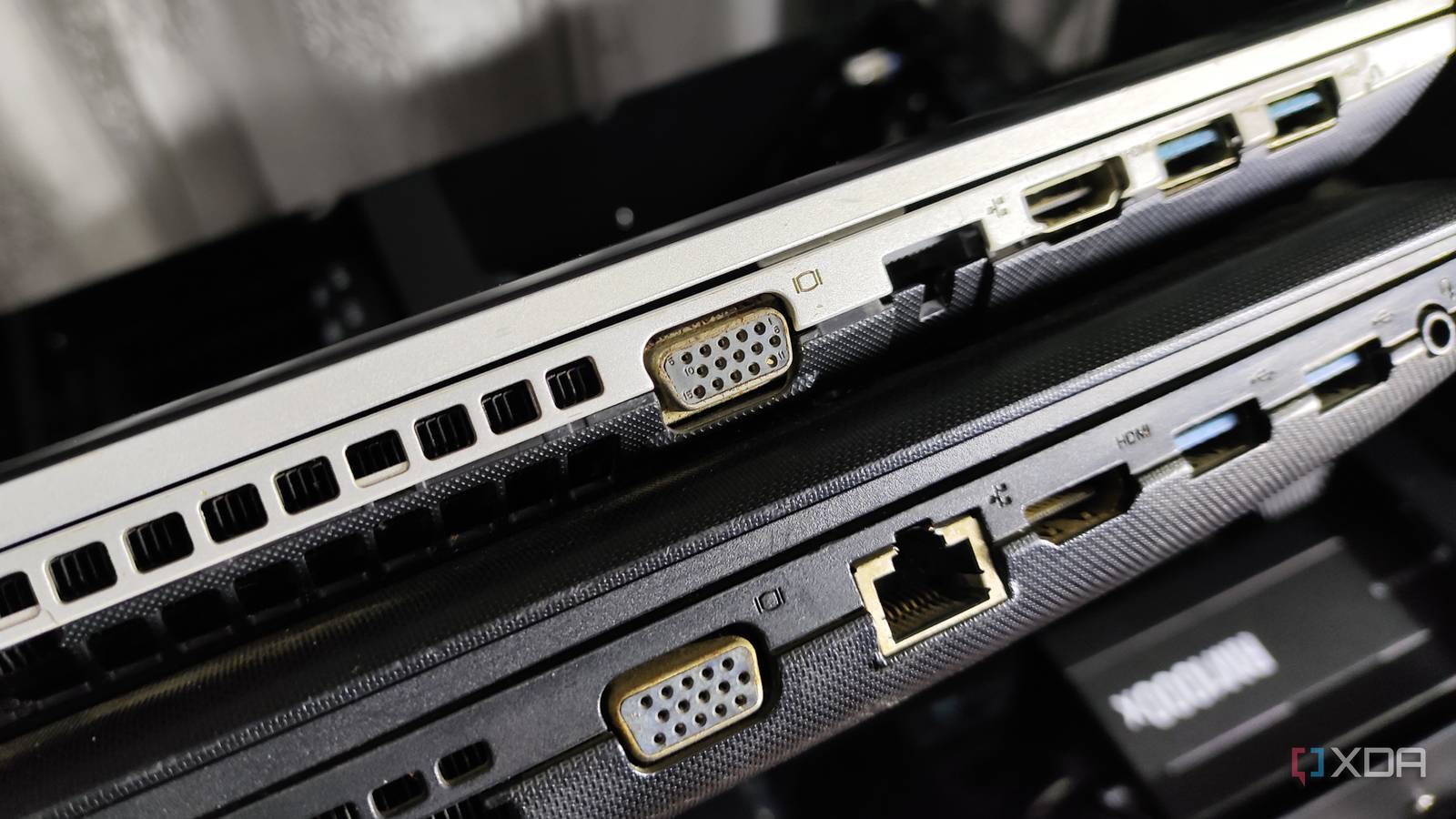
Published Oct 1, 2026, 12:00 PM EDT His love of PCs and their components was born out of trying to squeeze every ounce of performance out of the family computer. Tinkering with his own build at age 10 turned into building PCs for friends and family, fostering a passion that would ultimately take shape as a career path. Besides being the first call for tech support for those close to him, Ty is a computer science student, with his focus being cloud computing and networking. He also competed in semi-pro Counter-Strike for 8 years, making him intimately familiar with everything to do with peripherals. Few PC connectors ever make it to their 30th birthday, but the VGA connector which IBM introduced in 1987, made it well past the three-decade mark. It outlived the machines it first shipped on and even the graphics standard it was named after. Its survival had little to do with quality and everything to do with how easy it was to integrate, and by the time better options had arrived, it was already ubiquitous. An IBM standard that slipped through their hands VGA was quickly replicated everywhere IBM introduced VGA in 1987 with its PS/2 line of computers. It was a display controller, a graphics standard, and a new 15-pin connector all at once. IBM's earlier mainstream adapters, like CGA and EGA, sent digital signals over a nine-pin connector, which limited them to a small fixed set of colors. VGA switched to analog RGB, so instead of sending on-or-off values for each color channel, the card sent varying voltages, letting VGA draw from a palette of 262,144 colors and show up to 256 of them at once at 320x200. This wasn't a small deal, either. The PS/2 was meant to reassert IBM's control over the PC platform, but VGA escaped. Clone makers adopted it quickly, and it became the last IBM graphics standard that most of the PC-compatible industry followed. IBM's own successors, 8514/A and XGA, never came close to that reach. Within a few years, VGA was everywhere and it wasn't up to IBM anymore. The connector kept growing CRTs in particular loved it VGA was analog, and that's a big reason why the connector outlived the standard itself. A CRT, unlike today's LCDs, doesn't have a fixed grid of pixels. It sweeps an electron beam across the screen at whatever rate the sync signals indicate, and so when GPUs moved beyond 640x480 to 800x600 and beyond, the cable didn't have to change. Those 15 pins on VGA were more than enough to handle those resolutions on a CRT. The industry also just kept adding to the connector instead of replacing it, which helped its staying power. VESA, formed in the late 1980s, standardized higher-resolution modes and the BIOS extensions software used to reach them. In the mid-1990s, VESA's Display Data Channel repurposed some of the connector's pins as a small data bus, so the monitor could tell the graphics card which resolutions and refresh rates it supported. Pin 9, originally a blocked key, became a 5V supply. The connector looked the same, but it had gained plug-and-play. Then, in 1999, DVI was introduced as a successor to VGA, but that only helped keep it alive further. DVI's DVI-I variant carried analog signals alongside digital ones. A cheap passive adapter turned a DVI-I port into a VGA port, so graphics cards could ship newer outputs while keeping VGA compatibility for years. The installed base snowballed across offices, schools, projectors, KVM switches—VGA was the default in the majority of cases. Flat panels exposed VGA's crucial weakness The end of VGA CRTs were a great fit for VGA, but once flat panel LCDs became the norm, VGA's days were numbered. An LCD has a fixed grid of pixels and works digitally, so driving one over VGA meant a round trip. The graphics card converted a digital image to analog, and the monitor converted it back. To do that, the monitor had to work out where each pixel started and ended from a continuous signal. When it got that slightly wrong, you saw soft text, shimmer, or faint wobble. That's why so many monitors of the era had an auto-adjust button, something I pushed many times growing up. The problem also got a lot worse at higher resolutions and over longer or cheaper cables. The alternatives were simply so much better for LCDs: DVI sent pixels directly, and it was further developed in HDMI's 1.0 specification to handle audio. DisplayPort arrived soon after, and the writing was on the wall. In December 2010, Intel and AMD, alongside their partners, announced their plans to end VGA support in its processors and chipsets by 2015, and move to DisplayPort and HDMI for good. VGA still isn't dead It lives on in the enterprise Obsolete doesn't mean gone completely. There's still a decent install base of VGA monitors and projectors that live on in schools and offices, and in the enterprise world, it's still common on server boards. Many of them use ASPEED management controllers that still provide a VGA output, so an admin can plug in a monitor on a cart and see what's happening. KVM switches industrial displays kept the port for the same reason. For everything else, inexpensive HDMI and DisplayPort adapters bridge the gap that's left behind. The connector that outlived its standard The VGA standard lasted a few years, but the connector lasted through generations of PC hardware. It was easy to copy, flexible enough to grow and add features, and common enough that it felt like dropping it was too big of a risk. It took the better part of two decades to replace it, and while it's no longer on modern consumer hardware, it's still found in spades throughout offices, schools, and the enterprise world.
VGA lasted nearly 40 years because it was almost impossible to replace
Full Article
Original Source
Read the full article at Xda-developers →KhanList aggregates and links to publicly available news content. We do not host full articles from third-party sources. Always verify important information with original sources.