
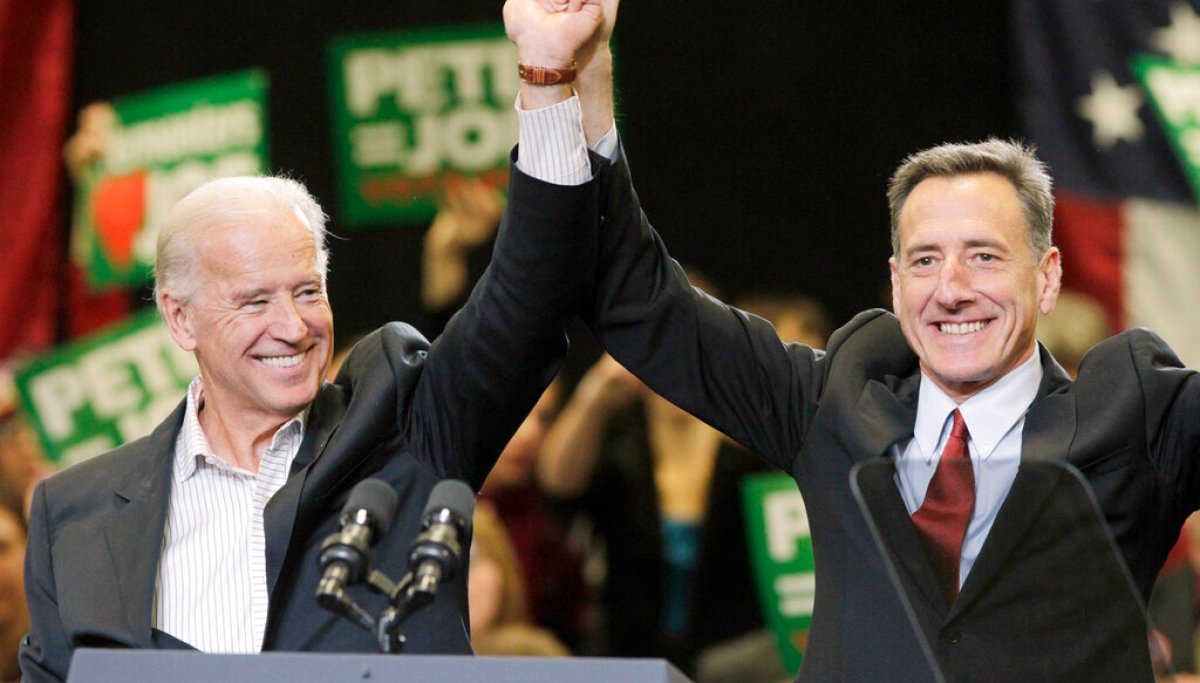
Vermont’s failed experiment with single-payer universal health insurance more than a decade ago illustrates the pitfalls of the push for “Medicare for all” from left-wing Democrats in the years ahead.Sixteen years ago, Vermont Democrat Peter Shumlin ran for governor with the promise of ushering in a state-run health insurance system to replace the private market, and the state became the first in the nation to pass a single-payer healthcare bill, called Green Mountain Care, in 2011.But by 2014, Shumlin was forced to abandon any attempt to create a payment mechanism to finish the job after realizing it would be too costly for Vermonters. Today, ballooning healthcare costs across the industry, coupled with the Democratic Party’s landslide victory in the 2026 midterm elections, have reinvigorated calls from the left wing of the Democratic Party to push forward a “Medicare for all” style single-payer health plan at the federal level. A single-payer healthcare system is one in which a government agency finances universal medical coverage using tax revenue.Such a plan likely won’t make it far with President Donald Trump still in the White House. But Democrats will have the next year to determine whether some form of single-payer health coverage will be on their platform for the 2028 presidential election season.Sen. Bernie Sanders (I-VT), the incoming chairman of the Senate health committee, has made advancing his Medicare for All universal coverage plan a key part of his legislative agenda. At a minimum, Sanders intends to pass legislation to lower the Medicare eligibility age to 55 and expand coverage to all Americans age 18 and under regardless of income. He has support from incoming left-wing “Medicare-for-all” supporters such as Sen.-elect Abdul el Sayed of Michigan and Rep.-elect Darializa Avila Chevalier of New York.El Sayed and Chevalier may be too new to politics to remember the failure of single-payer healthcare in Vermont, but Sanders is not. He was an advocate of the experiment in his home state.Before launching his national Medicare for All agenda, Sanders praised Shumlin’s Green Mountain Care on multiple occasions and said he was proud that Vermont was “taking big steps to lead the nation in healthcare.”In an MSNBC appearance in 2013, Sanders predicted that Vermont’s success would inspire larger states such as New York and California to do the same and eventually push “the entire federal government” toward single-payer universal healthcare.“We need some good models out there to show that a single-payer system can work. I hope Vermont leads the country in doing that,” Sanders said in 2013.Linda Blumberg, a fellow at the nonpartisan Urban Institute, told the Washington Examiner she believes politicians have not spent enough time educating voters about the pros and cons of a costly single-payer healthcare system in the decade and a half since the Vermont experiment failed.“I just don’t think we’ve had that clear, honest conversation as a country,” Blumberg said. “Because a reform of that size impacts every single person who lives in the country, I think as policymakers, and as policy experts, we owe that to people to educate them about what it means, so that they can make an educated choice.”Democratic presidential candidate Sen. Bernie Sanders, left, speaks alongside Gov. Peter Shumlin, center, and Sen. Patrick Leahy at a rally Friday, July 1, 2016 in Montpelier, Vt. (AP Photo/Wilson Ring) Green Mountain Care’s failure to launch Democrats in Vermont launched their campaign for a single-payer health insurance system in the afterglow of the passage of Obamacare in March 2010.Liberals in the Democratic Party were dissatisfied that the national health reform bill did not go as far as to create a nationally run insurance program, but instead created a marketplace for federally subsidized private insurance plans.But the ACA created an opportunity for Vermont to use federal funding designated for creating Vermont’s version of the Obamacare insurance exchange to instead underwrite the creation of Green Mountain Care as a single-payer experiment.The state legislature passed a bill to create Green Mountain Care in 2011, but it was not scheduled to take effect until 2017, when states were eligible to use federal funding from the Affordable Care Act to develop experimental coverage models. The experiment from the beginning was heavily dependent on federal funding. Democratic gubernatorial candidate Peter Shumlin addresses supporters in Burlington, Vt., Tuesday, Nov. 2, 2010. (AP Photo/Alden Pellett) In 2011, a Harvard University analysis found that the Vermont single-payer system would receive $420 million from the federal government through Obamacare and would require a 9.4% employer payroll tax as well as a 3.1% tax on household income.But a 2014 study by Shumlin’s policy advisers found the cost would be significantly higher, in part because Vermont only received $106 million in federal revenue for the program. To make up the difference without cutting benefits, Shumlin would have needed to raise the state budget by a total of 45% by implementing an 11.5% payroll tax on employers and a sliding scale of up to 9.5% of household income for employee payroll tax.Jessica Schubel, a Democrat health policy strategist who worked at the Center for Medicare and Medicaid Services at the time, told the Washington Examiner the Obama administration worked with Vermont to make Green Mountain Care a reality, but it ultimately became too costly for the state to afford.“I think it was the realization that what they wanted to do and accomplish was going to require additional state resources that they didn’t have,” Schubel said.After reviewing the numbers, Shumlin announced in December 2014 that his administration would no longer pursue the creation of a single-payer system, saying “the risk of economic shock is too high.”“We obviously wish that the numbers were different,” Shumlin said at the time. “It’s a huge disappointment for me, it’s the biggest disappointment of my public service so far.”The excessive costs of Green Mountain Care plagued Shumlin’s reelection campaign in 2014. Despite being heavily favored, Shumlin only secured a plurality of votes against Republican Scott Milne, who made the problems of single-payer the focus of his campaign.The narrow election was ultimately decided in favor of Shumlin by the Vermont General Assembly in January 2015, roughly two weeks after Shumlin pulled the plug on Green Mountain Care.John McDonough, a professor of public health at Harvard University, described Shumlin’s decision to drop Green Mountain Care as “a failure of political will” but ultimately necessary.McDonough, who was a Democratic legislative aide on the Senate health committee during the drafting of the Affordable Care Act, said at the time the taxes to collect the needed revenue would have “been a mammoth increase that would have been glaringly evident on every Vermonter’s tax bill.”“The political furor that would certainly have erupted over Shumlin’s tax plan–as foreshadowed by the political uproar over [Obamacare]—would have left most Vermonters believing they would be losers,” McDonough wrote in an article for the New England Journal of Medicine in 2015.Vice President Joe Biden, left, campaigns for Vermont Democratic gubernatorial candidate Peter Shumlin, right, Monday, Nov. 1, 2010, in Burlington, Vt.(AP Photo/Toby Talbot) Passing single-payer: ‘Hold hands and jump off the cliff together’ Much has changed since Green Mountain Care was abandoned in 2014, but implementing single-payer legislation at the national level would face many of the same challenges.One glaring similarity would be the problem of justifying and explaining the program’s sheer cost.For a “Medicare for all” system as proposed by Sanders, which provides expansive coverage for all health services with little to no out-of-pocket costs for patients, the Committee for a Responsible Federal Budget estimated in 2020 it could cost between $25 and $35 trillion over the first decade, or potentially more than 9% of cumulative gross domestic product.A more recent October 2026 study from the White House Council of Economic Advisors estimates the 10–year cost of a Sanders-style Medicare for all would be closer to $47 trillion, which is closer to 12% of cumulative GDP.Because a billionaire wealth tax would likely not be enough to cover the expense, the legislation would require some combination of steep payroll, income, national sales taxes, or other revenue generators affecting Americans of all income brackets to some degree.“Single-payer will cost a lot of money, and people just have to be wide-eyed on what that looks like and how to pay for it,” Schubel said.Schubel, who went on to serve as a White House health policy adviser during the Biden administration, also said getting healthcare industry players on the same team would, in theory, be more of a struggle on the national level than in a state the size of Vermont.“You need to have everybody, all the players in the healthcare system engaged, and to participate, and hold hands and jump off the cliff together,” Schubel said. “I think it’s not as challenging to herd those cats in a small state like Vermont versus trying to do it on a national level.”Despite the failure of single-payer in Vermont, proponents have been awaiting the day when it could become viable at the federal level.McDonough, writing in 2015, predicted that the rising costs of Medicare and Medicaid, coupled with growing subsidies for Obamacare plans, over succeeding years would inevitably become too heavy a financial burden and precipitate the need for federal change.“If advanced by the right leaders at the right time, the logic of consolidation may become glaringly evident and launch us on a new path,” McDonough wrote. “If such consolidation is to occur, like it or not, I believe it will happen federally and not in the states — and no time soon.”
Vermont’s failed single-payer experiment haunts Democrats
Full Article
Original Source
Read the full article at Washingtonexaminer →KhanList aggregates and links to publicly available news content. We do not host full articles from third-party sources. Always verify important information with original sources.