
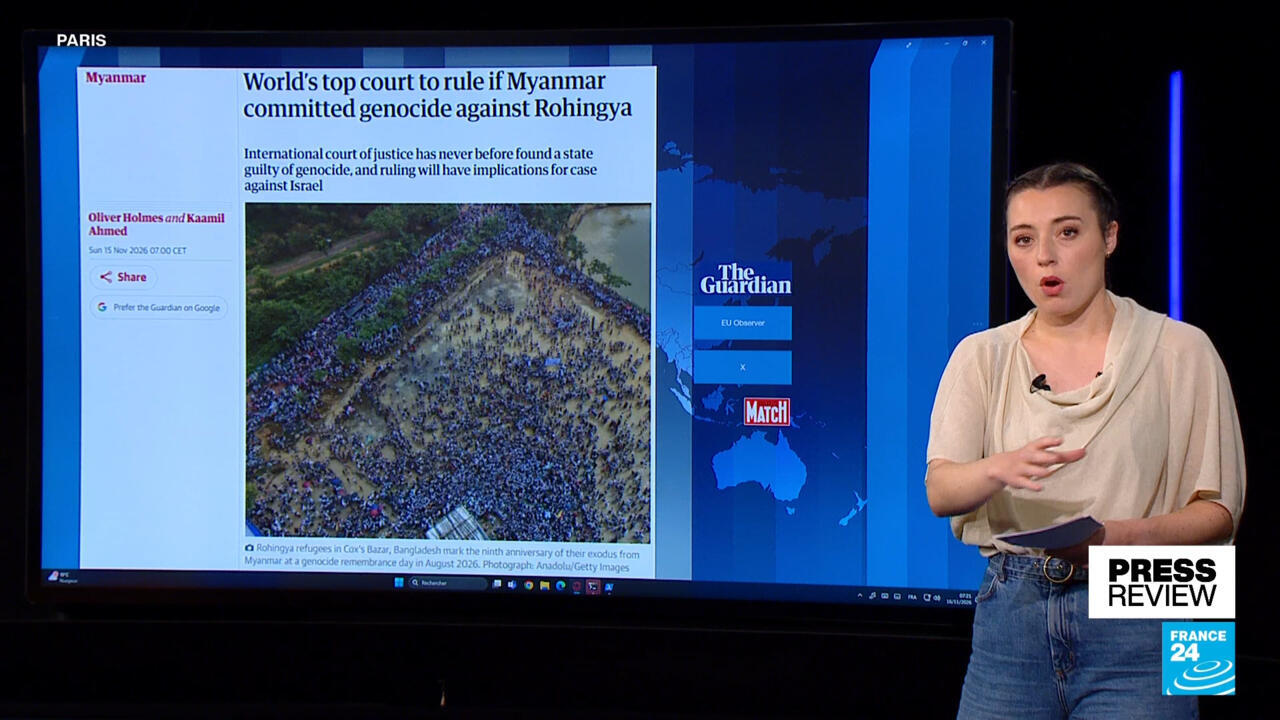
PRESS REVIEW – Monday, November 16: The international press looks ahead to a verdict that could find the state of Myanmar guilty of genocide against the Rohingya minority. In other news, French journalists lift the lid on the many trials involving child prostitution. And finally, in Ireland, a cache of 12,000 once-banned books is back in the spotlight. With Myanmar facing a genocide case at the International Court of Justice (ICJ) over atrocities committed against the Rohingya minority, the international press looks back on the massacres and ahead to the verdict. The Guardian recalls the burning of entire villages, the "systematic shooting of civilians", the "drowning of children in a river" and brutal sexual violence. The EU Observer points out, however, that no state has ever been held responsible for genocide since the creation of the ICJ and the adoption of the 1948 Genocide Convention. The legal threshold is high: proving that a state committed genocide requires establishing the crucial element of "genocidal intent". Whatever the outcome, the verdict will serve as an important reminder of the atrocities committed against the Rohingya in 2016 and 2017. It is also being closely watched for the precedent it could set on the question of intent, particularly as South Africa has brought a similar case against Israel over its actions in the Gaza Strip. Here in France, journalists at Libération have been following court proceedings involving child prostitution, a widespread but little-known phenomenon. Across the five trials they attended, victims were as young as 13. Most had grown up in care and were exploited by violent "clients", in some cases by pimps they believed to be their boyfriends. The trials also shed light on the impunity enjoyed by those who pay for sex with children: "not a single client in the dock". Three months ago, 42,000 hectares were devastated by wildfires in the Gironde region of south-western France. Le Monde revisits Le Porge, where 250 homes and other buildings were destroyed. The mayor says no one was left homeless, but for residents, uncertainty remains a constant. Some have been rehoused in bedsits, while others are staying in Airbnb accommodation that they may have to leave come spring. And finally, in Ireland, The Guardian reports that a collection of 12,000 formerly banned books is being transferred from the Department of Justice to the National Archives. Alongside them, records and ledgers from the Censorship of Publications Board will be made available to the public, opening the door to a reckoning with Ireland's long history of censorship, which lasted from 1926 to 1996. A move welcomed by The Irish Times.
Verdict week in the Myanmar genocide case
Full Article
Original Source
Read the full article at France24 →KhanList aggregates and links to publicly available news content. We do not host full articles from third-party sources. Always verify important information with original sources.