
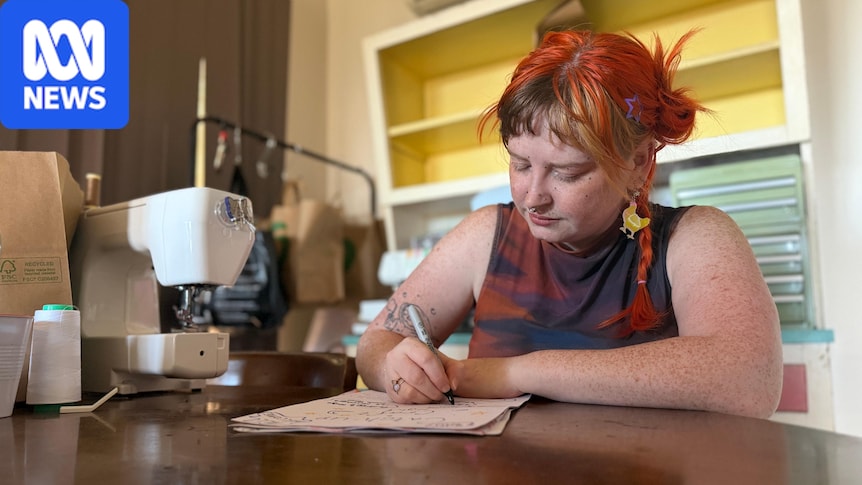
Chloe Young is sick to death of seeing images generated by artificial intelligence (AI) in their online feeds."You scroll and scroll and scroll, and it all looks the same," said the 28-year-old creative who runs an online sewing and garment-making business.Young is facing an uphill battle amid a global AI boom pushed by billions of dollars in investment and free or relatively cheap access for consumers.Closer to home, governments are fast-tracking applications for a growing number of data centres, while grappling with how to manage their vast power and water demands.Chloe Young is not a graphic designer but felt compelled to do something to push back. (ABC Southern Queensland: Dan McCray)But when Young put coloured pen to paper, they said they were deliberately rejecting the rise of AI's ability to generate "content" in the form of text, music, video and imagery.'Homogeneous' social feedsIn response, Young put out a call on social media to design the posters of small businesses and community groups in Toowoomba for a small fee, or free if they could not afford it.While that may be more expensive and take much longer than AI tools, Young said they felt they needed to push back against the "hollow", "soulless" and "homogeneous" AI-generated posters flooding social media feeds.Chloe Young is putting pen to paper to make the posters. (ABC Southern Queensland: Dan McCray)"I just got so frustrated with everything and everyone that I said, like, 'Hey, I will literally do anything for $5 or free,'" Young said.Despite not being a graphic designer, Young said within days of posting the call-out, they had received nearly 30 inquiries from people looking for alternatives to AI-generated content.Young said seeing businesses rely on AI immediately puts them off using their goods or services."I can't tell the difference between a local business and a community event anymore because everything has the same look," they said.Their biggest concern is the impact on artists and creative work."Art is meant to make you feel something," Young said."AI feels hollow. It doesn't bring feeling; it brings a lack of feeling."Author pushbackJust a few streets away from Young's sewing studio, Taylor Hailes said she felt pushback against AI while preparing to open her boutique wine bar and bookshop, The Book Pour.Book Pour owner Taylor Hailes never expected to need an AI policy for her bricks-and-mortar venue. (ABC Southern Queensland: Dan McCray)In the frantic days before opening, Ms Hailes said she turned to AI for help drawing up flyers and social media posts."When you're in a small business, and you're trying to do everything at once, you naturally turn to tools that can help you out," she said."I put together some AI-generated posters, which you see a lot of at the moment."But Ms Hailes said after posting the promotional material, she received a call from one of the authors, who had recently withdrawn from another event elsewhere because of its use of AI."[The author] reached out and asked about our AI policy," she said."That's when I realised I didn't actually know enough to understand what the issue was at its core."Ms Hailes said the conversation prompted her to learn more about how AI works and the risks it posed to creative industries.The Book Pour's AI policy states, "AI has no place in the creative industry". (ABC Southern Queensland: Dan McCray)She said she had not realised generative AI systems are trained using material already available online."I could totally see where they were coming from and why they wanted to protect the creative arts sector," Ms Hailes said.Taylor Haile's business posted an apology statement on her business's Instagram after learning more about AI. (supplied)Many generative AI systems are trained on collections of copyrighted material, which differs between companies and models.The ABC has also reported that second-hand booksellers have been getting orders for rare and out-of-print books from companies working for tech giants, sparking fears AI could be ingesting then destroying printed work.Earning goodwillThese realisations ultimately led Ms Hailes to introduce an AI policy and apologise for any harm she may have caused."It's about working with indie authors and making sure there's no AI used in their work, no AI used in the artwork, and making sure the work we do here doesn't use it either," she said.She said the move had earned her goodwill."We made sure our community knew what had happened, what had been brought to our attention and what we were going to do about it," she said."We had a really great response."Park Thaichon, an associate professor of marketing at the University of Southern Queensland, said the concerns reflected a broader shift among some consumers.While AI can be a cost-effective and time-efficient way to create content, he said some people were becoming wary of its growing use because "it can look too boring, and there's nothing new or outside the box at all".Australia's largest data centre in regional Queensland has just been proposed roughly 120 kilometres west of Toowoomba. (Supplied: Urbis)He said consumers were particularly concerned when businesses used AI-generated images of people or were not transparent about their use of the technology."This type of thing can lead to misunderstanding, and people will lose trust," he said.Meanwhile, Young said they felt the heavy adoption of AI seemed unnecessary in some cases and overlooked what could become a less-human future."We don't see the problem until it's problematic," they said."I know someone can look at (my posters) and be like 'wow, squiggles,' but at least I know that AI didn't make that."
Venue apologises for AI flyers that have 'no place' in creative industry
Full Article
Original Source
Read the full article at Abc →KhanList aggregates and links to publicly available news content. We do not host full articles from third-party sources. Always verify important information with original sources.