
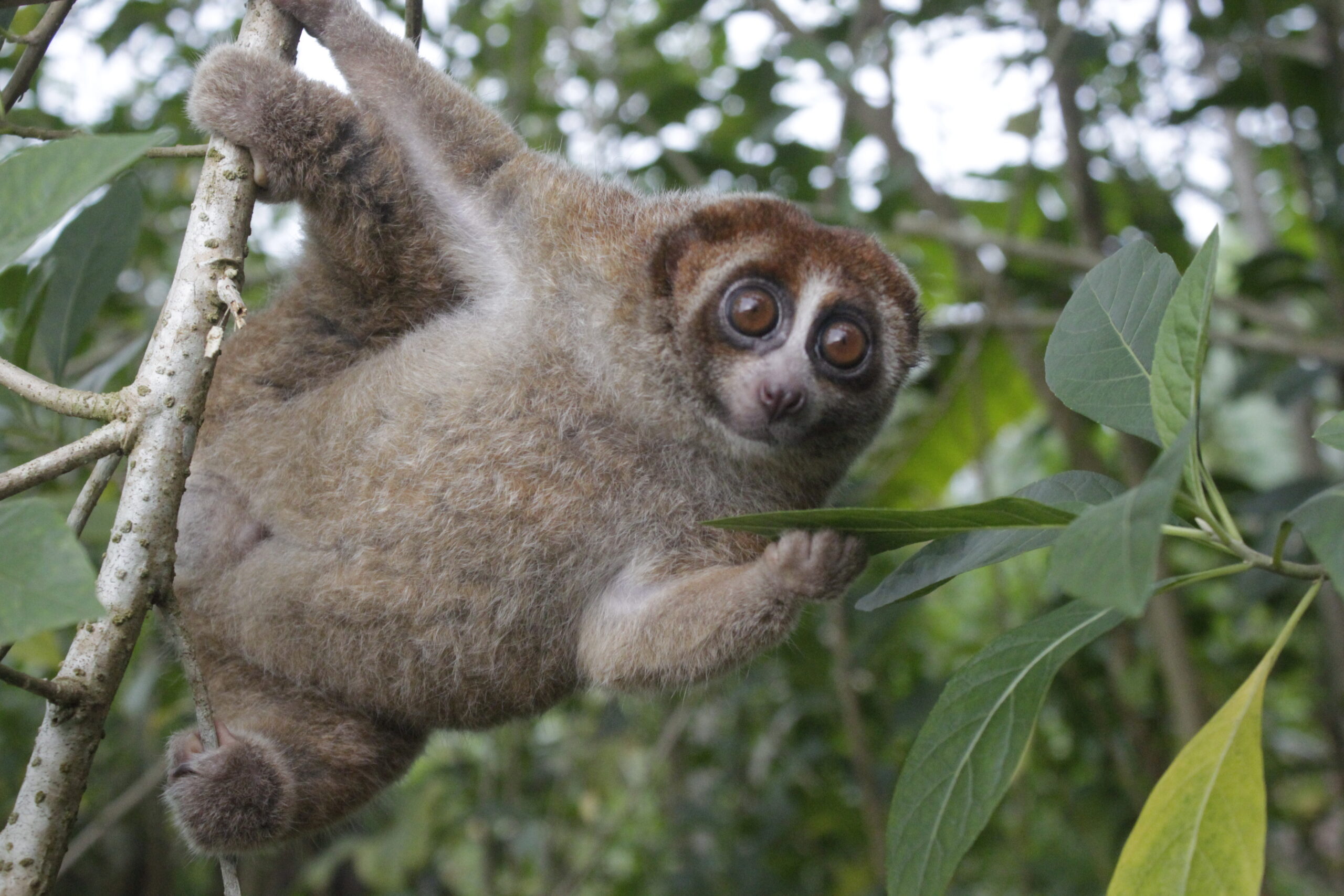
A small, venomous primate that scientists thought had gone extinct still survives on Indonesia’s Bangka Island, and to the communities there was never really “lost,” according to a recent study. The Bangka slow loris (Nycticebus bancanus), native to parts of Borneo and the island of Bangka, was declared critically endangered, and possibly extinct, on the IUCN Red List in 2015, after last being documented in the scientific literature around 1937. While there have been sporadic observations of the loris since then, none have been documented in any scientifically published studies, according to the study’s authors. In the latest study, researchers analyzed more than 90 Bangka slow lorises that the Alobi Wildlife Rescue Center, a local NGO, had rescued from backyards, roadsides, and plantations after being contacted by residents. “What surprised me the most was that such a distinctive and fascinating primate could remain almost completely overlooked by science for nearly a century,” said study co-author Timon Glaw, a graduate student in nature conservation and biodiversity management at the Haus des Meeres Aqua Terra Zoo in Vienna, Austria. Glaw co-authored the paper alongside researchers from Alobi and the Taman Safari Prigen Conservation Breeding Ark in Indonesia. In 2021 alone, Alobi rescued 43 lorises, of which they could map 39 from across all four districts of Bangka, including Pangkalpinang, the largest city on the island. This indicates that the species remains widely distributed across the island, the authors write. But human activities pose persistent hazards. The paper noted that in 2021, seven rescued lorises suffered electrical burns from power lines, while several had been injured after being struck by vehicle collisions on roads, attacked by domestic dogs, or entanglement in fences. At least three lorises died. Loris forest habitat on the island decreased by 62% between 2000 and 2012, the authors write. However, 86 lorises rescued since 2015 that subsequently recovered were released into remaining protected forest fragments. “Its natural habitat on Bangka Island has shrunk significantly because of illegal tin mining and massive land clearing for oil palm plantations,” Langka Sani, director of Alobi and study co-author, said in a press release. “Our findings clearly demonstrate that N. bancanus is not yet extinct,” the authors write in the study. They recommend a formal reassessment of its IUCN Red List status to remove the “possibly extinct” tag. The authors also recommend establishing habitat protections, monitored post-release tracking, and an ex-situ conservation breeding program. “Protecting its remaining natural habitats, together with Bangka’s threatened freshwater ecosystems, could help safeguard many other unique species that receive far less attention,” Glaw told Mongabay. Banner image: A rescued Bangka slow loris being released into one of the island’s last remaining natural habitats. Image © Andre Septian/Alobi Wildlife Rescue Center. Credits Topics
Venomous Indonesian primate feared extinct still clings on – but threats persist
Full Article
Original Source
Read the full article at News →KhanList aggregates and links to publicly available news content. We do not host full articles from third-party sources. Always verify important information with original sources.