
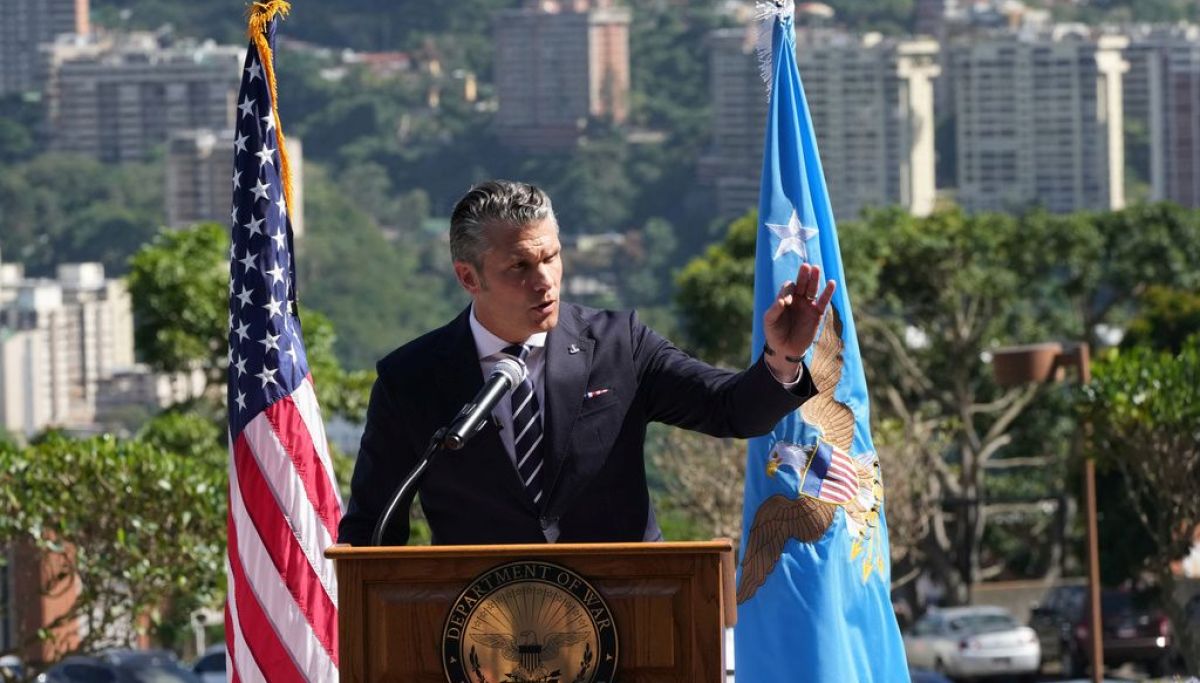
War Secretary Pete Hegseth traveled to Venezuela on Wednesday to meet with acting President Delcy Rodriguez in Caracas, where he announced that the United States will deepen its military partnership with the country.During his meeting with Rodriguez, Hegseth announced an agreement to reestablish military ties between the two countries, covering everything from training to intelligence sharing. Venezuela, he said, had gone from Washington’s “most aggressive regional threat to a compliant security partner.”Hegseth is the latest senior Trump administration official to visit Venezuela this year, following CIA Director John Ratcliffe, Energy Secretary Chris Wright, and Interior Secretary Doug Burgum. But his visit carries a different significance. The Venezuelan military that received him is the same institution that failed to prevent Nicolas Maduro’s capture in January. It is a remarkable reversal for an institution that spent nearly two decades defining itself in opposition to the U.S. Under Hugo Chavez and Maduro, Venezuela’s armed forces portrayed the U.S. as an imperial enemy while strengthening military ties with Russia, China, and Iran. Anti-Americanism was not merely political rhetoric. It was military doctrine.How Venezuelan officers will reconcile years of ideological indoctrination with a new partnership with the Pentagon remains an open question. Markets adapt quickly to new political realities, and diplomats are trained to. Changing the mindset of an armed force is far harder, especially when its new partner is the power that defeated it less than a year ago. For now, though, Venezuela’s political and military leaders appear to have concluded that cooperating with Washington is their best chance of staying in power.The military deal follows a pattern already set in the energy sector. In August, President Donald Trump announced an unprecedented agreement giving the U.S. majority control over more than 65 billion barrels of Venezuelan oil reserves. The deal raised alarm across Venezuela’s political spectrum about national sovereignty and about whether an unelected government had the authority to make such far-reaching commitments.Security cooperation appears headed in the same direction. Recent reports suggest Washington is considering a military base on Venezuelan soil, which would extend American influence from the country’s oil fields to its armed forces.Trump himself offered a revealing description of the relationship on Wednesday, calling Venezuela America’s “newest acquisition.” From the administration’s perspective, there is plenty to celebrate. It has removed a hostile leader, secured unprecedented access to Venezuela’s natural resources, and turned a former adversary into a security partner, all without being drawn into a prolonged military conflict.But those very achievements may be creating an obstacle to Venezuela’s democratization.There has been some political progress. Opposition leader Maria Corina Machado returned to Venezuela last month, and negotiations continue over the conditions needed for free and fair elections. Yet the speed of the economic and military agreements stands in sharp contrast to the slow pace of electoral reform. Washington is expanding its influence over Venezuela faster than it is advancing the country’s democratic transition.The administration has kept much of the Chavista governing apparatus in place to maintain stability, while limiting Rodriguez’s autonomy. Washington gets a government responsive to its strategic and economic priorities. Rodriguez and other Chavista elites get to stay in power without facing voters. The more successful this arrangement becomes, the less incentive either side has to change it.What is emerging in Caracas looks less like a partnership between sovereign equals and more like a de facto protectorate. Venezuela’s ruling elites appear willing to give up a considerable share of national sovereignty in exchange for keeping their grip on power at home.US DRONES JOIN THE HUNT FOR COLOMBIA’S DEADLIEST GUERRILLA GROUP AS VENEZUELA SWITCHES SIDESWashington has shown that it holds extraordinary leverage over Venezuela’s leadership. It should use that leverage to secure a binding electoral timetable, real reform of the country’s electoral institutions, and guarantees of political participation, and pursue those goals with the same determination it brought to the oil and military deals.The longer Washington waits, the more its own strategic and economic interests will become tied to the survival of an unelected government. If that happens, Maduro’s removal may be remembered not as the beginning of Venezuela’s democratization, but as the start of a new form of authoritarianism under American supervision.
Venezuela is becoming a US protectorate, not a partner
Full Article
Original Source
Read the full article at Washingtonexaminer →KhanList aggregates and links to publicly available news content. We do not host full articles from third-party sources. Always verify important information with original sources.