
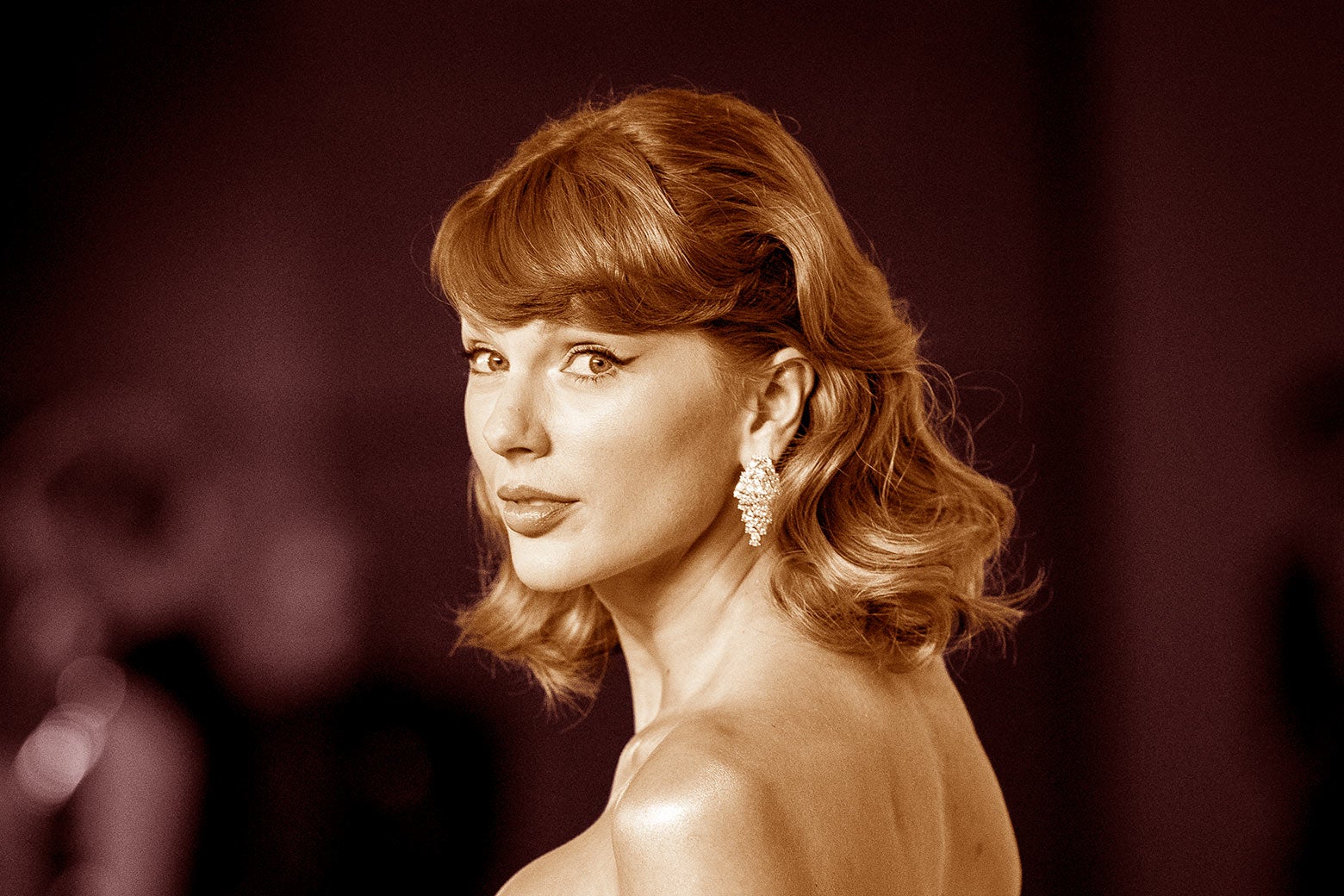
Fame We Knew It … We Know Her! Vanity Fair published what it thought was a bombshell essay about Taylor Swift. Hmm. By Enter your email to sign up for https://my.sailthru.com/list?list=aa_heather_schwedel. Sign in or create an account to better manage your email preferences. Unsubscribe from email alerts Are you sure you want to unsubscribe from email alerts for Heather Schwedel? Nov 25, 20261:21 PM Photo illustration by Slate. Photo by Emma McIntyre/Oscars/Getty Images for Academy Museum Foundation. Sign up for the Slatest to get the most insightful analysis, criticism, and advice out there, delivered to your inbox daily. It is very hard, in the year 2026, to have anything new to say about Taylor Swift. Credit to Vanity Fair for trying anyway—this week the magazine published a new piece by May Jeong called “The Mastermind.” Without quite naming Swift (it instead refers to her as “The Star”), the piece purports to offer a new lens on her celebrity and career through interviews with over 100 sources, conducted over a year of reporting. Almost immediately, it got people talking—which is exactly what magazine editors hope for when they sign off on an article—but less about the revelations within it than about how it managed to get published in the first place. Read on for a quick rundown of where you should stand on this very important matter. For anyone who hasn’t read the article, a quick summary, please? Jeong writes about Swift’s childhood and rise to fame, a story that will be pretty familiar to most people who know even a little about her—she grew up in Pennsylvania to well-to-do parents before moving to Nashville to be closer to the country music biz, she was determined to be a star, and some people think she has been ruthless in her pursuit and preservation of fame. The article is written in a very stylized way that’s unusual for a place like Vanity Fair, which is known for publishing pretty straightforward celebrity profiles in which the celebrity themselves usually not only is interviewed but participates in an expensive photo shoot. Here, though, in addition to not naming or talking to Swift, Jeong employs a narrative device, alternating between an “A-side” and a “B-side,” throughout the story, with the A-side being the more palatable, officially sanctioned version of events and the B-side being the more complicated version where Swift doesn’t come off as squeaky-clean. Also, in a gimmick reminiscent of Swift’s liner notes on early albums, there are capitalized, bolded letters throughout the piece that, all together, spell out the words Look What You Made Me Do, the title of a Swift song off Reputation. But the article never names Swift? No, and I’m a little bit stumped as to why. It’s not thinly veiled in a fun, wink-wink sort of way: It gives enough identifiable details that it could be only her. This means that legally, not naming her isn’t offering Vanity Fair any plausible deniability or protection. Instead, it is just confusing and, if anything, calls into question the magazine’s credibility. As Hell Gate put it, “The creative choices … are so intense that they could only be justified by absolutely celestial writing talent, or bombshell reporting. The article contains neither.” Either stand by your work and name her, or do something more creative and outside the box with leaving her unnamed, but this way is the worst of both worlds. (The magazine also doesn’t name some of the other characters within the piece—Scooter Braun is “The Manager,” Charli XCX is “The Brat”—but they are too obvious to anyone who’s fluent in pop culture to read as clever.) What new information do you actually learn from the piece? The point the article seems to be building toward is a criticism that has been frequently leveled at Swift over the years: that she acts nice in public but is fake and mean behind the scenes. That’s it. That’s the big reveal. Jeong recounts well-trodden Swiftie lore throughout the piece, but much of the original reporting that stood out seems to focus, oddly enough, on Swift’s middle school experience. A former music teacher of hers alleges that a story she used to tell about being excluded from a middle school cafeteria table couldn’t be true because seating in the lunchroom was assigned. She also says Swift was always popular and was never bullied, asserting that, in fact, she was more likely one of the bullies. Her career got off the ground, in this teacher’s assessment, only because her family could afford to fund it. Elsewhere, a fellow student from this teacher’s class remembers being envious of Swift’s shoe collection: She had Uggs in at least three different colors. Also, a guitar teacher remembers that once, when Swift was learning to play guitar, her mother brought home Taco Bell, but Swift was given a salad, because “Nobody wants to see a fat pop star,” her mother said. Uggs? Middle school? Wasn’t that, like, 20 years ago? Swift is about to turn 37, so yes, it was about 25 years ago. And yes, the petty things the middle school teacher said end up reflecting way more negatively on her than on Swift. Also, it’s not new to question Swift’s narrative that she was bullied, a claim that has always felt a little overblown to some. There have been other attempts to fact-check or debunk this aspect of her persona over the years, and it felt like a more worthy topic of discussion when she was closer to her adolescence. Now that she’s in her 30s, to continue to report on it only to come up with such weak sauce feels lame. And so what if she had three pairs of Uggs! There are plenty of legitimate reasons to call for sending Swift to the guillotines—her billions and her private jet usage come to mind—but three pairs of Uggs in middle school? God bless her, she was a tween whose wealthy parents loved her, attending a suburban middle school in the early 2000s. Unless she was caught in Australia personally skinning sheep to make them, let her live. The Swifties can’t be taking this lying down. What are they saying? Has Taylor said anything? Swift’s fans are calling it a “hit piece” and seem excited that, this time at least, a lot of journalists seem to agree with them. Swift herself has not addressed it, though a “source close to the singer” told Page Six, “Taylor has never pretended to be perfect, but she doesn’t believe a collection of old grievances and unflattering anecdotes defines who she is or what she’s accomplished.” How did this … happen? It feels important to make the distinction that the problem with the piece isn’t that a publication went looking for dirt on Swift. The problem is that it didn’t seem to find any. A year and 100 interviews, and this is what Vanity Fair came up with? On social media, some journalists have speculated that maybe the author had other material that didn’t make it through legal review. Certainly, it’s a curious pairing of journalist and story: Jeong doesn’t usually write about celebrity, and in fact has a background as a war correspondent. But fans theorizing that the magazine commissioned the piece because editors were bitter they didn’t get a wedding photo exclusive or because the author is somehow a puppet of Braun’s are being overly conspiracy theory–minded. It’s true that the balance of power has shifted and a star like Swift no longer needs media the way she once might have. But Vanity Fair, which has a newish editor in Mark Guiducci, doesn’t need to provide a motivation for publishing a juicy article about a celebrity—that is Vanity Fair’s reason for existing. I would be interested to hear, however, an explanation for why, after editors realized how much nothing this article actually contained, they moved forward with it anyway. Celebrities Journalism Taylor Swift
Vanity Fair Attempted to Take Down Taylor Swift. It Backfired Completely.
Full Article
Original Source
Read the full article at Slate →KhanList aggregates and links to publicly available news content. We do not host full articles from third-party sources. Always verify important information with original sources.