
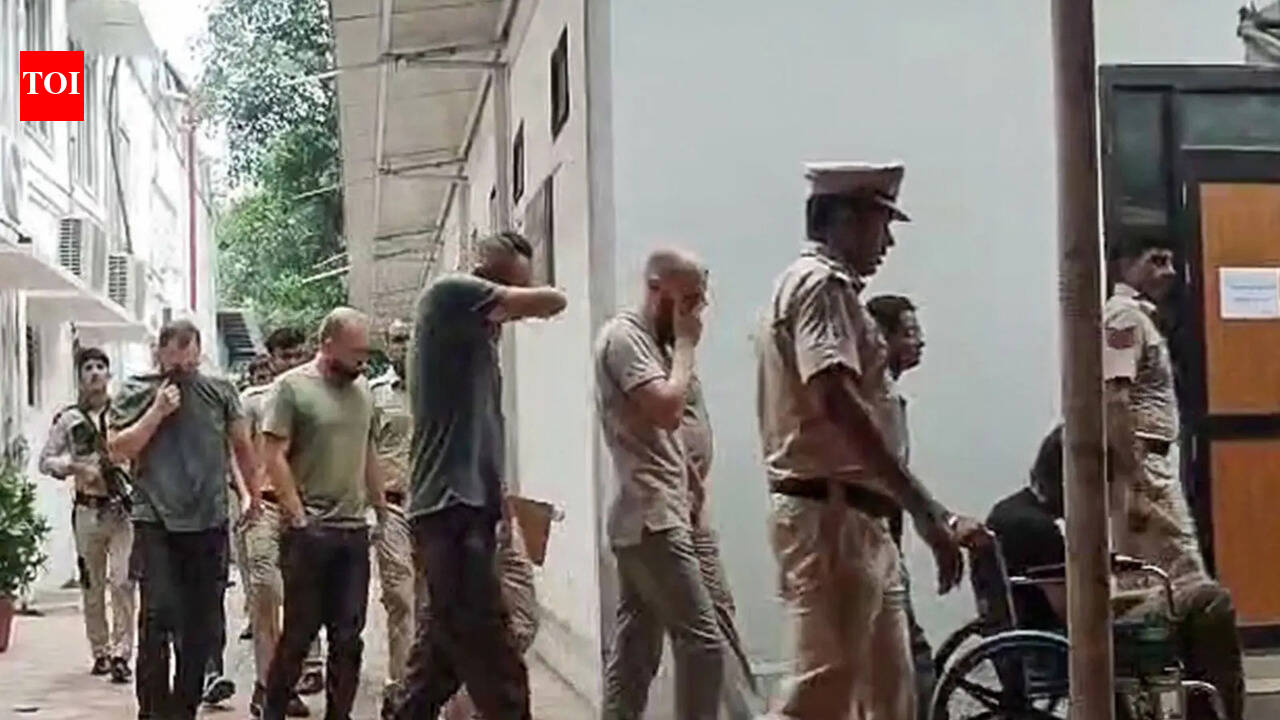
Myanmar Training camp case: US National Vandyke moves plea seeking default bail as UAPA offences not invoked against him by NIAThe arrest and subsequent release on bail of American national Matthew Aaron VanDyke and six Ukrainian nationals by a Delhi court raises important questions about India's internal security, counter-intelligence preparedness and the emerging threat of transnational military networks. The case is significant not merely because of the nationalities of those involved, but because it brings together drone warfare, foreign military expertise, ethnic armed organisations in Myanmar and the possibility of linkages with insurgent networks operating along India's northeastern frontier.The most disturbing aspect is the possibility that India's neighbourhood could become a theatre for the transfer of military technology and operational expertise to non-state armed groups, with consequences extending beyond Myanmar.The VanDyke toolkit: Beyond conventional military assistanceVanDyke, an American security consultant associated with Sons of Liberty International, has previously described involvement in conflict environments, including Libya and Ukraine. His professional background and reported contacts with armed organisations make the case worthy of closer examination, although these associations by themselves do not establish criminal conduct.The alleged activities involve a potentially dangerous combination of capabilities: drone warfare training, military equipment procurement, technology transfer, operational instruction and engagement with ethnic armed organisations. The Ukraine and West Asia conflicts have demonstrated how commercial drones can be transformed into effective military instruments. Reconnaissance, surveillance, targeting, precision attacks and disruption of logistics are no longer capabilities exclusive to conventional armed forces. Relatively inexpensive technology, when combined with specialised training, can significantly enhance the operational effectiveness of non-state armed groups.The concern is therefore not simply the transfer of drones. It is the transfer of an entire operational toolkit comprising equipment, technical knowledge, training and organisational capabilities.Warning signs: The convergence of security indicatorsAccording to the NIA investigation, the seven foreign nationals allegedly entered Mizoram without the required Protected Area Permits and subsequently crossed into Myanmar. They were accused of providing drone-warfare training to ethnic armed organisations fighting Myanmar's military government. The investigation also examined the movement of drone consignments from Europe through India and the possibility of connections with Indian insurgent groups.These developments present several warning indicators. The first is geographical. Mizoram's proximity to Myanmar, combined with ethnic linkages and the presence of armed organisations across the border, creates a sensitive security environment. The second is technological. The movement of drones and associated equipment through international supply chains raises questions about procurement, financing, end-users and the ultimate application of the technology. The third is operational. Foreign military trainers working with armed organisations in a conflict zone can potentially enhance the latter's capabilities without any formal military intervention by a state. The fourth is strategic. The possibility of links between Myanmar-based armed organisations and Indian insurgent formations requires serious investigation.Where are the smoking guns?The most important question is whether the investigation has established a direct connection between the accused, the alleged training activities and organisations threatening India's security. The evidence must go beyond establishing the presence of foreign nationals in Mizoram or their association with armed groups in Myanmar.Investigators need to establish the complete drone supply chain, including procurement records, shipment details, financial transactions, intermediaries and final recipients. Digital communications, operational instructions, training records and evidence of actual delivery would be particularly significant. Most importantly, the investigation must establish whether the accused knowingly facilitated terrorist activities or deliberately assisted organisations engaged in activities against India.There is a fundamental distinction between providing security-related training to an armed organisation in a foreign conflict and knowingly participating in a conspiracy to conduct terrorist activities against India. The former does not automatically establish the latter. Criminal liability must be supported by admissible evidence and proof of the requisite intent.Why was VanDyke released on bail?This is perhaps the most consequential aspect of the case. VanDyke was arrested on 13 March 2026 under Section 18 of the Unlawful Activities (Prevention) Act (UAPA), relating to conspiracy, abetment or incitement of terrorist acts. The NIA filed its first chargesheet on 8 September 2026, invoking Sections 21 and 23 of the Immigration and Foreigners Act, 2025. However, it did not include UAPA charges, stating that the terrorism-related investigation was continuing.Under Section 43D(2) of the UAPA, the investigation period in specified cases can be extended up to 180 days, subject to the statutory requirements and judicial approval. The 180-day period in this case expired on 8 September. On 18 September, Special NIA Judge Prashant Sharma granted VanDyke default bail. The court considered the chargesheet piecemeal because it covered immigration offences while the UAPA investigation remained incomplete.The legal position is straightforward. Under Section 187(3) of the Bharatiya Nagarik Suraksha Sanhita, an accused acquires a statutory right to default bail when the investigation is not completed within the applicable period and the required chargesheet is not filed. The court could not deny this right merely because the investigating agency wanted additional time. Subsequently, on 25 September, the court permitted the accused to travel to their respective home countries for one month, subject to conditions. This decision raises questions about investigative preparedness, but the distinction must be maintained: default bail is neither an acquittal nor a judicial declaration that the allegations are false.The Investigative and institutional questionsThe case raises serious questions about the NIA’s investigative sequencing and coordination. An investigation involving foreign nationals, international drone supply chains, specialised military training and cross-border insurgent connections requires multiple parallel investigative streams. These include technical forensics, financial intelligence, immigration records, international cooperation and verification of the identities and affiliations of the alleged recipients. Why was the investigation not sufficiently advanced to file the relevant chargesheet within the extended statutory period? Were there difficulties in obtaining evidence from foreign jurisdictions? Was coordination between the NIA, Intelligence Bureau, RAW, state police and border security agencies adequate? The government has clarified that the UAPA investigation was not closed and that further investigation remained underway. Nevertheless, the inability to complete the investigation within the prescribed period has exposed a procedural weakness in a case carrying significant national security implications.National security: The larger geopolitical dimensionIndia’s northeastern security environment cannot be viewed in isolation from developments in Myanmar. The prolonged instability in Myanmar, the activities of ethnic armed organisations and the presence of multiple insurgent networks create opportunities for external actors to influence the region.China’s strategic interests and influence in Myanmar add another geopolitical dimension. However, there is no established evidence that VanDyke’s alleged activities were sponsored by any foreign government. Such attribution must not be made without proof. The larger concern is that private military expertise, commercial technology and transnational networks can create new capabilities for non-state actors. These activities may not necessarily follow conventional patterns of state-sponsored warfare.Recommendations: Moving from detection to disruptionIndia needs a more integrated approach to identifying and disrupting transnational military networks.Strengthen counter-intelligence coordination: Establish closer coordination between the NIA, Intelligence Bureau, RAW, state police, border forces and financial intelligence agencies. Intelligence sharing must be timely and actionable.Monitor military technology supply chains: Develop stronger end-user verification and risk-based monitoring of drone components, communications equipment, navigation systems and other sensitive technologies. International procurement routes and suspicious intermediaries require scrutiny.Regulate foreign military trainers and security contractors: Introduce a robust framework for monitoring foreign security consultants, military trainers and private security organisations operating in sensitive border regions.Develop a specialised drone intelligence capability: Integrate technical forensics, drone identification, counter-drone preparedness and intelligence analysis to detect emerging threats before they become operational.Strengthen international cooperation: Establish effective channels for obtaining financial, digital and procurement-related evidence from foreign jurisdictions. Cooperation with Myanmar’s relevant authorities and other international partners should be pursued wherever feasible.Improve prosecution preparedness: National security investigations must be evidence-driven and legally sustainable. Dedicated investigative teams, forensic resources and prosecution planning should be established at the beginning of complex cases rather than towards the end of statutory custody periods.The common institutional challengesThese cases reveal recurring challenges in India’s counter-terrorism investigations. First, investigative continuity remains important. Transfers between state agencies and central agencies must not result in contradictory theories or loss of critical evidence. Second, forensic capability requires strengthening. Digital communications, financial transactions, DNA, ballistic evidence and technical intelligence must form the foundation of modern investigations. Third, witness management needs greater attention. Witness protection, independent corroboration and credible documentation are essential to sustaining prosecutions. Fourth, international cooperation has become indispensable. Terrorist networks, drone procurement and financial transactions frequently cross-national boundaries. Investigative agencies must be equipped to obtain admissible evidence from foreign jurisdictions. Finally, prosecution management must begin at the investigation stage itself. Statutory deadlines, judicial jurisdiction, sanctions and evidentiary requirements cannot be treated as administrative formalities.Recommendations: Strengthening the NIAIndia needs a comprehensive institutional response.Specialised investigation teams: Develop dedicated capabilities for drone warfare, cyber operations, foreign military networks, financial intelligence and transnational terrorism.Integrated intelligence architecture: Improve coordination between the NIA, Intelligence Bureau, RAW, state police, military intelligence and border security agencies within their respective mandates.Forensic-first investigations: Prioritise scientific evidence, digital forensics, financial trails and independent corroboration.Prosecution preparedness: Introduce periodic legal and evidentiary reviews to ensure that statutory requirements and investigation deadlines are met.Accountability and institutional learning: Conduct independent reviews of serious investigative lapses and maintain a repository of judicial observations to improve future investigations.International cooperation: Strengthen mechanisms for tracing cross-border funding, technology transfers, procurement networks and digital communications.Conclusion: National security requires anticipatory intelligenceThe VanDyke case is a warning about the changing character of national security threats. The battlefield is no longer confined to conventional military formations or clearly identifiable state-sponsored organisations. It increasingly involves private security networks, technology transfers, commercial supply chains, foreign expertise and non-state armed groups.The most important lesson is that India must move beyond conventional border management towards network disruption and anticipatory counter-intelligence. At the same time, the rule of law must remain central to national security investigations. The grant of default bail was a statutory consequence of the investigation not being completed within the prescribed period. It cannot be treated as proof of innocence, nor can national security concerns be used to disregard procedural safeguards.The real test for the Indian security establishment is whether it can establish the complete chain of activities, identify the beneficiaries, determine the extent of any threat to India and build an evidence-based prosecution. The warning signs must not be ignored, but the smoking guns must be established. National security depends as much on the quality of intelligence and investigation as on the ability to prosecute those responsible.The ultimate test of the NIA is not how effectively it arrests a suspect, but how effectively it establishes the truth and secures justice. National security demands strong investigations, but the rule of law demands sustainable prosecutions. Both are indispensable to the credibility of the Indian state.
Vandyke case: Foreign military trainers, drone warfare and security challenge
Full Article
Original Source
Read the full article at Timesofindia →KhanList aggregates and links to publicly available news content. We do not host full articles from third-party sources. Always verify important information with original sources.