
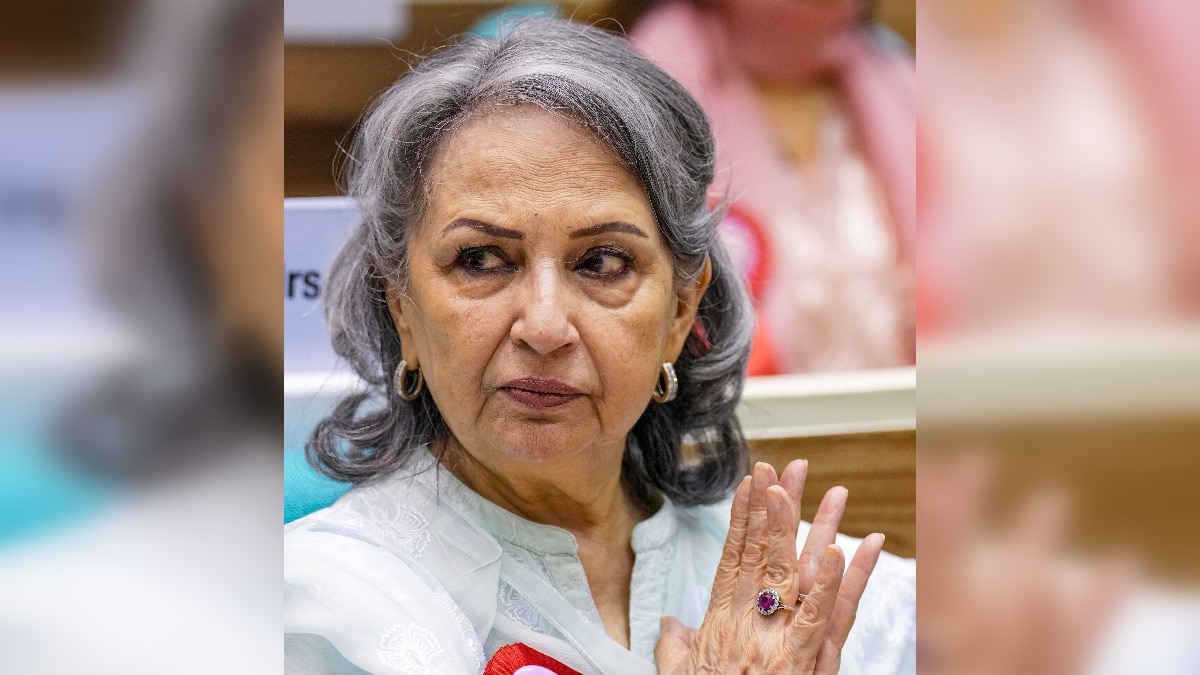
Veteran actor Sharmila Tagore's remarks on Vande Mataram have triggered a strong response from actor and BJP MP Kangana Ranaut. In a recent interview, Sharmila said that only the first two stanzas of the national song should be used, arguing that references to Hindu deities in the later verses could be difficult for people who believe in one God.Her comments came amid a wider political debate over the rendition of Vande Mataram, with the BJP and Congress taking opposing positions on which portions of the song should be sung at public and party events.What exactly did Sharmila Tagore say?Speaking to news agency IANS, Tagore said that India is home to people belonging to different religions, including those who believe in a single God. Explaining her position, she said that some of the later verses of Vande Mataram mention several Hindu deities by name. According to her, this could make the song difficult to recite for people who follow monotheistic faiths."My point of view is that there are many religious people who believe in one single God, not many Gods," Sharmila said. She went on to explain that the song contains references to deities such as Kali and Durga. "It is difficult for those who believe in one religion to say, 'Vande Kali, Vande Durga'," she said. Sharmila added that if people of all religions were to be considered together, she believed the first two stanzas were "very good".Her argument, therefore, was not against Vande Mataram in its entirety. She was specifically making a case for retaining the first two stanzas while leaving out the later verses that contain references to Hindu deities.Why did Kangana Ranaut object? Kangana Ranaut strongly disagreed with Sharmila's interpretation of the song. Sharing a video of Sharmila's interview on her Instagram Stories, Kangana said she respected the veteran actor's right to express her reservations but questioned her understanding of the song as an artist.Kangana argued that poetry and art often use metaphors and imagery and should not necessarily be interpreted as literal religious texts.She said Vande Mataram represents the spirit of India's freedom struggle and that Bankim Chandra Chatterjee's use of the idea of Shakti should be understood as a call for strength and awakening. Kangana wrote that she was "shocked as an artist" by what she described as a limiting interpretation of art and poetry. She argued that reducing Vande Mataram to a matter of religious practice overlooked the larger symbolism of the composition.She also referred to Swami Vivekananda's famous description of youth possessing strength and energy, saying that such references were not literal descriptions but expressions of power or Shakti.Kangana ended her message by asking Sharmila to "come out of Hindu-Muslim mindset". She also maintained a warm tone towards the veteran actor, saying she loved her and would not mind receiving one of Sharmila's "crushing" hugs.Kangana Ranaut is also a BJP MP, so her comments come amid the party's wider stand on Vande Mataram. The BJP has strongly opposed the Congress’s decision to stick to only the first two stanzas of the National Song. The Centre has also introduced guidelines mandating the singing or playing of Vande Mataram at designated government functions.What is the controversy around the first two stanzas?The debate over the first two stanzas of Vande Mataram is not new. The song, written by Bankim Chandra Chatterjee, was first published in the literary journal Bangadarshan on November 7, 1875. It was later incorporated into his 1882 novel Anandamath. While the original composition had two stanzas, the version that appeared in the novel contained additional verses.The song became an important part of India's freedom movement and was first sung at a Congress session in 1896 by Rabindranath Tagore. However, concerns were raised over some of its imagery and its association with Anandamath. Some Muslim leaders and sections of the Muslim community objected to references to Hindu deities and the portrayal of the motherland in a form resembling a goddess.The issue became particularly contentious within the Congress in the 1930s. There were concerns that using the complete song could alienate Muslims at a time when the freedom movement was trying to maintain unity.In 1937, Congress leaders eventually decided to use only the first two stanzas at political gatherings. Rabindranath Tagore, who had himself sung Vande Mataram at the 1896 Congress session, was consulted during the debate and supported the use of the first two stanzas.This historical decision is also at the centre of the Congress's present-day position.Why is the issue back in the news?The controversy intensified after the 80th Independence Day celebrations, when the full version of Vande Mataram was performed at the Red Fort on August 15. This renewed the debate over which parts of the song should be sung at official and political events.The Congress Working Committee has maintained its position of using only the first two stanzas of the song during party programmes, saying this follows the position adopted by the party in 1937. The BJP, however, has accused the Congress of disrespecting the national song. Congress president Mallikarjun Kharge has defended his party's position.Against this backdrop, Sharmila's comments have added a new dimension to the debate, while Kangana's response has brought the disagreement into the entertainment sphere as well.Sharmila Tagore's connection to Rabindranath TagoreSharmila Tagore is also related to Rabindranath Tagore. On her mother's side, her maternal grandmother Latika Tagore was the granddaughter of Dwijendranath Tagore, Rabindranath Tagore's eldest brother. She is also related to the Tagore family through her father's side.This connection is particularly interesting, given Rabindranath Tagore's own association with Vande Mataram. He composed the tune and also sang the song at the 1896 Congress session and later advised that only its first two stanzas be used amid concerns over its religious imagery.The contrasting views of Sharmila Tagore and Kangana Ranaut have now added another chapter to the long-running debate over Vande Mataram, particularly its religious references and artistic symbolism.- EndsPublished By: shweta keshriPublished On: Aug 21, 2026 17:45 IST
Vande Mataram row: What Sharmila Tagore really said that upset Kangana Ranaut
Full Article
Original Source
Read the full article at Indiatoday →KhanList aggregates and links to publicly available news content. We do not host full articles from third-party sources. Always verify important information with original sources.