
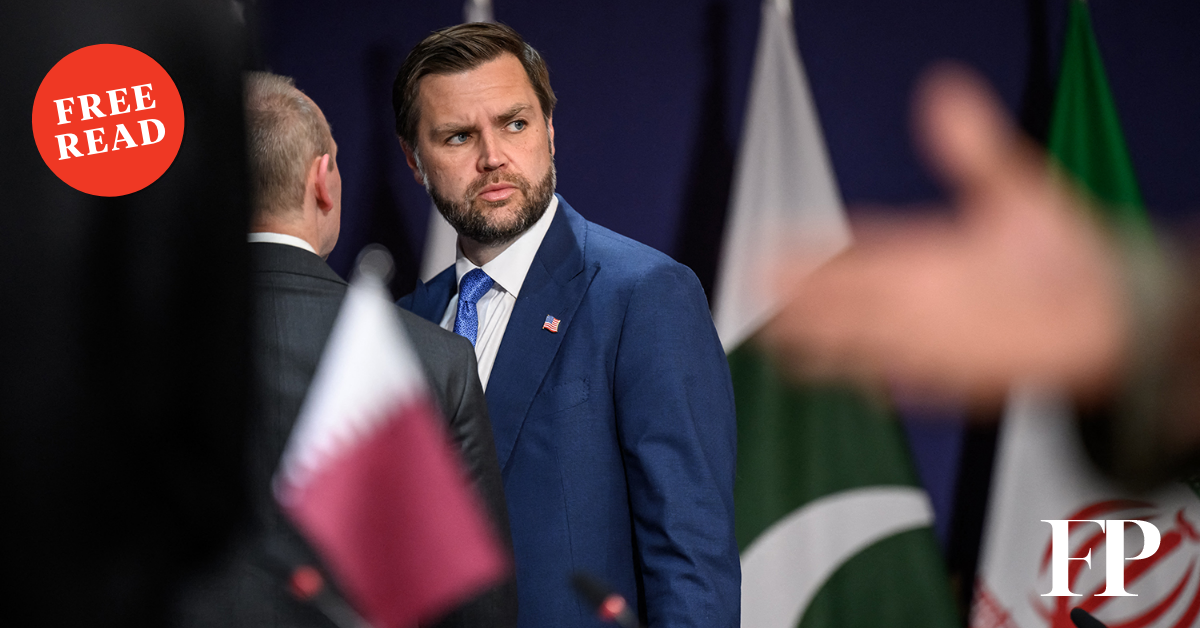
In a stunning statement, the U.S. vice president veered sharply from Trump’s defense of the war. Vance, dressed in a dark blue suit and blue necktie, glances over his shoulder, standing near other people in suits in front of a row of flags. U.S. Vice President JD Vance takes part in a meeting of the United States, Iran, Pakistan, and Qatar in Lake Lucerne, Switzerland, on June 21. Fabrice Coffrini/AFP via Getty Images November 4, 2026, 3:01 PM U.S. Vice President J.D. Vance on Wednesday offered an extraordinarily frank assessment of why he believes Republicans got clobbered in the 2026 midterm elections. He blamed the Iran war. “The reason we lost is the war. The president himself said so last night,” Vance said on X. U.S. Vice President J.D. Vance on Wednesday offered an extraordinarily frank assessment of why he believes Republicans got clobbered in the 2026 midterm elections. He blamed the Iran war. “The reason we lost is the war. The president himself said so last night,” Vance said on X. “If you’d like to argue it was worth it, that losing the Senate for the next 6 years was worth it, then do so. Argue it was a worthwhile cost to pay. Agree or disagree, that’s at least honest,” Vance added. “But everyone knows why we lost. And any honest conversation about where we go from here must start there.” It’s not often that a sitting vice president comes out so forcefully against a defining policy decision made by his boss—especially when that boss is as notorious for punishing perceived disloyalty as U.S. President Donald Trump is. But Vance, who is widely expected to be interested in running for president in 2028, appears to have calculated that the political cost of continuing to defend the Iran war outweighs the potential risk of drawing Trump’s ire. In the lead-up to elections, polling consistently showed that the Iran war was unpopular among voters and that the cost of living was their top concern. As Vance noted, Trump himself has acknowledged that the Iran war was a “piece” of what contributed to the historic defeat. But the president remains unapologetic about starting the war. “I did the right thing. I would have done it again,” Trump told the Wall Street Journal. Trump also blamed the quality of Republican candidates on the ballot, stating that some could’ve been “better.” In a separate interview with Fox News, Trump acknowledged voter discontentment over the war’s economic consequences, including high gas prices, but suggested the pain at the pump was worth it in the long run. “People agree with what I’m doing on Iran, but they really, probably weren’t willing to do the short-term consequence of paying more for gasoline,” Trump said. “And, you know, I understand that. I don’t agree with it, and I would say to people, you know, ‘It’s a short-term problem but for long-term gain.’” But Trump and Vance have never done a particularly good job of selling the Iran war to the American people. Since the very beginning, the administration has presented muddled and often contradictory explanations for why the United States needed to launch a full-scale war on Iran in February. Even in his final speech on the eve of the election, Trump undermined the war’s main justification by saying that Iran’s nuclear program had already been destroyed by U.S. military action last summer. “I hope people realize that when they go into the voting booth, because we had to stop Iran from having a nuclear weapon. If, if we allowed Iran to have a nuclear weapon, this country could never function the same way. The whole world would be a different place, so we’ve stopped that. We stopped that a year ago with those beautiful B-2 bombers, which hit every single mark, and just put hundreds of tons of rock on top of everything,” Trump said. Vance is believed to have strongly opposed the war behind closed doors; yet he outwardly maintained support for it. It seems that American voters’ unequivocal rejection of the war has convinced him that he no longer has to pretend. United States Iran John Haltiwanger Read More Sen. Chuck Schumer is seen standing next to Rep. Hakeem Jeffries. Where Democrats Can Thwart Trump’s Foreign Policy From the Iran war to boat strikes to Ukraine, Democrats now have powerful leverage. A crowd with raised hands gathers at night to watch a live television news broadcast displayed on a large outdoor screen in front of a modern glass building. America’s Rejection of Trump and the GOP Was Broad and Deep The president’s hold on national politics finally gave way Tuesday. Supporters of Democratic U.S. Senate candidate, Texas state Rep. James Talarico, cheer as they watch midterm election returns during a party in Austin, Texas, on Nov. 3. The Beginning of the End of Trumpism What the mass disapproval of U.S. voters means for the world. OTHER SUBSCRIPTION OPTIONS Stories Readers Liked Go to slide 1 Go to slide 2 Go to slide 3 Go to slide 4 Go to slide 5 Go to slide 6 Go to slide 7 Go to slide 8 Go to slide 9 Go to slide 10 Three people rest on a sandy beach while a large, partially submerged and tilted ship sits out in the water in the background. The sky above is a hazy gray with cloud cover. A Taiwanese crowd protests while waving flags of the Republic of China. U.S. Undersecretary of Defense for Policy Elbridge Colby, left, and NATO Secretary-General Mark Rutte, right, stand during a press conference at NATO headquarters. Rutte is looking over at Colby, whose fingers are pressed together in a steeple gesture in front of him. Both men are wearing dark suits and ties, standing in front of a blue backdrop and U.S. and NATO flags. A camera rig and a red light are partially visible in the foreground, slightly obscuring the center of the frame. Xi (left) and Trump (right) are shown up close, with Xi looking at Trump. Putin and Xi are both seen in profile as Putin walks to the right and away from Xi, just a few feet of space between them. Xi, meanwhile, is also faced away from Putin, standing and looking down at his feet or the red carpet beneath them. Both men wear dark suits. A man wearing a dark suit jacket, light blue button-down shirt, and patterned red tie sits on a dark gray couch against a textured dark blue wall. He is looking off to the side with a mild smile, next to a teal pillow. The Twilight of the Francis Fukuyama Era By Jeremi Suri An illustration in red and blue tones depicting five silhouetted figures running forward through a dark corridor flanked by large, textured Russian lettering on the walls and floor. Light radiates from the far end of the tunnel behind them A statue of a seated, bearded man with a bare torso and draped cloth around his waist, holding a scroll in one hand, positioned in front of a row of large classical columns. Negotiators from the United States, Canada, and five European countries converse after finishing the draft of the North Atlantic Treaty in Washington on March 18, 1949. Trans-Atlanticism Isn’t Dead—It’s Being Renegotiated By Alexandra de Hoop Scheffer An aerial photo shows Doha in the booming petrostate of Qatar. U.S. Midterm Election Sen. Chuck Schumer is seen standing next to Rep. Hakeem Jeffries. Where Democrats Can Thwart Trump’s Foreign Policy From the Iran war to boat strikes to Ukraine, Democrats now have powerful leverage. Two people at night bend down along an outdoor ground memorial covered in small flags and flowers, flanked by rows of tall standing flags against a dark city background. People gather on a stage behind a podium labeled "Fighting for an Affordable America," with a woman clapping on the left, two men smiling toward each other in the center, including Jeffries, and two people embracing on the right in front of a blue backdrop. Supporters of Democratic U.S. Senate candidate, Texas state Rep. James Talarico, cheer as they watch midterm election returns during a party in Austin, Texas, on Nov. 3.
Vance Blames Iran War for GOP Midterms Wipeout
Full Article
Original Source
Read the full article at Foreignpolicy →KhanList aggregates and links to publicly available news content. We do not host full articles from third-party sources. Always verify important information with original sources.