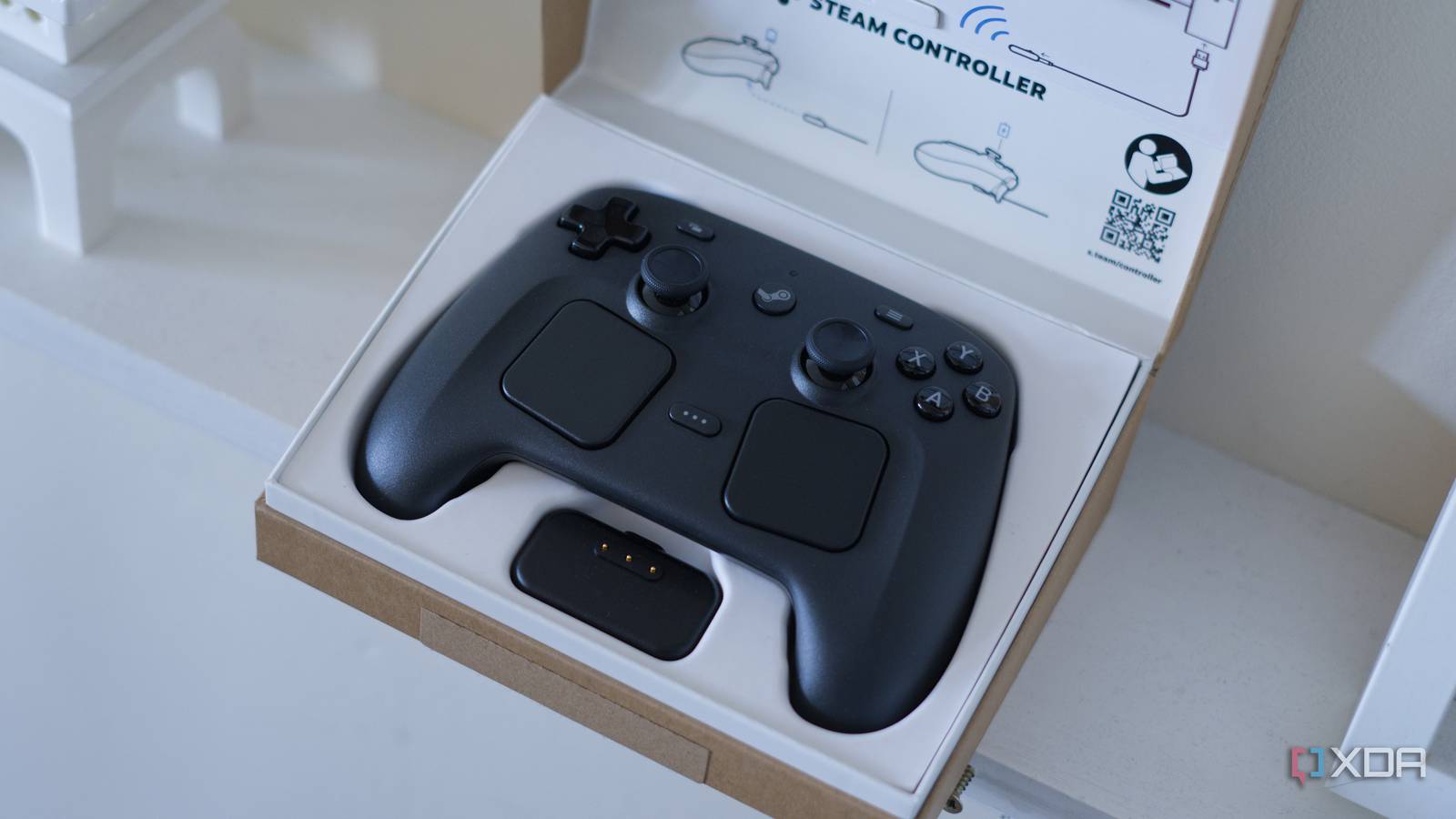
Published Aug 2, 2026, 8:00 PM EDT I’m Adam Conway, an Irish technology fanatic with a BSc in Computer Science and I'm XDA’s Lead Technical Editor. My Bachelor’s thesis was conducted on the viability of benchmarking the non-functional elements of Android apps and smartphones such as performance, and I’ve been working in the tech industry in some way or another since 2017. In my spare time, you’ll probably find me playing Counter-Strike or VALORANT, and you can reach out to me at adam@xda-developers.com, on Twitter as @AdamConwayIE, on Instagram as AdamConwayIE, or u/AdamConwayIE on Reddit. Sign in to your XDA account I never owned the original Steam Controller. It launched in November 2015 at $49.99, sold somewhere in the region of 1.5 to 1.6 million units across four years, and was eventually discontinued in November 2019 with the remaining stock dumped at about a fiver each. I was aware of its existence at the time, though it never interested me, and I wouldn't become interested in Valve's hardware until the Steam Deck arrived and I got my hands on one. With that said, as someone who has a Steam Deck and loves it, Valve's second go at the Steam Controller feels like you took the screen out of the Steam Deck then merged both sides together. I picked one up as a result, but I was approaching it without any of the loyalty the people who stuck with the 2015 gamepad tend to have, and without a decade-old grudge about the industry ignoring Valve. This time around, after the proliferation of the Steam Deck, a controller with two trackpads on it suddenly seems to be something everyone can agree was a good idea all along. One could argue that Valve was right way back in 2015 with the original Steam Controller, and to be fair, I remember seeing people talk about games like Civilization V being a great couch gaming experience with one. Now, after spending a week with the new one, I absolutely love it. With that said, Valve isn't actually the innovator of most of the technology in here, and in fact, it lost four million dollars in court because of that. Even if that's the case, there are still innovations Valve got right here. There's one downside, though: on devices that don't have Steam, like my Mac, my Xiaomi TV Box, and on my Orange Pi Zero 3W, this controller never once presents itself as a gamepad. It was kind of a surprise, actually, given that it's, you know, a controller. As it turns out, it's genuinely amazing in Steam and a bit of a shame outside of it. The trackpads and Steam Input are what Valve actually got first Eleven years later, nobody else has copied the pads The haptic trackpads are the best part of Valve's Steam Controller, though, and this is the third product from the company that has them. First was the original controller from 2015, then there was the Steam Deck, and now the 2026 Steam Controller. Even after eleven years, essentially nobody else in the industry has followed. There are third-party gamepads doing Hall effect and TMR sticks, back paddles, swappable modules, and every other premium feature you can name, but none of them have put a pair of pressure-sensitive haptic pads under your thumbs. The other thing Valve was right about doesn't get credited to the controller at all, because it's software. Steam Input is the universal remapping layer that came about as a result of needing to make the 2015 gamepad usable, and it ended up making everyone else's controllers better instead. It's the reason a DualSense or a Switch Pro Controller works properly on a PC at all, despite neither Sony nor Nintendo showing much interest in making that happen. Valve built it to sell a controller that failed, and it became the layer that made every other controller worth using on a PC. It's hard to attribute that win to the Steam Controller, and if I'm honest, it kind of sounds like a consolation prize. Steam Input is free, it works with input devices that Valve doesn't make and doesn't profit from, but it's still entirely true, and something Valve deserves credit for. Valve only wrote it because a gamepad with two trackpads and one stick couldn't function without something sitting between it and the game, and that something is still here long after the controller it was built for was discontinued. Most devices don't see a gamepad at all Mouse, pointer, keyboard, and something Valve won't explain I paired the controller to my Mac over Bluetooth, quit Steam entirely, and looked under the hood to see what input devices were being reported. Every USB and Bluetooth HID device declares a set of top-level collections describing what kind of device it is, and you can read them out of IOKit without installing anything. Valve's vendor ID is 0x28DE, and this controller reports as product 0x1303. What I got back was the following: DeviceUsagePairs = ({1,2}, {1,1}, {1,6}, {65280,1}) {1,2} is a mouse, {1,1} is a pointer, {1,6} is a keyboard, and {65280,1} is a vendor-defined page, which is Valve's own private interface. "Vendor-defined," in this case, means that the contents follow no standard whatsoever, so a host can only make sense of what's in there if it has been specifically taught how. There is no {1,5}, which would be a gamepad, and no {1,4}, which would be a joystick. The primary usage, on a controller marketed for playing games, is Mouse. What this means is that everything that makes it a controller, like the sticks, gyro, haptics, and buttons, all are reliant on that vendor definition. Without something that speaks Valve's protocol, the controller reports nothing a host can understand. This isn't a Mac problem, either. On Windows the controller also presents itself as a keyboard and a mouse for the same reason, leading to the creation of tools like SteamlessController which can send the feature reports that turn that behaviour off, read Valve's private report itself, and give Windows a virtual Xbox 360 gamepad through ViGEmBus. In fact, Linux is the only place that it works out of the box, and that's because the kernel comes with a driver called hid-steam that understands the vendor protocol natively and gives you a proper gamepad even if Steam is nowhere in sight. Steam has to create the gamepad itself Lizard mode has been sitting in the firmware since 2015 Credit: Jack of Some The mouse and keyboard behavior intrinsic to the Steam Controller actually has a name, and it's been around since the original controller. Valve seems to refer to it as "lizard mode," which I assume is a joking reference to the lizard brain, the primal part that runs on instinct when nothing more sophisticated is in charge, because that's more or less what this is. It's a firmware-level fallback that turns the right trackpad into a pointer, the shoulder buttons into mouse buttons, and A and B into Enter and Escape. It runs with no Valve software present at all, which is exactly why the controller works to some degree on practically anything. Launching Steam doesn't change the controller so much as change what's around it, because running the same probe again with Steam open turned up three Valve devices instead of one: 0x28de 0x1303 Bluetooth LE Steam Ctrl (BT) 1/2 Mouse 0x28de 0x1146 Virtual Mouse-1 1/2 Mouse 0x28de 0x1147 Virtual Keyboard-1 1/6 Keyboard On Mac, Steam creates a virtual mouse and a virtual keyboard, both operating under Valve's own vendor ID, and it doesn't create a virtual gamepad. In contrast, on Windows, Steam Input creates a synthetic XInput device that any application can pick up and treat as a real gamepad. How it works is pretty simple: Steam can read Valve's private page and feed the input straight into the game in its own process, sidestepping the operating system's HID layer entirely. I installed Brotato to check, partly because it's what I used when I tried to turn a Steam Deck into a PC controller, and it worked perfectly, with the desktop cursor vanishing the moment the game took focus and coming back the second I alt-tabbed out. Android does the same thing Half-Life 2 on a Xiaomi TV box, but only through Steam Link I was unsure how the Steam Controller worked at first, and I assumed that the 2.4GHz puck might act as a compatibility shim... but it doesn't. On both the Xiaomi TV box and an Orange Pi Zero 3W running Android, the controller connected through the puck and worked in lizard mode, giving me a mouse and a keyboard. At the very least, it's enough to use an Android TV interface without much hassle. The problem here is the same: there's no gamepad for Android to bind to, so the games have nothing to read, and the puck doesn't make the situation any better. Even though Android uses the Linux kernel, meaning that a kernel driver can technically exist, device makers typically only compile their kernels with the drivers they actually need... and I don't think a Valve controller is making that list. If you want it working anyway, HID Remapper supports it, though that means using something like a Raspberry Pi Pico to translate in between devices. Where it works well, though, is in Steam Link, and being able to stream Half-Life 2 and play comfortably on the couch was a great experience. It's kinda funny, too, because the Xiaomi box actually cost me less than the Steam Controller in the first place. The reason it works is because of Steam Link, and that's because it's Valve's software doing the same work that the desktop client does. The Orange Pi is where lizard mode worked well, though. Text entry on an Android TV is miserable, and the Orange Pi with stock Android and a tablet-like UI wasn't any better. However, with an on-screen keyboard and the Steam Controller, it made typing with the trackpad incredibly easy. Valve didn't invent the back buttons or the gyro But they're still great features Source: Les Orchard via Wikimedia Commons There's a backstory to the Steam Controller though, and one that resulted in Valve sending a Steam Controller to every juror so that they could compare the hardware for themselves. You see, the paddles were Scuf's, or at least Scuf got to the patent office first. Ironburg Inventions, which holds Scuf's portfolio, warned Valve about the design in 2014, a year before the Steam Controller shipped. Valve shipped it anyway, Ironburg sued in December 2015 within weeks of the launch, and in February 2021 a jury found Valve had willfully infringed seven claims of one patent and awarded $4,029,533.93. There's a lot more than meets the eye here. By the time the case reached trial, the Patent Trial and Appeal Board had already cancelled the first claim, which was the one that actually described the idea of two elongate back controls, and Judge Thomas Zilly said as much when he refused to treble the damages, noting that the features Ironburg accused Valve of copying "are not themselves protected by the '525 Patent." What Valve lost on were dependent claims covering the details attached to the idea, like the control being between one and three millimetres thick, sitting in a recess, and being formed as part of the outer case. Zilly also declined to increase the damages because Valve's lead designer testified he'd never read the patent until his own deposition, and Zilly described the two companies as competitors who "independently arrived at similar solutions to the same problem." Even with that, none of it got Valve out of paying, because patents don't work like copyright and arriving somewhere independently isn't a defence. If your product ultimately finds itself in a valid claim you're considered to have infringed, whether or not anyone at your company even knows what the thing you've infringed is. However, independent invention does change whether or not you're merely compensating the party you've infringed or if you're being punished. That's why the number stayed at four million rather than the much larger figure that Ironburg was pushing for. The gyro wasn't Valve's either. Sony had put one in the DualShock 4 in 2013 and then more or less ignored it for years, and Nintendo is the company that actually made gyro aiming mainstream, with Splatoon coming to the Wii U in 2015, the same year the Steam Controller launched. Valve arrived late to the party, as gyros had been in controllers since the Wii and the 3DS was aiming with one back in 2011, and what it actually did was build the software that made it usable everywhere. Eleven years on, Valve is still fighting for the original Steam Controller And the new controller has twice as many back buttons The fight over the original Steam Controller isn't over, and it seemingly influenced the development of the successor. Valve has spent years arguing it should be allowed to attack the patent owned by Ironburg using prior art it had been barred from raising at trial, and on June 18 this year the Federal Circuit agreed. Specifically, the Federal Circuit found that a search for prior art returning 26,333 unnarrowed results, one of which described a design that could potentially invalidate Ironburg's patent, doesn't amount to having found anything, and it sent the case back with instructions that the district court "shall consider the invalidity of the '525 patent." The test is whether a skilled searcher doing a diligent search would reasonably have been expected to turn that prior art up back in 2016, and the Federal Circuit decided Ironburg hadn't proved that it would have. The original verdict still stands for now, and Valve has merely won an argument rather than the entire case, but eleven years on, the patent behind that four million dollar award is back in front of a judge who has been asked to decide whether it should even exist. Meanwhile, the 2026 Steam Controller has four back buttons, and it's an interesting choice given those prior claims. The original patent covered an elongate member extending the full distance between the top and bottom edges of the case, which is what the original controller had. The Deck's back buttons aren't that, and neither are these, as they're small discrete buttons that nothing in that claim really matches. To be clear, this is my reading of the patent, alongside the claim from Ironburg, when held up against the hardware. Nobody has ever tested the Deck's buttons against these patents, but that's why I suspect that the Steam Deck and the subsequent Steam Controller have gone unscathed. Ironburg sued Valve within weeks of the 2015 controller going on sale, and the fight has continued through a jury trial and repeated appeals for eleven years. Meanwhile, the Steam Deck has been on sale with four back buttons since February 2022, a year after the original verdict, and has sold significant numbers without a peep from Ironburg. There could be a licence nobody has announced, or Ironburg could be waiting to finish one case before opening another, but Valve already argued that its back controls weren't elongate members once, about a controller whose back controls were long flexible strips, and lost that argument in front of a jury. Whatever the term stretches to cover, a small round button appears to sit a long way outside it. No matter what, Valve never took the easy way out of any of this. Microsoft licensed the same patents for its Xbox Elite pads and has had no trouble since, and it signed that deal in October 2015, a month before the Steam Controller went on sale and a year or so after Valve had received its warning letter. The Steam Controller shipped anyway, Valve lost, and the company has spent a decade since trying to prove the patents shouldn't exist rather than paying to use them. The 2026 controller walks back most of the original What Valve kept, and what it dropped For all that the new controller feels like a vindication of the original, it concedes nearly every criticism the original attracted. The 2015 gamepad had one stick and a trackpad where the second should be, and this one has two clickable sticks on TMR magnetic sensors, a proper d-pad, and a symmetrical PlayStation-style layout. The enormous concave pads are gone, replaced with smaller ones angled towards your thumbs. Valve's team has said that they started the design by splitting a Steam Deck in half before working back towards something that felt like a normal gamepad, and you can really tell. That also arguably makes the Steam Deck a closer cousin to this device than the original Steam Controller ever was. The rest of the spec would have been remarkable in 2015 and is merely "good" now, with around 35 hours on a single charge, weighing in at 292g, and packing a six-axis IMU, capacitive grip sensors, infrared LEDs so the Steam Frame can track it, and the puck that charges it magnetically when you're done. I'm also pleasantly surprised that the 8.39 Wh cell can be replaced easily, as that kind of thing often gets value-engineered out of products like this. However, what did survive from 2015 are the trackpads and their governing philosophy; everything else is an implicit admission by Valve that they got a lot of it wrong the first time. The original was ahead of its time, but it also wasn't a great product, and Valve learned from that. Unfortunately, the limiting factor here is that you can really only use it in places that Valve has its own software: that means the Steam client on Windows, macOS and Linux, Steam Link, the Deck, and the Steam Machine when it comes out. Still, it's an excellent controller, and the trackpads are genuinely unique to Valve's hardware. The controller and Steam Input aren't really separable products, and after using it for a week I'd say that was at least part of why selling the hardware on its own went as badly as it did a decade ago. My only complaint is that I can't just use it anywhere like I can an Xbox controller, and that isn't something the hardware forced on Valve. The DualShock 4 has a touchpad and a gyro that HID has no way to understand either, and Sony still exposes an ordinary gamepad underneath so the thing works anywhere you plug it in. Valve could have done that, but the company just chose not to.
Valve's new Steam Controller is the best gamepad I've used, but it stops being one when you close Steam
Full Article
Original Source
Read the full article at Xda-developers →KhanList aggregates and links to publicly available news content. We do not host full articles from third-party sources. Always verify important information with original sources.