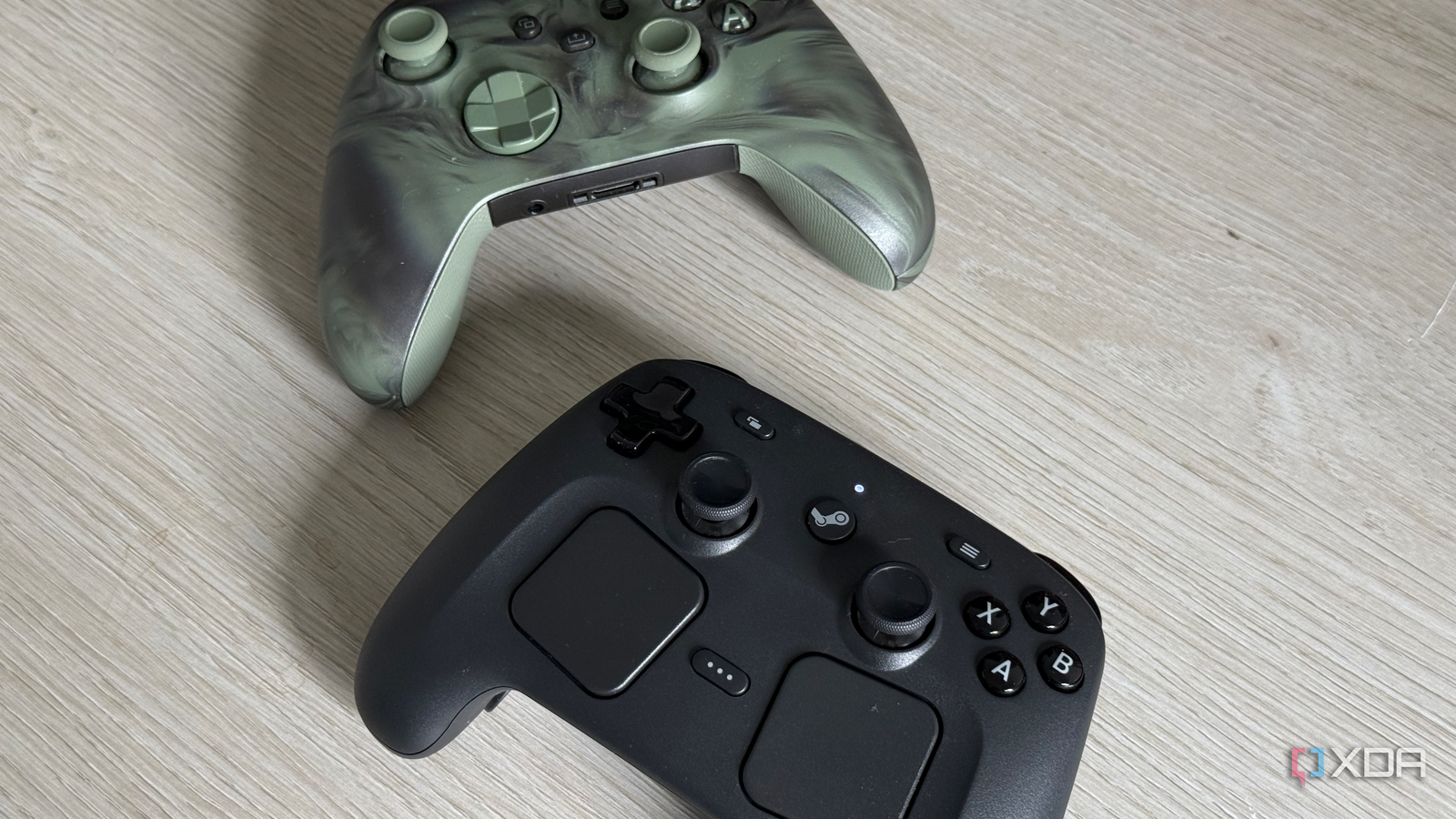
Published Aug 16, 2026, 1:30 PM EDT I’m Adam Conway, an Irish technology fanatic with a BSc in Computer Science and I'm XDA’s Lead Technical Editor. My Bachelor’s thesis was conducted on the viability of benchmarking the non-functional elements of Android apps and smartphones such as performance, and I’ve been working in the tech industry in some way or another since 2017. In my spare time, you’ll probably find me playing Counter-Strike or VALORANT, and you can reach out to me at adam@xda-developers.com, on Twitter as @AdamConwayIE, on Instagram as AdamConwayIE, or u/AdamConwayIE on Reddit. Sign in to your XDA account Stick drift is one of the oldest complaints in gaming, and it's seemingly not going away any time soon. Controllers made by Sony, Microsoft, and Nintendo all still use potentiometers, and those wear down as a condition of how they work. Underneath, a metal wiper scrapes across a carbon film resistor every time you tilt the stick, and after enough scraping, the film degrades. It's the hardware that's the problem, meaning no firmware update can ever really fix it. Valve's $99 Steam Controller doesn't have that problem, or at least, not in the same way. The reason for that is pretty interesting: the analog sticks don't use physical contact to measure their position. Instead, they read the position of a magnet on the end of the stick shaft using tunneling magnetoresistance, and what a TMR sensor measures is how many electrons make it through a thin barrier that conventional physics says should stop them entirely. What this means is that there's no physical contact with a wiper and there's no resistive track that can be worn out. The Steam Controller is using fifty-year-old physics that spent the vast majority of its life unused before it made its way to hard drives and the memory industry. Only in recent years has it become cheap enough to put in a game controller, and Valve didn't invent it, nor was was it even the first to use it. However, it's the only console manufacturer shipping one, and at a price that undercuts the potentiometer-based flagships from Sony and Microsoft by $80 to $100. And the sticks should still work in the years to come. A TMR sensor is two magnetic layers and a barrier two nanometres thick And it took fifty years to get one into a controller Credit: Jack of Some Every electron carries spin, which is an intrinsic magnetic property that points, loosely speaking, either up or down. In most materials, roughly the same number point each way, so the effect cancels out. Ferromagnets are different, though, and the iron-cobalt alloys used in these sensors are a good example. More of the electrons available to carry current point one way than the other, which means a ferromagnet doesn't just respond to a magnetic field, it also sorts electrons by their spin. The sensing element is called a magnetic tunnel junction, and it's a sandwich of three layers. The outer two are ferromagnetic films, and between them sits a barrier of magnesium oxide that's around one to two nanometres thick, which works out at roughly five to ten atomic layers. One of those magnetic films is pinned, meaning its magnetisation is locked in a fixed direction to act as a reference. The other one is free, and it rotates to follow whatever external magnetic field it happens to be sitting in. The barrier is an insulator, so in theory, nothing should get across it. An electron arriving at it doesn't have the energy to get over, in the same way that a ball rolled at a hill it can't climb just rolls back down. Quantum mechanically, though, the electron isn't a ball, it's a wave function, and that wave function isn't merely stopped by a wall. Instead, it decays inside the barrier, and if the barrier is thin enough, there's still some of it left on the far side. And that means there's a real probability of finding the electron on the far side even though, classically, it doesn't have enough energy to cross the barrier. That's tunneling, and it falls off exponentially with thickness. Add another nanometre of magnesium oxide, and you may not see the same effect. Spin is conserved while an electron tunnels, so one that starts out spin-up has to find a spin-up state waiting for it on the far side. When the two magnetic layers are aligned there are plenty available, so lots of electrons get through and resistance is low. When the layers oppose each other there aren't, so far fewer make it and resistance climbs. Polarized sunglasses describe a similar concept: two filters lined up will pass light happily, and rotating one of them by ninety degrees kills it. The junction is doing the same thing, just with spin instead of light. Michel Jullière found the effect in 1975 and got roughly 14% out of it at 4.2 kelvin, which is liquid helium territory, but practical room-temperature TMR remained elusive for roughly two decades. That came in 1995, when two groups independently achieved a reproducible 10% to 20% using barriers of oxidised aluminium. Magnesium oxide turned out to work far better, and by 2004 it was managing around 200% at room temperature, which makes it worth manufacturing and the reason the same basic stack now shows up in MRAM and hard drive read heads. You may also have heard that TMR dates back to 1990s hard drives, but it doesn't. Those drives used giant magnetoresistance read heads, which is the sibling technology that won Albert Fert and Peter Grünberg the 2007 Nobel Prize in Physics, and TMR heads only displaced them around 2005. Getting from a drive head to a thumbstick took another twenty years, but not because nobody thought of it. Hard drive read heads are already analog sensors, even though the data they ultimately read is binary, but a joystick asks something quite different of the same underlying technology. It needs to measure the direction of a magnetic field accurately across a wide range of angles, with a smooth output, low hysteresis, and the same reading on the way back as it gave on the way out. That meant engineering TMR specifically as an angle sensor, with a free layer that rotates predictably with the external field and sensor elements arranged to turn that rotation into a usable position. TDK's angle sensors grew out of the same thin-film manufacturing expertise it developed for hard drive heads, but they're designed for a very different job. Cost eventually made that practical in something as cheap as a game controller, while Hall Effect had already spent decades getting cheaper at enormous scale. The sensor reads which way the magnet points, not how hard it pulls Magnet strength doesn't come into it The free layer follows field direction, so the junction's resistance varies with the angle between the free layer's magnetisation and the pinned layer's. Sensor makers arrange multiple TMR elements into two sensing channels set at right angles, which between them give an unambiguous reading of where the field is pointing. Mount a magnet on the joystick shaft, put the sensor underneath it, and tilting the stick sweeps the field direction across the sensor. Because the output is designed around field direction rather than simply using field strength as a proxy for position, changes in magnet strength and spacing have much less influence on the reading. The field still has to stay within the range the sensor was designed for, but small variations in the air gap between the magnet and sensor aren’t as important. Neither is a small loss of remanence as the magnet ages or warms up. That makes the whole assembly more tolerant of the tiny mechanical and magnetic variations that inevitably appear in a mass-produced controller. Hall Effect can measure angle too, and sophisticated Hall angle sensors use multiple sensing axes to cancel out many of the same problems. However, the simpler linear Hall sensors commonly used for joysticks measure magnetic flux density directly, making their output more dependent on the strength and position of the magnet. TMR's combination of high sensitivity, large output, and low power consumption is what makes it particularly attractive here. A bare Hall element's raw output is also small enough that it needs amplification, and amplification adds noise and burns power. A TMR junction can produce a much larger resistance response as the field rotates, giving the sensing circuitry a stronger signal to work with while consuming very little power. GuliKit specs its TMR sensors at 0.1 to 0.3 milliamps, against 0.5 to 2 milliamps for a linear Hall sensor. Valve engineer Jeff Mucha told GamersNexus: "TMR is kind of new to the scene. It solves some of the power problems that Hall had, and keeping the sensitivity." TMR sensors can also be designed with strong cross-axis rejection, making them less sensitive to stray fields coming from the wrong direction; useful when haptic motors, trigger magnets, and other magnetic hardware are sitting only centimetres away. A potentiometer, by comparison, is a metal wiper dragging across a carbon film, which makes it a wear component in the same way that brake pads are. Every movement adds a tiny bit of wear, and over time, the track can become worn or contaminated enough that the electrical reading no longer cleanly matches the stick's actual position. You can compensate for some of that in software with larger deadzones, but you can't put the missing material back. Xbox and PlayStation still use sticks that wear out The big three have had years to fix this Credit: Andy's Tech Table on YouTube None of the three major console manufacturers have put magnetic sticks in their standard controllers, even despite their cost. Take the Xbox Elite Series 2: it costs $180 and still uses potentiometers. In October 2020, weeks after the Elite Series 1 and 2 were folded into an existing drift class action, Microsoft extended the warranty from 90 days to a full year. It applied that retroactively to every unit sold, and refunded people who had already paid for out-of-warranty repairs. The complaint had named the potentiometer inside the stick assembly specifically, but Microsoft said the issue affected a "small percentage" of users. Seems a fairly expensive way to treat a small percentage. On the side of Sony, things are a little better, but not by much. The DualSense Edge is $200, but it uses replaceable stick modules. It at least prevents otherwise working controllers from becoming e-waste, but the modules themselves are still potentiometer based. It'll still wear out, it's just easily replaced. Nintendo's no better either, with the Switch 2 packing the same potentiometer tech with an Alps-style graphite wiper on a resistive track. Theorists believe that Nintendo can't use Hall Effect as the Joy-Con 2's magnetic attachment system would interfere with the sensor magnets, but Nintendo has never confirmed it to be the case. At the very least, Nintendo redesigned the sticks and made the pads larger than on the original Switch, but the wear mechanism is identical. And TMR demonstrably would have been an option: aftermarket TMR modules for the Joy-Con 2 already exist, magnetic attachment system and all. Nintendo ultimately went with plain old potentiometers. Third-party makers have been doing it for a long time, though, and for cheap. TMR controllers can start at as little as $30, and there's a long list of them from GameSir, 8BitDo, Razer, GuliKit, and others, running all the way up to $200. GuliKit also sells aftermarket TMR replacement modules for PlayStation and Xbox controllers for roughly $30, though fitting them means soldering, which rules it out for most people. So you can get rid of potentiometer wear for $30 from a third party, or an entire $99 controller from Valve. You can't get one from Sony, Microsoft, or Nintendo at any price. Valve soldered the sticks down because of physics Bad news if you were planning to mod them Valve’s TMR sticks are soldered to the board, which is an odd choice on the surface from a company that prides itself on repairability. However, the trade-off makes more sense with TMR than it would with a potentiometer. A replaceable stick needs a socket, connector, or separate module around a component specifically designed to be replaced, whereas the TMR sensor has no resistive track or wiper to wear through in the first place. If Valve expects the sensor to outlast the rest of the stick assembly, soldering it down removes cost and complexity from a failure mode that should be much less common. There's a caveat to that; the stick surround, return spring, and the linkages are all still mechanical, meaning they all still wear. Once a stick stops settling reliably to centre, you get drift with a perfectly healthy sensor underneath it, because the sensor is faithfully reporting a resting position that genuinely isn't centre. It's not as broad a problem as a scraped-out potentiometer, but the controller has only been out since May meaning problems could crop up in the future. For what it's worth, I love my Steam Controller. The thumbsticks feel floaty in a good way, smooth rather than loose, and they've been perfect for the month I've had it. That doesn't really say a whole lot though, given that the potentiometers in a Joy-Con are very likely to be perfect for a month, too. The downside of soldering the whole assembly down is that if the stick does fail, replacing it becomes board-level work. Valve has at least made the rest of it repairable. The controller opens with a T6 Torx driver and has no clips or adhesive holding it together, and the company put its CAD files on GitLab under a Creative Commons BY-NC-SA licence a day after launch, complete with engineering drawings marking the antenna and LED keep-out zones so that accessory makers know what not to cover. Sony and Microsoft have never offered anything like it. Valve is carrying TMR forward The Steam Deck 2 might have them Valve designer Lawrence Yang told Adam Savage's Tested that TMR thumbsticks are "things that we're pretty happy with," and that he could see the company using them again. He named the Steam Frame controllers, which Valve's own engineers have confirmed use the same sticks, and left the door open on future hardware more generally. The Steam Deck came with potentiometer sticks, and enough owners replaced them with Hall Effect mods that it seems Valve paid attention. A Steam Deck 2 with TMR as standard would close that gap, and it would close it on the device where drift actually ends the product's useful life rather than just annoying you. There are a couple of things worth keeping in perspective, though. Valve buys these stick modules from outside suppliers rather than building its own, so this is Valve picking the right part rather than engineering a breakthrough, and the same parts are on the shelf for everyone else. Valve made some other cuts too, such as the Steam Controller polling at 250Hz where plenty of pads manage 1,000Hz, and 8BitDo's Ultimate 2 pairs TMR sticks with 1,000Hz polling for about $60. I'll be honest, though, I didn't even know it was 250Hz until I was researching for this piece, and I've put a lot of hours into Marvel's Spider-Man 2 on it without the polling rate ever even being a thought. Half-Life 2 over Steam Link was the same, and the gyro aim is genuinely fantastic. That's more or less the point, as this is a controller built for a sofa, and a sofa isn't ordinarily where 250Hz causes problems. Getting hold of a Steam Controller is a different matter entirely; stock lasted roughly half an hour on May 4, and while the reservation queue that Valve opened on May 8 has been steadily delivering since, anyone joining it now is being quoted a delivery window in 2027. Still, Sony and Microsoft have anchored their premium controllers at $180 to $200 for years without fitting magnetic sticks at all, and Valve has undercut both of them with a sensor that works by counting electrons that have tunnelled through a wall. It's the only first-party gamepad you can buy whose sticks don't rely on a resistive track scraping itself away every time you use them, and it costs half what the other two charge for ones that do. Assuming you got your reservation in early, anyway.
Valve's $99 controller drops the part that causes stick drift, and Sony and Microsoft's flagships still haven't
Full Article
Original Source
Read the full article at Xda-developers →KhanList aggregates and links to publicly available news content. We do not host full articles from third-party sources. Always verify important information with original sources.