
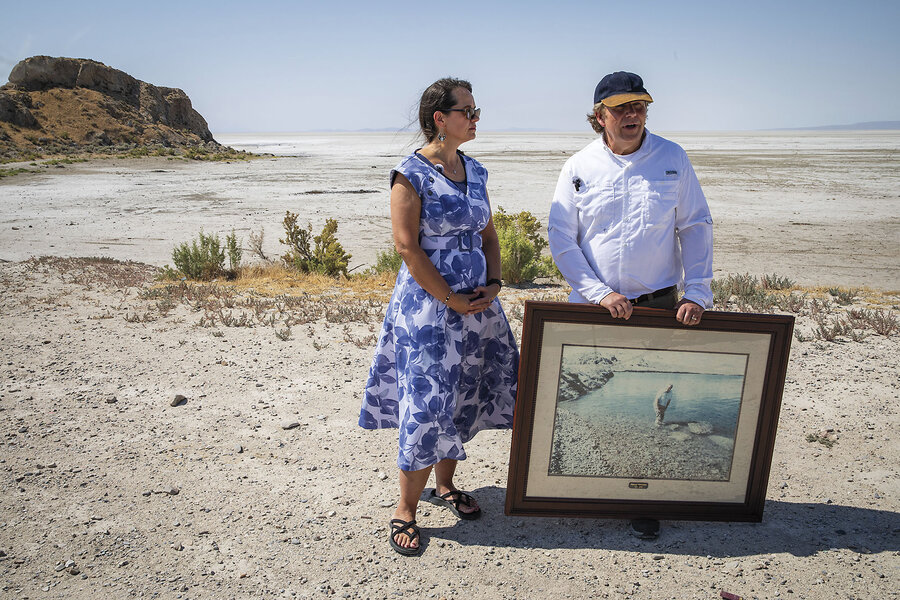
As data centers proliferate across the country, amassing space in both acreage and America’s politics, no projects compare with the one planned for this corner of northwestern Utah.The basic specs describe an endeavor unlike anything on Earth. The Stratos Project is set to take over 20,000 acres of desert brush and farmland in Box Elder County, abutting the Great Salt Lake. Even at this reduced size (the original plan was 40,000 acres), the site would be bigger than Manhattan. At full build, the Stratos Project estimates it would consume 9 gigawatts of electricity, more than twice the amount used to power the rest of the state.“We keep saying ‘data center,’ and that’s something different” from this project, says Robert Davies, an associate professor of physics at Utah State University. His calculations put the project’s electricity consumption at more than double what the developers are suggesting. The thermal energy coming off the Stratos Project, says Dr. Davies, could be equivalent to the energy of 23 atomic bombs being deposited on this valley every day in the form of waste heat – potentially raising nighttime temperatures in the area by as much as 12 degrees Fahrenheit. Why We Wrote This Utah aims to be industry-friendly. But choosing a fragile ecosystem to house a sprawling facility has generated intense grassroots opposition. Given that the project is discussed in terms of atomic bombs, and given that grassroots opposition to data centers appears to have permeated every region of the country, such a project might seem daunting, if not impossible, to many developers. But Stratos is backed by Kevin O’Leary, who has earned the sarcastic nickname “Mr. Wonderful” because of his ruthlessness toward fledgling startups on the reality TV series “Shark Tank.” He plans to change the name of Hansel Valley – with its rolling farmland, nearby migratory bird refuge, and soon, the biggest data center in the world – to Wonder Valley.Mr. O’Leary and his team had decent reason to believe that if such a gargantuan project were to work anywhere, it would work here. That has a little bit to do with the demographics of Box Elder, which is a rural and Republican county within a rural and Republican state, and a lot to do with an obscure Utah commission that allowed the project to get approved in May without the same community input or environmental reviews that typically dog data centers a fraction of Stratos’ size. In news interviews, Mr. O’Leary has described Hansel Valley as “arid desert” that’s “not in anybody’s backyard.”But many assumptions that Stratos’ investors or Utah politicians might have had about Box Elder County – about either the acquiescence of its people or the barrenness of its landscape – have been proved wrong over the past few months. County commission meetings have been moved to the local fairgrounds for space, some of the most powerful local politicians have been voted out of office, and efforts to save the ever-shrinking Great Salt Lake have seen a surge of interest. If data center opposition has scrambled politics and electoral stereotypes across the country over the past few months, Box Elder County has shown that to be true even in the unlikeliest of places.“The environment here is largely compliant,” says Brenna Williams, who has lived in Box Elder County for two decades. “We take what we get and go with the flow and don’t speak out about much. I bet they were totally shocked when all of a sudden they had all this backlash.” Melanie Stetson Freeman/Staff Hansel Valley is the intended location for the Stratos Project, a massive artificial intelligence and hyperscale data center facility in Box Elder County, Utah, July 13, 2026. Many local business owners and residents are opposed to the project, which is backed by celebrity investor Kevin O’Leary. Located near the dwindling Great Salt Lake, in a region that is in the midst of a megadrought, the project faces intense environmental and community scrutiny regarding water rights, power consumption, and local ecological impacts. Bipartisan blowbackFew issues have united increasingly polarized Americans like data centers. Voters across the country – rural and urban, Republican and Democratic – have joined in opposition, criticizing data centers for guzzling local communities’ resources with little long-term economic gain for residents. Seven in 10 Americans oppose the construction of an AI data center in their area, according to a Gallup survey from March. That means more Americans say they are willing to live next door to a nuclear power plant.This opposition includes conservative voters – like many of those in Box Elder County – who typically align with the Republican Party’s guiding principles of a free market and small government. While 75% of Democrats in the Gallup poll strongly or somewhat oppose data centers to support AI in their community, 63% of Republicans say the same. In early August, Republican Gov. Greg Abbott of Texas announced a pause on new data centers in his state, which had the fastest-growing data center market in the country, pending a thorough review of their energy and water usage. U.S. Rep. Byron Donalds, the GOP gubernatorial nominee in Florida who is backed by President Donald Trump, has been running ads about how he will “protect Florida families and communities from data centers.”At least 75 data centers worth approximately $130 billion were blocked or delayed in the first quarter of 2026 alone, according to the research firm Data Center Watch, roughly equivalent to the entire pushback in 2025. Lawmakers in 15 states have introduced legislation for data center bans or pauses, and more than 100 localities have already approved their own pauses. In mid-July, New York became the first state to enact a statewide moratorium when Democratic Gov. Kathy Hochul signed an executive order putting a one-year pause on facilities using more than 50 megawatts.“Large” data centers in the United States are sized at 10 to 50 megawatts. New, “hyperscale” data centers use between 200 and 500 megawatts. The Stratos Project “is 20 times bigger than the high end of a hyperscale data center,” says Dr. Davies. “This would be one of the largest single-site heat sources on the entire planet. That includes volcanoes.”Grassroots opposition has already come to northwestern Utah. In June, the two Box Elder County commissioners who were up for reelection were voted out of office, along with Utah’s most powerful state lawmaker, Republican State Senate President Stuart Adams, who also chairs the special state group that approved the project. Republican Gov. Spencer Cox of Utah has argued that his state has a national security “obligation” to build data centers and compete with China, while rebutting claims that approval of the Stratos Project was pushed through. And in response to criticism of the Stratos Project, Utah Republican Gov. Spencer Cox signed an executive order in late May establishing a “higher bar” for data center development in the state. (Mr. Cox, however, hasn’t walked back his support for the Stratos Project itself.)“Effect on resources,” such as water and energy, was the top concern by participants in the Gallup poll – more than half of poll respondents mentioned this. But some who study data centers say these claims are overblown. Even in the West, which is in the middle of a historic megadrought, more water is used every year watering lawns. Utahns are shocked when they are told that data centers currently use less than 1% of the state’s water, says Ben Abbott, a global ecologist at Brigham Young University in Provo. Dr. Abbott pays close attention to the state’s water supply as executive director of Grow the Flow, a group leading the effort to save the Great Salt Lake.There is a tendency “for any change in a community to get a lot of blowback,” he says. And as Americans grow increasingly anxious about the societal and professional implications of artificial intelligence, and without a clear national direction for regulating the technology, many say data centers have stood in as a useful proxy for voters to vent their fears and frustrations. When Dr. Abbott first heard about the pushback rising up in the sleepy, northwestern corner of his state, he thought, “Let’s cool our heels” and wait for the details.“But then, when I saw the specs of the [Stratos] project,” says Dr. Abbott, “my jaw just dropped.”The project initially requested 13,000 acre-feet (more than 4 billion gallons) of annual water rights. After reading through the project’s details, however, Dr. Abbott concluded that the amount of water needed for the project could be closer to 100,000 acre-feet. That kind of water usage by Stratos “would more than erase all the work we have done to save [the] Great Salt Lake,” he says.The past 25 years in the American West have been the driest since the year 800, say scientists. Less snowpack, as well as more water diversions for agricultural and urban uses, has brought the lake down to less than 33% full and 8 feet below its minimum healthy elevation. Without the Salt Lake region cutting water usage by 40%, the lake’s ecosystem could be dead in the next few years, says Dr. Abbott, as the final puddles of water become too salty for anything to live. Among other consequences, the professor and others say, the lake’s deterioration has international implications for the 12 million migratory birds that stop here every year. “We’re in a total state of emergency,” he says.Mr. Cox officially declared a state of emergency over Utah’s record-breaking drought in May, and he has lobbied Washington for funding to save the Great Salt Lake. All of which makes his support for the Stratos Project confusing, say locals, especially as the governor calls on Utahns to pray for rain and pushes a campaign to save the Western Hemisphere’s largest saline lake ahead of the 2034 Salt Lake City Winter Olympics. Melanie Stetson Freeman/Staff The dry land around Monument Point used to be filled with water from the Great Salt Lake. During a news conference in late April, Mr. Cox argued that Utah had a national security “obligation” to build data centers and compete against China, while rebutting claims that Stratos’ approval was pushed through. “We can’t just say no and shut the doors and go home and let China win this, this technology race, so that just can’t be an option,” Mr. Cox said. “I’m so tired of our country taking years to get stuff done. It’s the dumbest thing ever. We think that taking time makes things better or safer. It absolutely does not.”One week later, in a post on X, Mr. Cox reiterated that “Industry” is Utah’s state motto, but expressed regret for his news conference comments while also instructing state departments to follow through on conducting thorough environmental assessments. Later in May, the governor said “there’s no question, the process was not good” for approving Stratos, and that future projects like this should involve input from both his office and the state legislature.A heated meetingJust as Box Elder County is an unsuspecting location for a data-center opposition movement, Ms. Williams, the longtime resident, is its unsuspecting leader, even by her own admission. The soft-spoken grandmother of six was enjoying her retirement as a former econometrician – a specialist who studies the intersection of economics and statistics. Then, in late April, she heard at the grocery store that the Box Elder County Commission would be voting in a few days on whether to approve a data center project endorsed by Utah’s Military Installation Development Authority on 40,000 acres of private land in the county.The legislature created MIDA almost two decades ago after Utah’s Hill Air Force Base, one of the state’s largest employers, faced possible closure in the mid-1990s. The goal for the eight-member board, a mix of elected officials appointed by other elected officials, is to approve economic projects “with a military touch,” said Mark Shepherd, a MIDA board member and mayor of Clearfield City, Utah, on a panel about the Stratos Project in July. And this state-level political group is granted great power to do so, as MIDA can levy taxes for projects while bypassing local or county laws. Critics argue that MIDA has taken power beyond its original charter, approving projects such as Stratos and a Deer Valley ski resort development whose military connection is tenuous at best.Ms. Williams was one of more than 1,000 people to show up in early May to a Box Elder County Commission meeting, which had been moved to the county fairgrounds to accommodate the expected crowd. “I don’t know that has ever happened in Box Elder County history,” says Brigham Daniels, an environmental and property law expert at the University of Utah. When the three commissioners signaled they were ready to approve MIDA’s project without the public input that many attendees came for, there were boos and jeers. The commissioners moved to a private room and approved the project unanimously. As she was leaving the fairgrounds, Ms. Williams’ husband, Alan, whose family has lived in Box Elder County for five generations, turned to her and said, “Are you really going to referendum this thing?”The next morning, Ms. Williams and other locals went to the county clerk and filed for a referendum, which would allow local voters to either approve or reject the Stratos Project at the ballot box. The county denied the referendum, with the county attorney arguing that the issue wasn’t legally referable to voters because the objection was to administrative actions, not “broadly applicable legislative acts.” If a data center project the size of a big city is not “broadly applicable” to the county, says Dr. Daniels, “then we have all lost our minds.” Melanie Stetson Freeman/Staff Ben Abbott (from left), with Grow the Flow, and Alan and Brenna Williams look at a map of the proposed site of the Stratos Project data center, which they are fighting, in Box Elder County, Utah. The project faces intense community scrutiny regarding water rights, power consumption, and local ecological impact. Ms. Williams and members of a group she helped create, the Box Elder Accountability Referendum, known as BEAR, filed an appeal of the referendum denial. In early August, attorneys for both the county and Mr. O’Leary asked a judge to dismiss the appeal. BEAR now plans to file a motion on why the appeal should go forward. O’Leary Digital, Mr. O’Leary’s company backing the Stratos Project, did not respond to repeated requests by the Monitor for comment.“They are going to do everything they can to draw this out as long as possible,” says Ms. Williams. She doesn’t see opposition dwindling, however.Mr. Shepherd, the MIDA board member, assured concerned locals at the Grow the Flow panel event that the project would be subject to a full slate of environmental reviews and permits, which are currently in a “holding pattern” as the referendum process plays itself out. Whereas a city would have to get environmental reviews and permits done before an economic project is approved, MIDA operates “almost the opposite,” says Mr. Shepherd. In other words, the project approval comes first, and then the project must meet the state’s environmental standards.But the problem with this process, say legal experts, is that promises were already made to developers. Now, outside of the referendum process, any government backtracking on the project could open the state of Utah to lawsuits. And without any state environmental assessments, local scientists say, they must do their own analyses – often on their own time – to help locals understand what the project could mean for such a fragile ecosystem.Because, in a place like this, that fragility is not discreet. Nearby Locomotive Springs, named for the noise of the water that once rushed up from the earth, is now a stagnant pond with green algae blooming at its edges. A single dirt road cuts across the landscape, running parallel to wire fences snarled with tumbleweeds. At the Great Salt Lake’s Monument Point, the soft, gray belly of the lake bed lies exposed, no water in sight.“We’re past the point where we should be concerned” about the lake, says local business owner Val Anderson, as he stands with his sister, Rhonda Lauritzen, and holding a photograph of their father here at the lake’s edge just a few decades ago. Now, to touch the waters of the Great Salt Lake, Ms. Lauritzen needs to walk out on the lake bed for more than 4 miles from the shoreline where she swam as a teenager.“They thought [the Stratos Project] was a good idea here, because if you look superficially at the landscape, there is a lot of empty open land here,” says local artist Erik Linton, who has walked miles around barren salt flats only to find a covey of snowy plovers congregated around a spring. “Just because it doesn’t look maybe what most people think is a stereotypical beautiful lush landscape, then it’s empty and not useful. ... That’s such a misguided way to value land.”After a few silent minutes at the now-still Locomotive Springs, there is a rustling. An animal’s croaking rides away with the wind, and two sparrows rise from the reeds.
Utah planned the world’s biggest data center. Then came the bipartisan pushback.
Full Article
Original Source
Read the full article at Csmonitor →KhanList aggregates and links to publicly available news content. We do not host full articles from third-party sources. Always verify important information with original sources.