
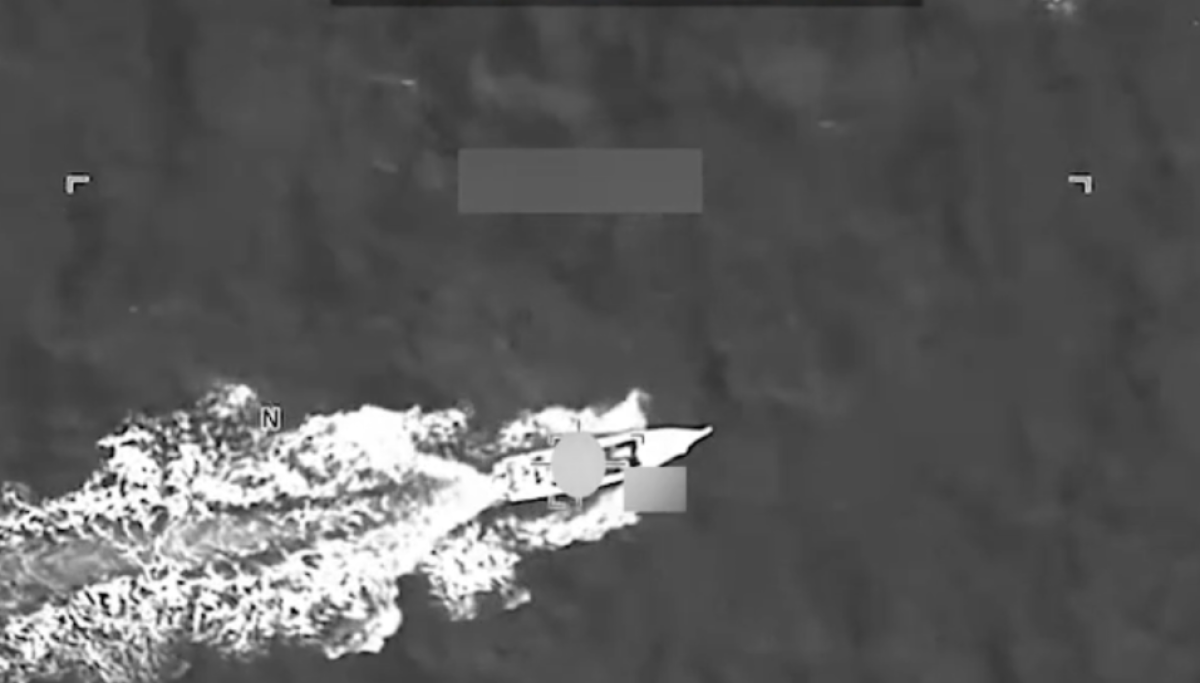
Since late last month, U.S. forces have stopped eight vessels, officials say, were involved in refueling drug boats traveling from South America, and those on board were handed off to Ecuadorian authorities, before the U.S. forces blew up the empty vessels.Joint Task Force-Western Hemisphere has carried out the interdictions of logistic support vessels off Ecuador’s coast since Aug. 28 with their consent and cooperation, a stark difference from the kinetic strikes they’ve carried out for more than a year now that have killed more than 200 mariners.“These recent interdictions through JTF-WHEM are taking place near Ecuadorian territorial waters under the government of Ecuador’s consent along with their cooperation,” a spokesperson for U.S. Southern Command told the Washington Examiner. The refueling vessels have been linked to Los Choneros, which Secretary of State Marco Rubio designated as a Foreign Terrorist Organization and Specially Designated Global Terrorists earlier this month. After interdicting the vessels and securing the mariners, U.S. forces have blown up the vessels.“The interdictions of these logistic support vessels (LSVs) off the coast of Ecuador are part of the total systemic friction approach that Gen. Donovan has stated under JTF-WHEM,” the spokesperson said. “This means that threat networks are being disrupted at multiple points—not merely stopping drug shipments or destroying individual boats—it also means that their movement, financing, logistics, personnel, and operational choices become slower, costlier, riskier, and less effective. Additionally, U.S. forces conduct maritime operations under established legal authorities in compliance with U.S. and international law.”The Trump administration has taken a much more aggressive posture toward cartels and the flow of drugs from Central and South America. Last September, the military carried out its first lethal strike on a vessel purportedly carrying drugs intended for the United States.A U.S. official told the Washington Examiner on Sept. 2 — the one-year anniversary of that first lethal strike, which has since been dubbed Operation Southern Spear and now JTF-WHEM — there had been 227 mariners killed in 68 kinetic strikes. There’s been one lethal strike since then, on Sept. 9, that killed three people on board.“As to why we weren’t conducting [maritime interdiction operations] previously, Operation Southern Spear focused on executing kinetic strikes on vessels along known narco-trafficking routes in the Eastern Pacific and the Caribbean,” the spokesperson said.BREAKING DOWN THE MILITARY’S NEARLY $40 BILLION IRAN WARIn late July, a Pentagon inspector general report revealed that U.S. Southern Command estimated it spent roughly $820 million on the mission.It’s only one aspect of their broader counternarcotics mission, which includes the establishment in March of the Americas Counter-Cartel Coalition. There are nearly 20 countries involved in the coalition, which has come together to “aggressively and urgently confront threats to our homeland and hemisphere,” Secretary of War Pete Hegseth said at the time.In March, there was a joint U.S.-Ecuadorian military operation targeting a training camp used by the Comandos de la Frontera near the Colombian border.“I want to commend Ecuador for its regional leadership to become the first A3C member to partner with the United States in combined kinetic operation against narco-terrorists in Ecuador,” Hegseth said last month during an A3C meeting in Panama.
US’s interdiction of refueling vessels comes with Ecuadorian consent
Full Article
Original Source
Read the full article at Washingtonexaminer →KhanList aggregates and links to publicly available news content. We do not host full articles from third-party sources. Always verify important information with original sources.