
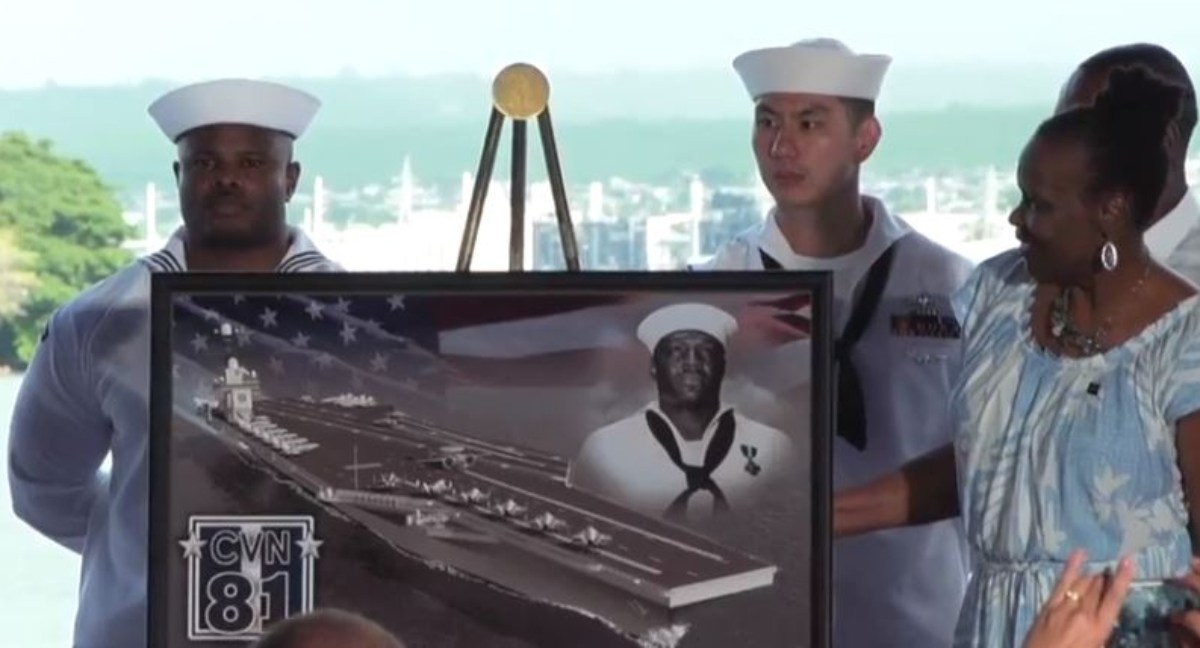
The future Ford-class aircraft carrier CVN-81 will remain the USS Doris Miller, the U.S. Navy confirmed. “There is no intention to change the name of the USS Doris Miller,” a spokesperson for the secretary of the Navy told Military Times. In August, speculation over whether the Navy was pivoting to name CVN-81 after President Donald Trump sparked outrage, particularly among Miller’s descendants. Thomas Bledsoe, Miller’s great-nephew, told CNN at the time that the possibility of such a move “was quite a shock.” When asked in August about the potential pivot, the sea service told Military Times that the “Navy has no announcement to share at this time.” The confirmation comes as HII’s Newport News Shipbuilding announced the ceremonial keel laying of the Doris Miller on Dec. 5 in Newport News, Virginia. The Navy’s fourth Gerald R. Ford-class aircraft carrier, which was initially slated for 2032, was bumped to February 2034 due to “constraints” at the HII shipyard and is projected to take 15 years to complete. CVN-81 will be the first U.S. aircraft carrier named for a Black American, and the first named in honor of an enlisted sailor. Miller’s namesake was chosen by then-Acting Navy Secretary Thomas Modly in 2019. Miller, born in rural Texas to sharecroppers and the grandson of slaves, joined the U.S. Navy in September 1939 after struggling to find work in the Jim Crow South. During that time, Black sailors were not only barred from promotion, but consigned to the messman branch, where they were tasked with the lowly job of making the beds and shining the shoes of their white officers and waiting on them in the officers’ mess. According to historians Thomas W. Cutrer and T. Michael Parrish, by regulation, Black men could not be trained in or assigned to any other specialty, such as signals, engineering or gunnery. Their battle station was below decks in the “hole,” or magazine, where they passed ammunition up to the gunners. They were not even allowed to wear buttons marked with the Navy’s insignia, an anchor entwined with a chain, and had to wear plain buttons instead. It was under these circumstances that on Dec. 7, 1941, Miller found himself stationed on the USS West Virginia. When the first Japanese torpedo slammed into the ship, Miller was below, doing the laundry. However, as six successive torpedoes — a seventh failed to explode — rocked the battleship, Miller sprang into action. Upon finding his battle station, the ship’s magazine, already flooded, Miller sought reassignment. The USS West Virginia, with the USS Tennessee behind it, burns as its keel rests on the bottom of Pearl Harbor. (National Archives) Once topside, Miller, the ship’s heavyweight boxing champion, was ordered to lift the West Virginia’s mortally wounded commanding officer, Capt. Mervyn Sharp Bennion, to a place of relative safety. After placing Sharp in a sheltered spot just aft of the conning tower below the port side anti-aircraft guns, Miller once again looked for his next assignment. While the ship had already begun to list badly, the starboard guns were still operational. Finding a .50-caliber Browning machine gun unattended, Miller, with absolutely no training, began to shoot. “It wasn’t hard,” he later recounted in 1942. “I just pulled the trigger and she worked fine.” It was only when his gun ran out of ammunition, and orders rang out to abandon the ship’s bridge, that Miller left his station. From there, according to the action report from Cmdr. R.H. Hillenkoetter, Miller was “instrumental in hauling people along through oil and water to the quarterdeck, thereby unquestionably saving the lives of a number of people who might otherwise have been lost.” As the oil-slicked water flooded the below decks of the West Virginia, the surviving senior officer gave the order to abandon ship. Doris Miller was one of the last three men to leave the West Virginia. One hundred and six crewmembers perished on that day of infamy, many from drowning as the compartment hatches sealed. In the aftermath of Pearl Harbor, there was a push to award Miller the Medal of Honor, but Georgia Democrat Carl Vinson — the House of Representatives’ Chairman of Naval Affairs, and a staunch segregationist who would later oppose Brown v. Board of Education and the Civil Rights Act of 1964 — claimed that Miller’s deeds were not deserving of the nation’s highest award for valor. William Franklin Knox, the secretary of the Navy, concurred. In subsequent years, there have been numerous calls for Miller’s Navy Cross to be upgraded to the Medal of Honor. In March 2025, Maryland Congressman Kweisi Mfume introduced legislation to award both the Medal of Honor and a Congressional Gold Medal to “Dorie Miller so he can finally be recognized with an American salute that is long overdue,” Mfume wrote, using Miller’s nickname. As of this reporting, there has been no update on the push for the award.
USS Doris Miller to keep its name, Navy says
Full Article
Original Source
Read the full article at Militarytimes →KhanList aggregates and links to publicly available news content. We do not host full articles from third-party sources. Always verify important information with original sources.