
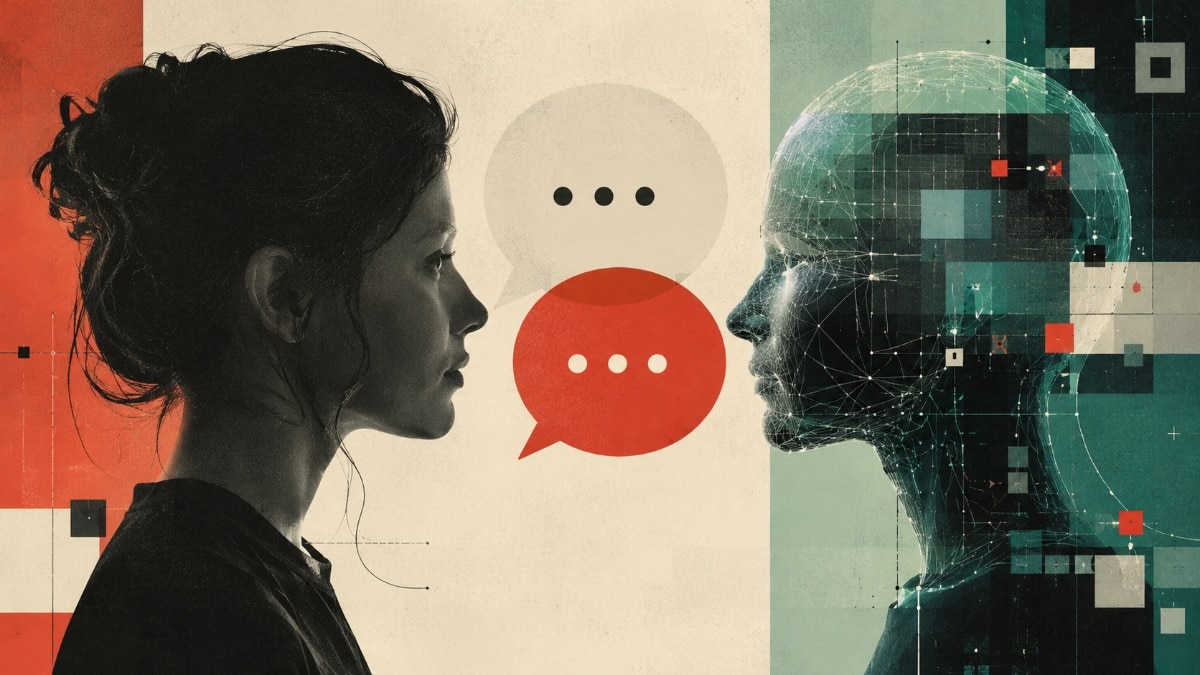
The more time we spend talking to AI, the more we could start communicating like machines. In a new paper, researchers reveal that AI could possibly be changing the way we speak, behave and present ourselves.How much time do you spend with AI? If the answer is a lot, we have some bad news for you. Turns out, spending more time with AI could make you— inadvertently—sound like AI. According to a new study, while AI is getting better at talking to us like a human, it may also be impacting how humanly humans talk.A new theoretical paper published in AI & Society reveals that repeated interactions with AI could gradually make people adapt the way they communicate and present themselves to fit what machines understand best. The researchers call this proposed shift “robotoid humanness”, a situation where people may start feeling more fluent, correct or socially effective when they follow machine-friendly patterns.The paper was written by Selcen Ozturkcan of Linnaeus University, Jean-Paul de Cros Peronard of Aarhus University and Inci Toral-Manson of the University of Birmingham.According to the researchers, the more we interact with AI, the more we may start changing the way we communicate to make those interactions easier. They explain this with a simple example. Imagine you regularly use an AI customer-service chatbot. You may notice that it understands you better when you are clear, direct and structured. So, over time, you might start communicating with it in that way more often. The researchers say this can turn into a kind of feedback loop. AI learns from what you say and uses that information to personalise its responses. As you keep interacting with it, you may also start adjusting the way you talk based on how the AI responds.The paper explains this loop in three steps. First, the AI starts feeling like a social presence to users rather than just a tool. They have conversations with it and may feel that it understands them.Second, the AI uses information from users’ previous interactions to build a simplified picture of them. It then uses that information to give personalised responses.Third, users may start changing the way they present themselves based on what the AI understands and responds to most easily. In simple words, users adapt to the machine just as the machine adapts to them.And this is where the researchers see a possible problem.When users talk to other people, their reactions can be messy and unpredictable. They can disagree with us, misunderstand us or challenge how we see ourselves. AI, on the other hand, works through patterns, prediction and personalisation.The researchers argue that repeated interactions with AI could therefore make us more comfortable with being clear, predictable and easy for a machine to understand. Over time, that could leave less room for the quirks, contradictions and unpredictability that are also part of being human.That is what the researchers mean by “robotoid humanness”. It does not mean people literally become robots. Instead, it describes a possible shift where people start shaping their behaviour around machine logic and machine legibility. They suggest that this could gradually make people more predictable and easier for AI systems to understand, while reducing some of the natural quirks and unpredictability of human behaviour.Meanwhile, the researchers stress that this is still a theory that needs to be tested.- EndsPublished By: Divya BhatiPublished On: Sep 1, 2026 16:42 IST
Using too much AI can make you sound like AI, researchers call it robotoid humanness
Full Article
Original Source
Read the full article at Indiatoday →KhanList aggregates and links to publicly available news content. We do not host full articles from third-party sources. Always verify important information with original sources.