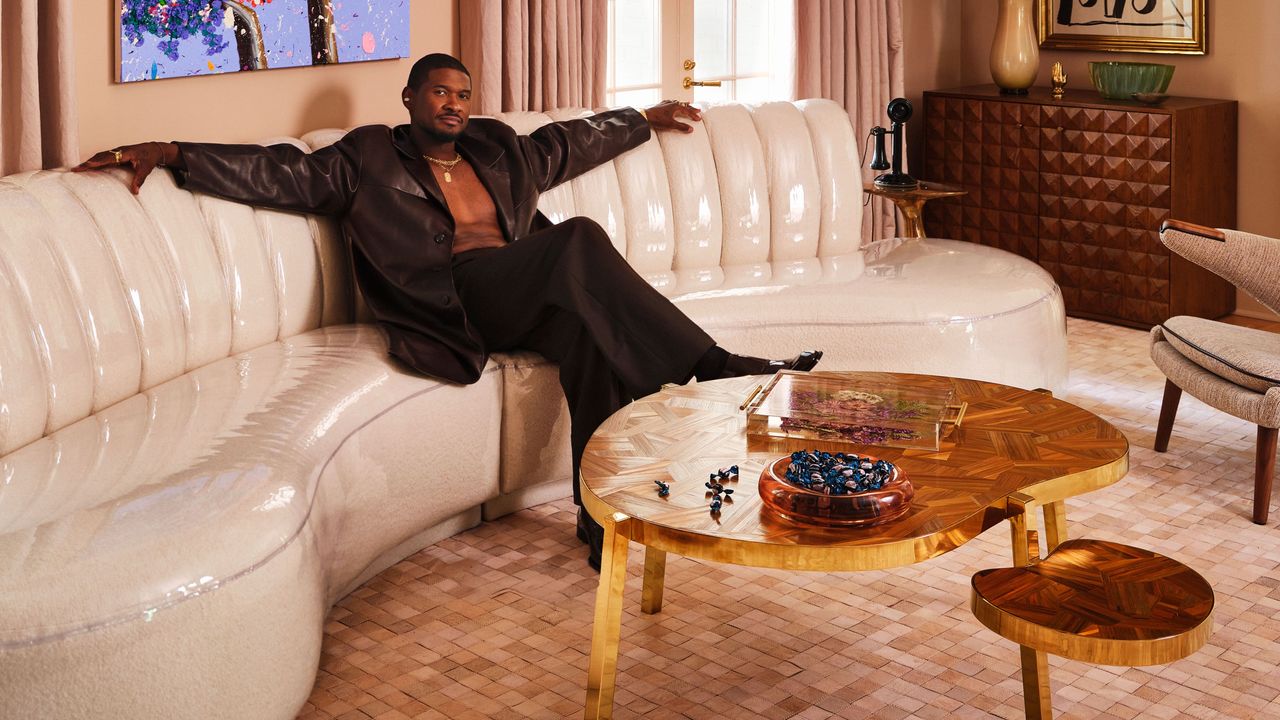
This article was featured in the Interior Monologue newsletter. Sign up here.There were few things I found so unfriendly in childhood as a plastic-covered sofa. Even in youth, I understood it meant something like: We don’t trust you to behave. It was discomforting to sense the palpable anxiety of adults even then, which made me shy to ask for things like a glass of water, or where the bathroom was.At Usher’s house, the plastic isn’t keeping you at arm’s length—actually, it’s showing off. The R&B star’s living room features a seven-seater cloaked in ivory vinyl. The vertical channel backing gestures to diner booths, but the curvaceous silhouette leans more ’70s than it does old-school Sonic drive-in. The piece was designed in collaboration with old friend Nicole Fuller, who also took on the rest of the Georgian-style Atlanta compound, and Atlanta-based Bjork Studio. As Usher simply describes it: “This is my art.”It dominates the room, flanked by artwork from Damien Hirst, a Campana Brothers coffee table, and a portrait of Usher’s childhood nanny. The September cover star explains the house is designed with family in mind: His son’s paintings are hung throughout the house, and a troweled concrete wall immortalizes the handprints of each family member, including the dog.The plastic-covered sofa has a very specific connotation for many people growing up in the ’60s and ’70s. The Tenement Museum keeps a re-creation of one in its “Under One Roof” exhibit, where they note its prevalence in Puerto Rican, Jewish, and African American homes, a common denominator of family life and identity during that period. Visitors routinely announce it as a fixture from their childhood that is equal parts affection- and anxiety-inducing. The plastic coating was an argument for preservation: You worked hard for the things you had, and you protected them accordingly. Artist Alima Lee writes about PVC-cloaked symbolism for the L.A. Times: “I could only look at it sometimes, but I feel that drew me closer to it—like wanting to touch something that I wasn’t really allowed to.”A sofa of powder-coated steel and vinyl cushions (made from vinyl Nuriev found in NYC’s garden district) creates a tension between nostalgia and futurism that characterizes much of the home’s design. Photo: Mikhail LoskutovBut vinyl has begun to shed its more precious context. Instead, it began circulating in high-design conversations with Harry Nuriev’s cobalt sofa, a fixture of his Brooklyn apartment and the calling card of Crosby Studios. The glossy futurism of the material contradicts the apartment’s otherwise nostalgic details (in Nuriev’s case, standing beneath an Orthodox icon of Saint Alexander). Nuriev went further for Balenciaga, stuffing a sectional with deadstock and wrapping it in scrapped vinyl for Design Miami, making excess itself the subject. Usher’s piece is less erudite, more relaxed. He even verified for AD: Yes, it makes the crunching sound.It exemplifies real luxury as living carefree. And carefree indeed is the man who owns a sofa that says: Sit back, relax, and by all means, set your red wine down right there on the cushion.Shop Vinyl SeatingPillow Modular Two-Seater Sofa x Kassl by Muller Van SeverenGilbert Rodhe Lounge Chair1950s Italian Wood & Vinyl SofaVintage 2-Seat Italian Sofa
Usher’s Vinyl Sofa Isn’t Your Grandmother’s Plastic Couch
Full Article
Original Source
Read the full article at Architecturaldigest →KhanList aggregates and links to publicly available news content. We do not host full articles from third-party sources. Always verify important information with original sources.