
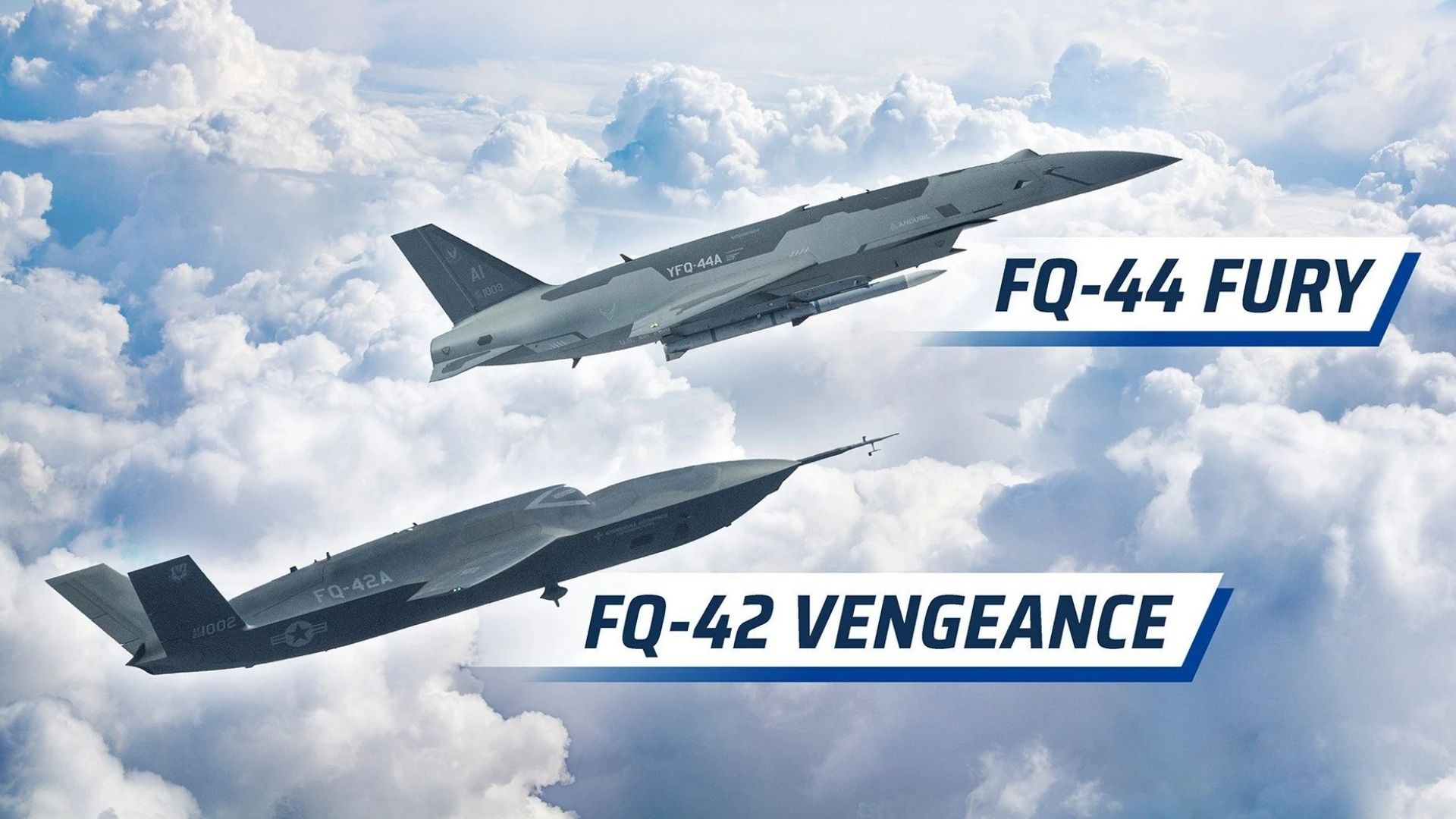
The U.S. Air Force plans to field at least 500 Collaborative Combat Aircraft (CCA) by 2032, sharply expanding its ambitions for semi-autonomous aircraft that can fight alongside human pilots. Air Force Secretary Troy Meink announced the target on September 14 while revealing the official names of the service’s first two CCAs: General Atomics’ FQ-42 Vengeance and Anduril’s FQ-44 Fury. The aircraft are designed to work alongside crewed fighters such as the F-35 and future F-47, providing additional sensors, weapons and other capabilities without putting another pilot in each aircraft. Air Force wants hundreds of robotic wingmen The new target represents a significant increase from the Air Force’s previous plans. In June, the service said it intended to procure more than 150 combat-capable CCAs by the end of the decade after awarding production contracts to General Atomics and Anduril. The service now wants at least 500 in operation by 2032. The Air Force has separately described an overall goal of approximately 1,000 combat-capable CCAs, with the program built around continued competition and successive increments. The FQ-42 and FQ-44 are the first Increment 1 aircraft. Their job is not to replace conventional fighters but to increase what a crewed aircraft can do by distributing sensing, weapons, and other functions across a larger formation. Rather than remotely flying each aircraft throughout a mission, the CCA concept relies on semi-autonomous systems that can handle navigation and other tasks within parameters established by human operators. According to Army Recognition, The Air Force has already moved the aircraft beyond basic flight testing. In July, a YFQ-44A fired an AIM-120 air-to-air missile at a digital target during a live-fire test. The service stressed that humans retain control of weapon employment and that CCAs will not autonomously decide to fire. The aircraft have also been tested in more realistic operating conditions. During an Agile Combat Employment exercise at Creech Air Force Base in Nevada, the Air Force generated multiple CCA sorties, integrated the unmanned aircraft with crewed platforms and evaluated operations from a dispersed location. Software will be as important as the aircraft The Air Force is also separating CCA mission-autonomy software from the aircraft themselves. Its government-owned Autonomy Government Reference Architecture is intended to allow software from different suppliers to be integrated across compatible platforms. Six companies, including Anduril, General Atomics, Lockheed Martin, Northrop Grumman, RTX Collins Aerospace and Shield AI, are competing to develop mission-autonomy software for the program. The approach is intended to keep competition alive and allow the Air Force to introduce improved autonomy without redesigning the aircraft. The scale of the new target, however, presents a major production and operational challenge. The Air Force will need to manufacture hundreds of aircraft while developing the maintenance, weapons, communications, and command-and-control infrastructure needed to operate them. For General Atomics and Anduril, the transition is already underway. The FQ-42 Vengeance and FQ-44 Fury have moved from prototype designations into production, while the Air Force continues testing how humans and autonomous aircraft can work together. If the service reaches 500 aircraft by 2032, CCAs will no longer be an experimental addition to American airpower. They will represent a substantial new layer of the U.S. fighter force. One designed to put more aircraft, sensors, and weapons into contested airspace without requiring a corresponding increase in pilots. Get the latest in engineering, tech, space & science - delivered daily to your inbox.Kaif Shaikh is a journalist and writer passionate about turning complex information into clear, impactful stories. His writing covers technology, sustainability, geopolitics, and occasionally fiction. A graduate in Journalism and Mass Communication, his work has appeared in the Times of India and beyond. After a near-fatal experience, Kaif began seeing both stories and silences differently. Outside work, he juggles far too many projects and passions, but always makes time to read, reflect, and hold onto the thread of wonder.
USAF to field 500 collaborative combat aircraft by 2032, named GA FQ-42 and FQ-4
Full Article
Original Source
Read the full article at Interestingengineering →KhanList aggregates and links to publicly available news content. We do not host full articles from third-party sources. Always verify important information with original sources.