
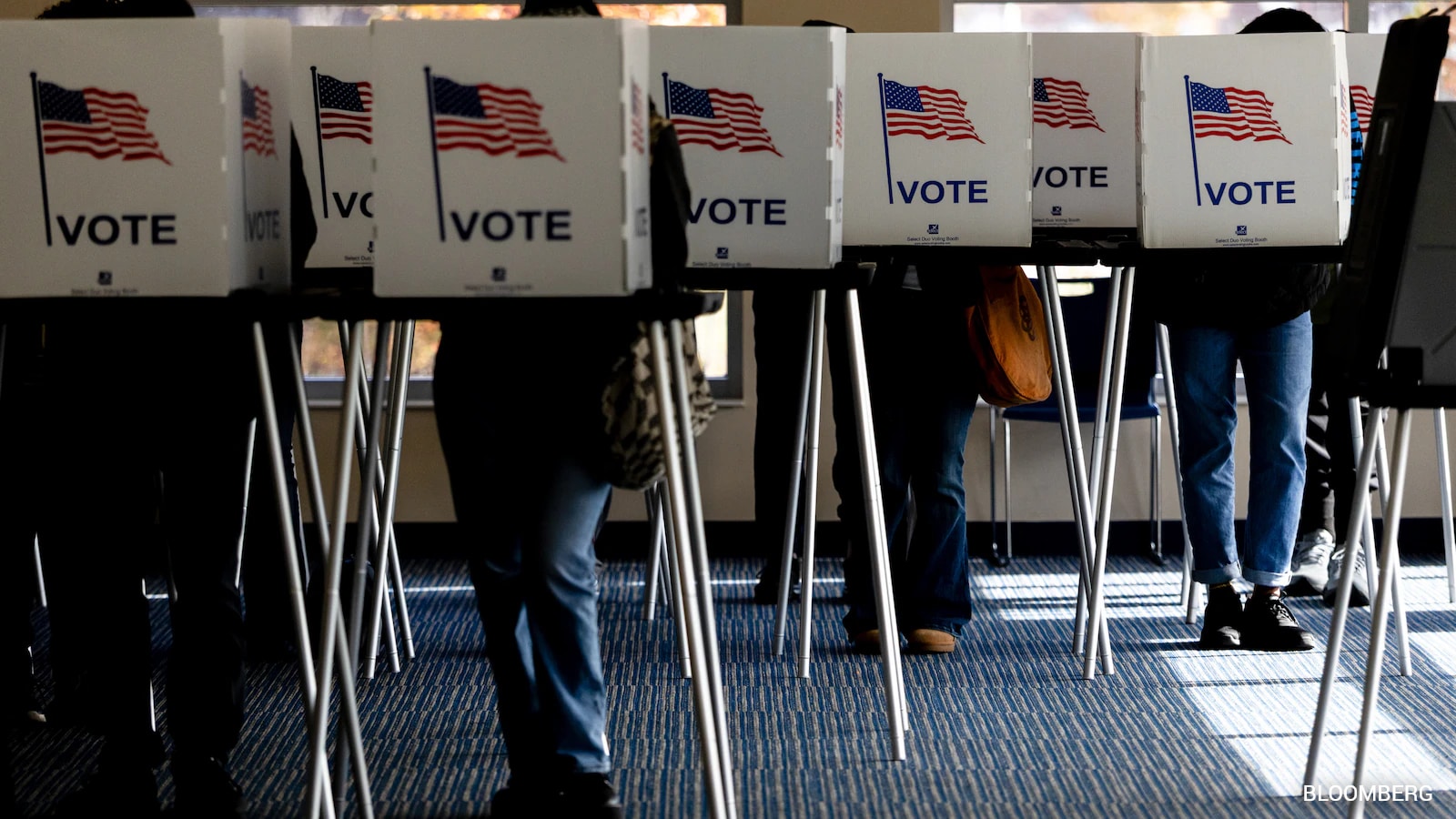
America's referendum on President Donald Trump's second term is underway.With polls set to open Tuesday morning for the US midterm elections and tens of millions of early ballots already cast, voters say they are frustrated by the high cost of living, fuel prices that spiked after the launch of the Iran war and uncertainty over where their jobs and the world's largest economy are headed in the age of AI.Democrats are expected by many to take control of the House of Representatives, with opinion polls signaling for months that the party has a wide enough advantage with voters to overcome headwinds from Republican-led redistricting efforts.Winning the Senate is more uncertain but has shifted from being a Democratic pipe dream mere months ago to a real possibility, with the GOP unexpectedly playing defense in traditionally safe bastions like Kansas, Texas, Alaska and South Carolina.Democratic control of even one chamber would throw a wrench into Trump's second presidency, after nearly two years of a largely supine Congress confirming his controversial cabinet nominees, passing his signature tax-cut legislation and doing little to rein in his tariff regime or operations against Iran.The party that campaigned in part on providing a check on the president's power has signaled it will investigate Trump and his allies inside and outside of government if Democratic lawmakers reclaim the oversight gavels.Trump has sought to head off that outcome in familiar fashion: by betting that his personal currency with the Make America Great Again base and disaffected independents will carry the party - even with his approval rating at a nadir."Pretend I'm on the ballot," Trump said over the weekend in Iowa, in a refrain he's used for months. If voters are doing that, it doesn't appear to be helping the GOP: An October New York Times/Siena University poll found likely voters trusted Democrats more than Republicans to handle a wide range of issues, including the economy, foreign wars and immigration.Legal ChallengesPolls will begin to close as early as 6 p.m. Eastern Time on Tuesday, with race calls expected to be made quickly in many of the safer seats. But it could take weeks to know which party will control the Senate, given individual states' rules around counting mail-in votes and longer tabulation times in states that use ranked-choice ballots. There are already legal challenges and more court fights are expected if the results of key races are close. The Justice Department has appealed a federal judge's decision to throw out a lawsuit to preemptively stop Alaska from certifying the results of its Senate race if the Republican candidate loses narrowly. Late on Monday, the Supreme Court rejected the Trump administration's bid to force thousands of California ballots to be set aside over unproven claims of widespread illegal voting by noncitizens. In a separate case last week, a federal court in California ordered the department not to threaten election workers.Democrats need a net gain of just three seats in the House of Representatives to take the majority - a victory that would likely propel Representative Hakeem Jeffries of New York to become the first Black speaker of the House. The nonpartisan Cook Political Report has projected a Democratic increase of between 15 and 25 House members. In the Senate, Democrats would need to flip four Republican-held seats to take control.Even if Democrats can recapture Congress, their path ahead is murky. Trump is sure to veto much of the legislation they'd prioritize, and there are no quick fixes for voters' anger about fuel and housing prices.Exactly which Democrats prevail in their contests will shape a fiery debate within the party about how to win back critical cohorts of voters and the White House in 2028. In Michigan, Democratic Senate nominee Abdul El-Sayed won a bruising primary by tacking left, including calling for universal Medicare coverage and criticizing aid to Israel. An El-Sayed victory would be held up by the party's progressive wing as evidence of the appeal of its platform - and perhaps spark momentum for potential presidential hopefuls like Representative Alexandria Ocasio-Cortez. But his defeat would mean vindication for some Democrats who have chafed at his stance on Israel, as well as for the American Israel Public Affairs Committee, whose super PAC has spent millions to block his election.And there'd be plenty of finger-pointing at El-Sayed's primary rival, Democratic Representative Haley Stevens, who shocked party leaders on Sunday by endorsing Republican Mike Rogers in a move Senate Minority Leader Chuck Schumer called a "despicable betrayal."Meanwhile, some Republican candidates whom Trump helped push onto the ballot have struggled, including in places where the GOP is accustomed to winning easily. Many Republicans are ruing the primary victory in Texas of Attorney General Ken Paxton, who beat Senator John Cornyn for the party's nomination but has lagged Democratic rival James Talarico thanks to a track record littered with scandal. In North Carolina, Trump-backed Senate candidate Michael Whatley has long trailed Democrat Roy Cooper, leading some Republican allies to essentially write off the race.Republican PACs have even been forced to spend money in reliably red South Carolina, where polls show Senator Darline Graham - the Trump-anointed lawmaker appointed to succeed her late brother Lindsey Graham - in a competitive race for a full six-year term. MAGA candidates were also struggling in state-level races, especially in Ohio, where Trump ally Vivek Ramaswamy sparked bipartisan outrage with a last-minute attack ad featuring the estranged mother of his rival for governor, Democrat Amy Acton. Cash AdvantageWhile the GOP works to shore up its standing with voters on pocketbook issues, there are bright spots it can point to: Unemployment is low, economic growth is strong and the stock market has soared. The party also has the benefit of a huge cash advantage in what is projected to be the most expensive election ever.Elon Musk, the world's richest person, has given more than $445 million this election cycle, including at least $205 million to prop up Paxton against Talarico in a place where the Democratic Party hasn't won statewide since 1994.In Maine, super PACs are blanketing the airwaves with millions of dollars' worth of ads attacking Republican Senator Susan Collins and her Democratic challenger, former state Senator Troy Jackson. Collins has positioned herself as a moderate willing to stand up to Trump, while Jackson and the Democrats point to her support for the president's cabinet and Supreme Court picks to dismiss her as ineffective. 'Dummymander' RiskBoth parties sought to strengthen their hand in the midterms via redistricting. Republican governors and legislatures, at Trump's urging, redrew congressional maps to redistribute Democratic voters and create more safe districts for Republicans. But those changes also raised the risk of a so-called "dummymander" - a situation in which one party actually wins seats designed by the other party to be safe. The Republican redistricting efforts could also flop if the party can't sustain the gains it made with Hispanic voters in 2024 - and polling suggests this group has soured on the GOP amid Trump's immigration crackdown. That will be a possibility under scrutiny in states like Texas and Florida. Since he declared his candidacy for the Republican nomination in 2015, Trump has seemed mostly immune to the laws of political gravity. His gaffes faded harmlessly, and he reclaimed the White House even after his first-term culminated in a riot at the US Capitol.The election will test whether he remains so resilient.The move to attack Iran represented for many Americans a reversal of Trump's promise to avoid foreign wars. Its effects - especially the increase in fuel prices - helped turn simmering voter concerns about affordability into a political crisis for Republicans. The surge in diesel prices was a drag on the already vulnerable Collins and in other farming states, with Republicans in Iowa, Nebraska and Kansas scrambling to eke out victories in what have been solid red states.As voter sentiment on the economy and the GOP has curdled, some Republican candidates have eschewed direct references to the president in television advertising spots and highlighted their willingness to break with the administration.In Michigan, Rogers called for an end to the war in Iran, blaming it for fuel price increases.Even more pronounced was a campaign ad from former Senator John Sununu of New Hampshire, who is running in a competitive race to reclaim his old seat. Of Trump, Sununu said flatly: "I've never even met the man."(This story has not been edited by NDTV staff and is auto-generated from a syndicated feed.)
US Voters Head To Polls In Biggest Referendum On Trump's Presidency
Full Article
Original Source
Read the full article at Ndtv →KhanList aggregates and links to publicly available news content. We do not host full articles from third-party sources. Always verify important information with original sources.