
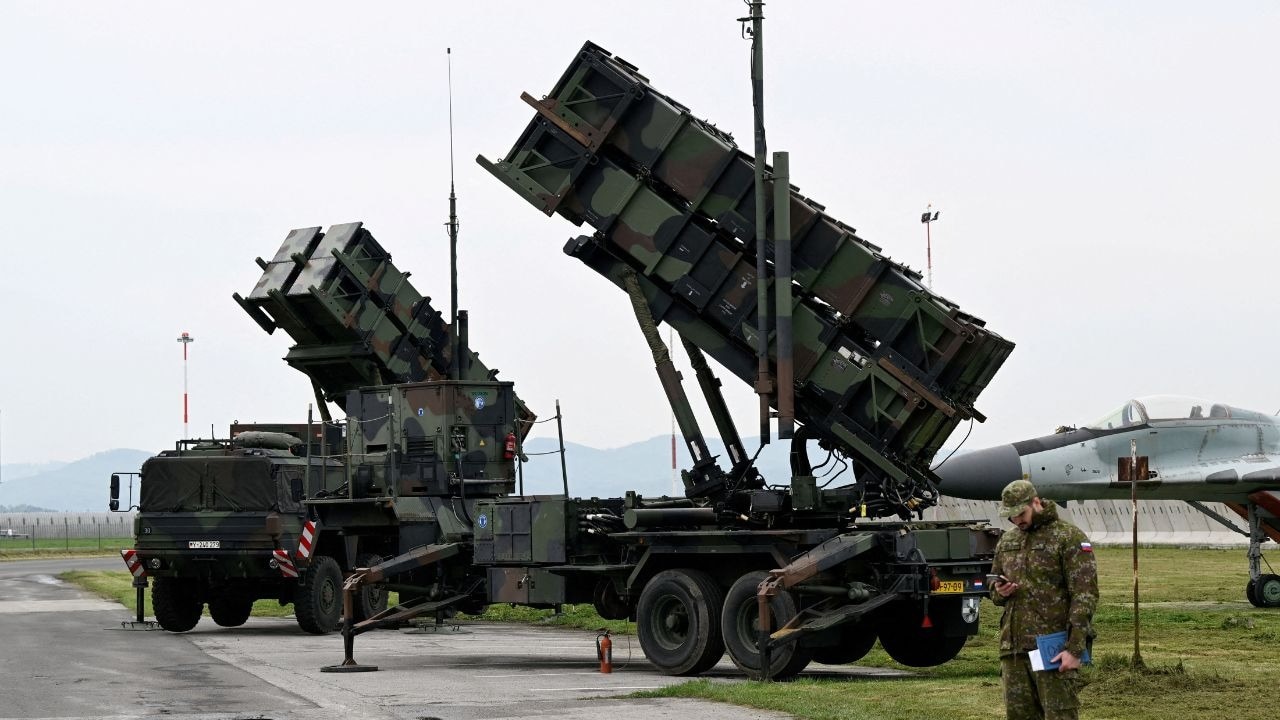
It has been more than six months since the first US strikes hit Iran. Since then, Washington has expended thousands of missiles in its campaign to pressure Tehran, while Iran's ruling regime has refused to bend and continued launching barrages of missiles and drones at US forces and its regional allies. The US, in turn, has fired thousands of interceptors to defend against those attacks.Now, with American war planners facing growing shortages of critical weapons such as Tomahawk missiles and Patriot interceptors, Washington is diverting weapons supplies from other parts of the world to the Middle East. The strain on US stockpiles is raising concerns about whether America could be left less prepared to confront other adversaries, particularly China, which boasts a far more advanced arsenal than Iran and has spent decades preparing for a hot war.The numbers speak for themselves. Reuters reported earlier in August that the US Army had used "virtually all" of its Army Tactical Missile Systems (ATACMS) and Precision Strike Missiles (PrSM), citing three people familiar with the data.The depletion extends beyond these weapons. The Washington Post reported that US forces fired more than 850 Tomahawk cruise missiles in just the first four weeks of the war. It also reported that more than 1,000 Patriot and Terminal High Altitude Area Defence (THAAD) interceptors were fired during the same period. The strain on Patriot stocks has been particularly severe. Reuters, citing an analysis by the Centre for Strategic and International Studies (CSIS), reported that about 65% of the US Patriot interceptor stockpile had been expended between February and July, leaving fewer than 850 interceptors from around 2,330 before the war.Now, with the end of the Iran war nowhere in sight, US military leaders are growing increasingly concerned that diverting resources meant for other theatres like Europe and Asia would leave Washington unable to deal with a worst-case scenario, that being the outbreak of hostilities with either of its two primary adversaries, Russia and China. US Patriot interceptor inventory fell from approximately 2,330 to under 850 after about 65% were expended during the Iran war, far exceeding the current annual production rate of 600. (Data: Reuters, CSIS) WHY IS THE US RUNNING SHORT OF MISSILES, AIR DEFENCE INTERCEPTORS?The main reason the US is currently facing a critical shortage of missiles and interceptors is the inability of its domestic defence industry to produce replacements quickly enough to replenish depleted stocks.Take for instance, the interceptors used by the Patriot air-defense missile batteries that have worked overtime to defend the Gulf against Iranian drone and missile strikes. According to a Reuters report, the US currently produces at least 600 PAC-3 MSE interceptors per year, each of which can cost up to $4 million a piece, and can take as long as two years to produce.According to CSIS, nearly 1,500 of these Patriot interceptors have been expended to stop Iranian drones and missiles which can cost little less than $100,000 a piece.With local commanders firing as many as two or even three interceptors to down one Iranian drone/missile, the expenditure has been prodigious. According to the CSIS, the entire US military has less than 850 interceptors remaining across the world. It is a similar story for the THAAD system, an advanced air defence system that can take down ballistic missiles. The Washington Post reported that supplies of THAAD interceptors are down 38% from their pre-war levels.It is not just air defence interceptors whose numbers are dwindling. Long-range precision missiles, which were used to hammer Iran in the early months of the Iran war, including Tomahawk, the ATACAMS and the PrSM, are also running low, with Reuters reporting that the US has used up much of its global stockpile of highly accurate long-range missiles.Publicly, the US has for months denied reports of missile shortages. Secretary of War Pete Hegseth labelled them as "manufactured stories" back in June."That is a manufactured story that the media wants to peddle and ultimately our stockpiles are great, and they're only getting stronger," CBS had quoted him as saying.At the same time, news agency Associated Press (AP) reported that the US has diverted supplies deployed across Asia and Europe, and The Washington Post reported that deliveries of weapons systems like Patriot interceptors to countries like Japan, Taiwan and Ukraine have been delayed multiple times.In the case of the vital Patriot missile interceptors, Lockheed Martin reached an agreement with the US earlier this year to increase production to 2,000 interceptors a year by 2030. Yet, PBS News reported back in May, that US military contractors would need at least three years to replenish stockpiles of Patriot and THAAD interceptors and Tomahawk missiles, used heavily in the Iran war.HOW US WEAPONS SHORTAGES LEAVE IT VULNERABLE AGAINST CHINA, RUSSIAThe impact of US weapons shortages is already being felt across the world.In Europe, news agency AP, citing Nato and US military officials, reported on August 27 that, because of the declining arsenals and diversion of supplies to the Middle East, US and allied Nato militaries in the continent are experiencing a "beyond critical" shortage of the advanced missile interceptors used in Patriot batteries.In fact, stocks of these interceptors are at such a low level in Europe, a US military official told AP that the continent "definitely" does not have enough Patriots to stop any possible sustained ballistic missile attack and would have "very limited" capability to defend against a single ballistic missile strike or a stray Russian missile that goes off course.As a result of shortages on the European continent, Ukraine, embroiled in a war with Russia for nearly five years, has entirely run out of Patriot interceptors, leaving it unable to defend against Russian missile strikes against major cities like Kyiv.It is a similar story in Asia.The Washington Post reported on August 26, that the massive expenditure of US munitions in the Middle East is increasingly worrying Asian allies and frustrating Pentagon officials overseeing the Indo-Pacific, who fear that the prolonged war with Iran could undermine US readiness for a conflict with China as it continues to step up military pressure across the region.US allies in the region, in particular South Korea, Japan and Taiwan, despite having their own sophisticated defence industries, remain reliant on US supplies of certain weapons, like air defence missiles and cruise missiles. The Washington Post reported that these countries are now having to deal with year-long backlogs of weapons orders thanks to the US-Iran war.One Taiwanese official told the outlet that they expect "significant delays" of Pac-3 Patriot missile deliveries. For context, nearly $30 billion in US arms approved for sale to Taiwan have yet to be delivered, including $882 million worth of Patriot missiles, according to Taiwan Security Monitor.Japan has similarly been warned by the Pentagon of possible delays in defence shipments, including Tomahawk cruise missiles, whose order for 400 missiles could be delayed by as much as two years.South Korea, meanwhile, has been forced to bear witness to US military systems like radars and THAAD batteries deployed to the country being progressively diverted to the Middle East, leaving it vulnerable to a potential North Korean attack.This comes even as Beijing has stepped up military activities in the region, having concluded a massive exercise in December last year, which saw Chinese air and naval forces completely surround Taiwan. Chinese President Xi Jinping has ordered the People's Liberation Army (PLA) to be operationally ready to invade Taiwan by 2027, that being next year.The continued diversion of US military resources from the Indo-Pacific, Europe and Latin American regions has reportedly alarmed US commanders. A Pentagon assessment warned that sustaining current military operations against Iran could weaken the US military’s ability to respond to threats elsewhere and protect the homeland, according to The Washington Post.The warning appeared in the Secretary of Defence Orders Book, which tracks US military resources worldwide. After the document indicated some troops would remain in the Middle East into 2027, the chiefs of the US Pacific, European and Southern Commands issued a "non-concur", opposing the move while agreeing to carry it out, reported The Post.Military resources, including aircraft and ships, have been diverted from operations and training in Europe, Asia and Latin America to support the six-month-old Iran war. As many as 30 ships that were supposed to be in the Pacific had been sent to the Middle East during the war, including the US Navy's only dedicated aircraft carrier in the region.For the US, the picture is clear. Its war with Iran continues to extract the lion's share of vital military equipment that will take years to replace, while leaving the American military critically vulnerable to threats from its two primary adversaries, that are China and Russia.- EndsPublished By: Shounak SanyalPublished On: Sep 1, 2026 13:10 IST
US using 3 missiles on every Iranian rocket. Stocks low, China risk high
Full Article
Original Source
Read the full article at Indiatoday →KhanList aggregates and links to publicly available news content. We do not host full articles from third-party sources. Always verify important information with original sources.