
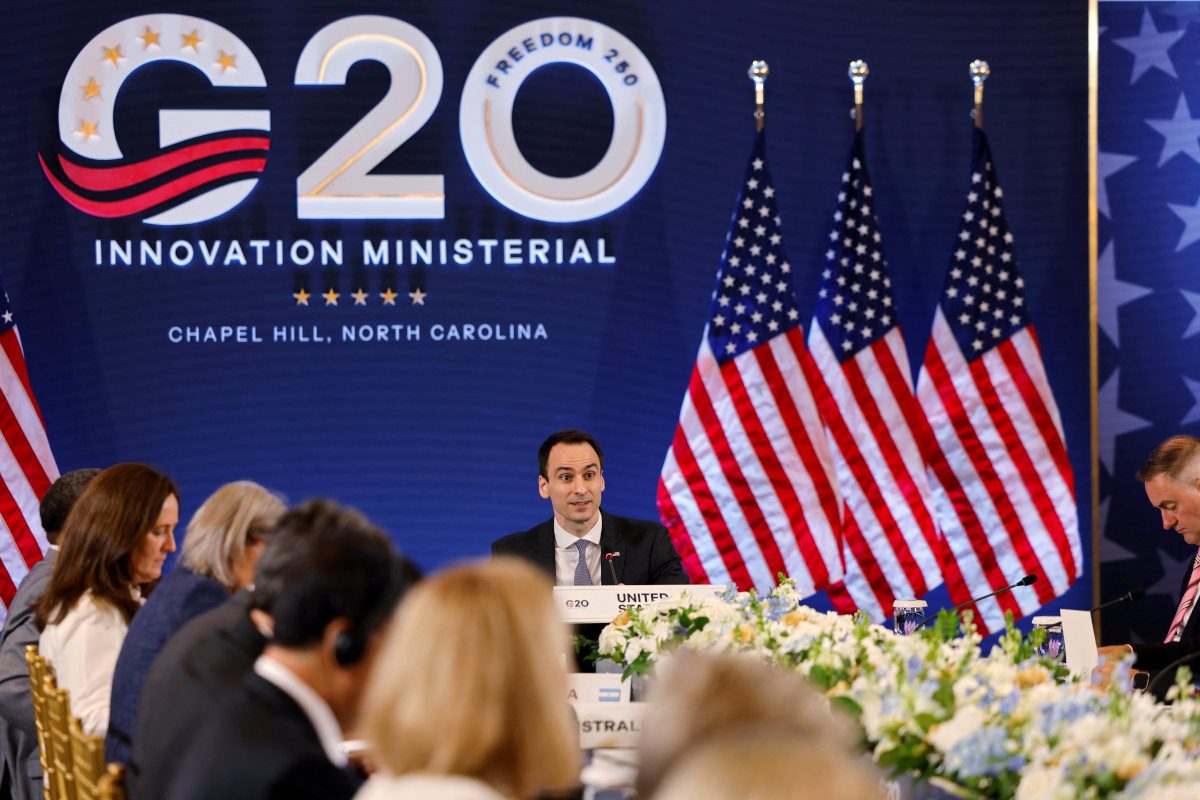
G20 MEETING. White House science and technology advisor Michael Kratsios speaks to delegates at the G20 Innovation Ministerial summit, in Chapel Hill, North Carolina, USA, September 1, 2026. Jonathan Drake/Reuters The US goals largely align with the thinking of the world's biggest AI companies. They want less regulation around the world for their rapidly growing businesses, or to shape the rules as they are written. The US urged G20 members to avoid strict AI regulations, aligning with major American AI companies seeking less oversight. US tech adviser Michael Kratsios promoted the 'Carolina Principles' for AI regulation, which China has signed, focusing on rules for novel situations rather than new regulations. The meeting highlighted concerns over China's advancing AI capabilities and the need for the US to maintain its technological leadership amid growing competition. This is AI-generated. Read the article for full context. Report any errors. NORTH CAROLINA, USA – The US pressed G20 members on Tuesday, September 1, to take a hands-off approach to AI regulation and avoid creating rules for the technology at a gathering of industry titans and commerce ministers in North Carolina. The US goals largely align with the thinking of the world’s biggest AI companies, nearly all of which are American. They want less regulation around the world for their rapidly growing businesses, or to shape the rules as they are written. Federal government requirements could hurt the industry’s profits if they slow the release of new models or prompt the companies to change how their products perform to address security concerns. US tech adviser Michael Kratsios, who is co-hosting the two-day meeting, advocated for countries to adopt the “Carolina Principles.” Countries that signed on agreed to avoid writing entirely new regulations for AI, and instead focus on writing rules for “novel” situations involving the technology, he told the G20 officials in a speech on Tuesday morning. The Chinese government signed the principles, he told reporters on Tuesday afternoon. He did not provide a copy of the document. The Chinese embassy did not immediately respond to a request for comment. “Policymakers do not need to approach each innovation in isolation and should not treat every emerging technology as a first-of-its-kind policy problem,” Kratsios said in his morning speech to the delegates. China’s Technology and Science Minister Yin Hejun represented the Chinese Communist Party at the gathering. Kratsios told reporters he had a “great” bilateral meeting with his Chinese counterpart. Industry leaders Anthropic co-founder Tom Brown is slated to address the group on Wednesday, a company spokesperson said. Google DeepMind’s Demis Hassabis, Meta’s Mark Zuckerberg and SpaceX CEO Elon Musk addressed the gathering by video on Tuesday. Hassabis called on the G20 officials to set up safety tests for AI systems. Zuckerberg said countries should not restrict open-weight AI models. Open-weight AI models are systems with publicly accessible core elements. Zuckerberg has tried in recent weeks to position his company as a leader in open-weight models, and restrictions could dampen his ambitions. Musk criticized the European Union’s tech regulations, saying that the EU’s policy “inhibits progress” for companies. He also urged leaders outside China to develop new energy sources to power data centers. Debates over data centers have become a key political issue in the U.S. ahead of the 2026 midterm elections, with development influencing voter attitudes toward candidates. A United Nations panel recently warned that AI’s developments are outpacing scientific understanding and government policy. Recent events, including a hack triggered by a rogue OpenAI agent that compromised the infrastructure of AI company Hugging Face, added to concerns about how closely leading AI companies are monitoring tests of their products. AI agents are programs that run with minimal human supervision. US faces growing threat from China’s AI prowess The G20 leaders are convening at a key moment in the AI sector’s development and the global debate over how to govern it, and as the US faces an increasing threat from China for AI supremacy. Chinese open-weight AI models are becoming increasingly capable when compared to proprietary systems from American AI giants such as Anthropic and OpenAI. Chinese-made open-weight models are gaining ground with US companies, also posing a potential security risk if the country’s leaders decide to interfere. “It has increased urgency for this administration to make sure that the rest of the world stays within the American tech ecosystem and doesn’t seek alternatives,” said Vivek Chilukuri, a technology and national security fellow at the Center for a New American Security. The meeting is one of a series of gatherings taking place over the next few months in US cities leading up to the G20 leaders’ summit in Miami in December. Reuters previously reported that OpenAI CEO Sam Altman and Nvidia CEO Jensen Huang will separately appear before the delegates with Howard Lutnick, the US commerce secretary, on Wednesday. A handful of protesters gathered outside the G20 meeting. John Montavon, a protester from North Carolina, disagreed with Musk’s advocacy for data centers, adding that their power needs would make the planet warmer. “Mr. Musk has shown he is completely disassociated from the reality that most of us live in,” he said. – Rappler.com How does this make you feel? Loading
US urges hands-off approach to AI regulation at G20 tech meeting
Full Article
Original Source
Read the full article at Rappler →KhanList aggregates and links to publicly available news content. We do not host full articles from third-party sources. Always verify important information with original sources.