
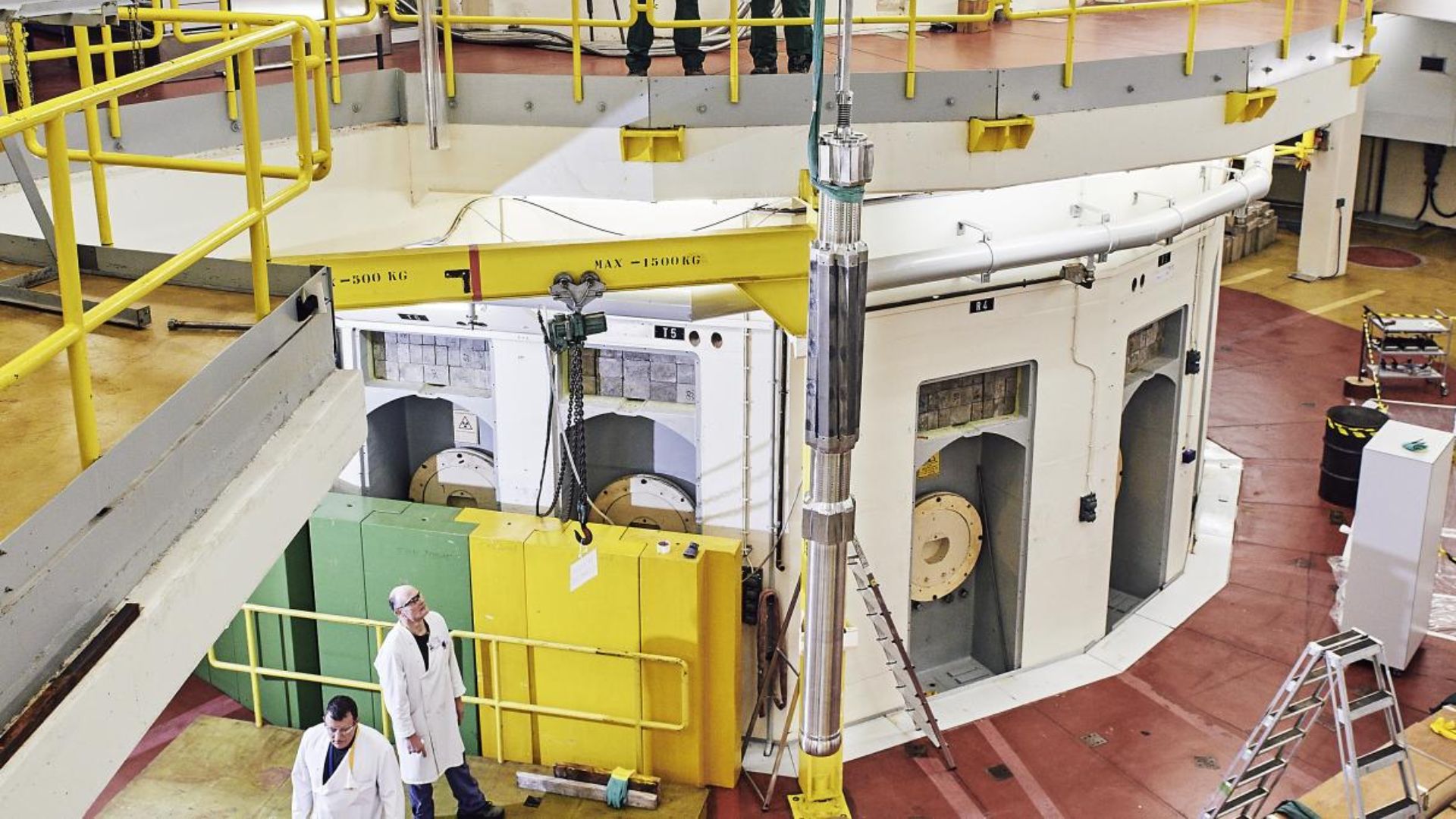
One of Europe’s most critical nuclear research reactors has moved closer to running on low-enriched fuel. SCK CEN, the Belgian nuclear research center, has officially asked national regulators for permission to convert its flagship BR2 reactor. The facility currently relies on highly enriched uranium, a material that poses nonproliferation risks because it can be used in nuclear weapons. Switching to low-enriched uranium (LEU) will remove the threat of weapons-usable material being diverted while keeping the reactor fully operational. “They are working to obtain approval for the fuel conversion proposal in 2027 and to begin converting systems soon afterward,” said Argonne National Laboratory. Unlike commercial power stations with uniform, stationary core layouts, research reactors present unique engineering challenges. The BR2 is especially difficult to convert because its core configuration changes every few weeks. The reactor runs in seven distinct 30-day operating cycles each year. Between cycles, engineers reconfigure the core to accommodate different experiments and production schedules. Overcoming technical hurdles in core design Because the reactor layout is never fixed, scientists could not rely on a standard conversion design. Instead, they had to prove that a low-enriched uranium core could safely handle every possible operating arrangement. Over the past decade, a team from the US Department of Energy’s Argonne National Laboratory worked with Belgian researchers to solve the problem. Using specialized computer codes, the team ran detailed safety analyses to model how the new fuel would behave under extreme conditions. Their data proved that LEU fuel could meet strict international safety standards across all operational setups. “We need a design that reflects how the reactor is actually used,” said Jeremy Licht, who manages Argonne’s Research Reactor Methods group. “Then we have to show it can meet safety requirements across a wide range of uses.” The stakes for the conversion are remarkably high. The BR2 is not just an experimental site; it is a linchpin of global healthcare. The reactor produces about 25 percent of the world’s molybdenum-99. This radioisotope decays into technetium-99m, an essential diagnostic imaging agent used to detect cancer and cardiovascular disease. Hospitals also rely on the facility for therapeutic isotopes, including Lutetium-177 and Terbium-161. Protecting critical supply chains Beyond medicine, the reactor supports modern industry through silicon doping. “Doping is the process of intentionally adding impurities to a material to alter its properties. In silicon, this helps create semiconductors used in technologies such as electric vehicles, wind turbines and other high-power electronics,” explained the press release. A successful conversion ensures these vital supply chains remain steady without requiring weapons-grade material on-site. For decades, Argonne experts have converted reactors across the globe to secure nuclear materials. However, the BR2 is among their most complex assignments so far. The successful submission offers a proven path forward for the wider continent. Europe operates three other high-performance research reactors with similar core complexities. Demonstrating that the BR2 can operate safely on lower-grade fuel proves that modern science does not have to depend on weapons-grade uranium. Get the latest in engineering, tech, space & science - delivered daily to your inbox.An active and versatile journalist and news editor. He has covered regular and breaking news for several leading publications and news media, including The Hindu, Economic Times, Tomorrow Makers, and many more. Aman holds expertise in politics, travel, and tech news, especially in AI, advanced algorithms, and blockchain, with a strong curiosity about all things that fall under science and tech.
US tech drives European nuclear reactor to ditch weapons-grade uranium fuel
Full Article
Original Source
Read the full article at Interestingengineering →KhanList aggregates and links to publicly available news content. We do not host full articles from third-party sources. Always verify important information with original sources.