
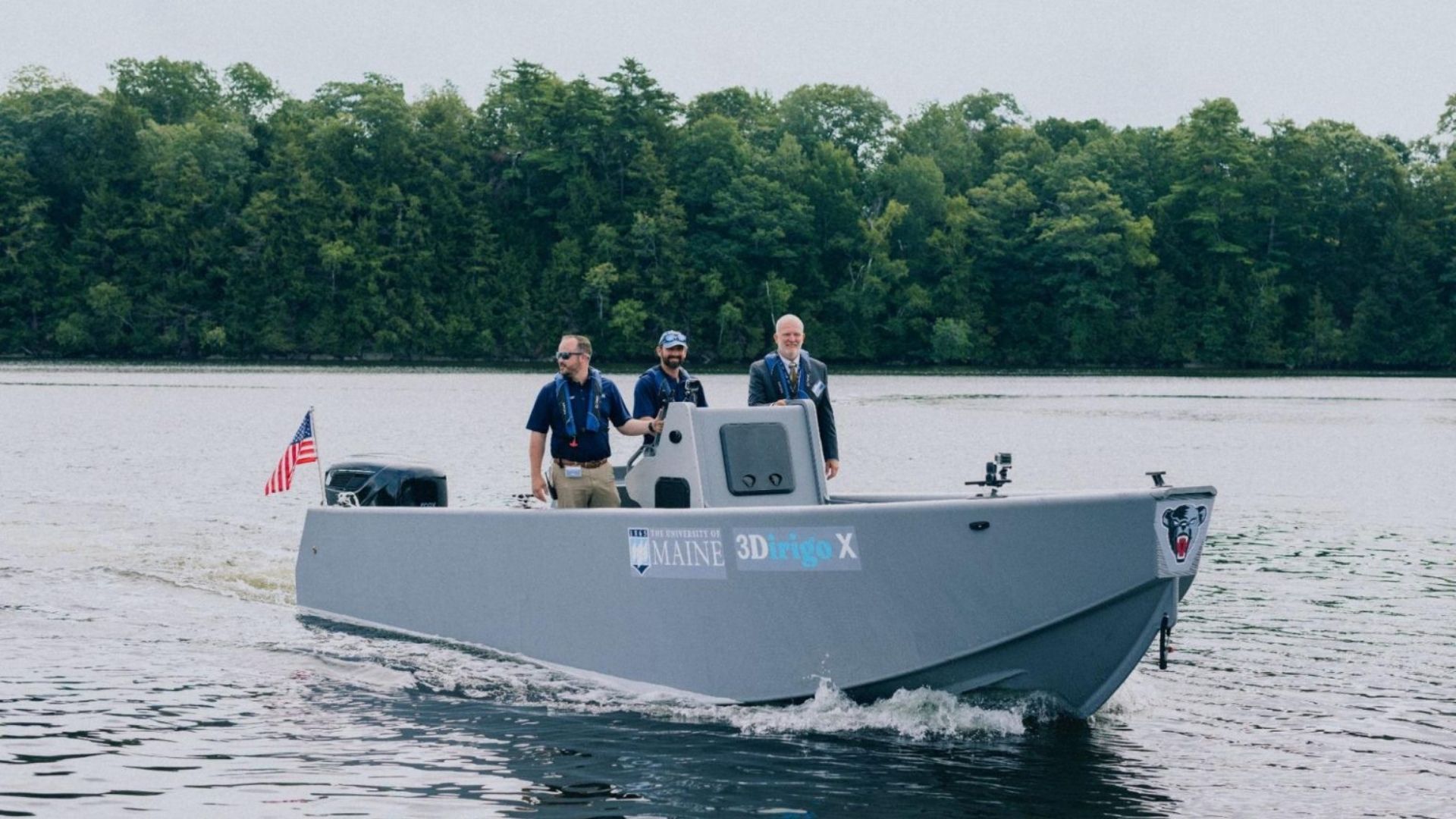
Shipbuilding used to mean months of labor, custom wooden frames, and massive upfront tooling costs. Now, it takes a digital blueprint and a giant nozzle squeezing out molten composite. The University of Maine’s Advanced Structures and Composites Center (ASCC) launched the 3Dirigo X, a 30-foot boat that sliced through the water at speeds approaching 40 knots. Most of all, it proves additive manufacturing has outgrown the tech-demo phase to become an integral part for defense and commercial industry. Print on demand Compared to UMaine’s 2019 Guinness World Record-setting original 3Dirigo, which proved that a massive 3D-printed boat could float, the newly developed 3Dirigo X represents a dramatic leap forward. This updated vessel was designed specifically to withstand the violent dynamic forces, high speeds, and harsh realities of open-ocean transit. Speed matters in production, too. When researchers first began tinkering with large-scale additive manufacturing, printers squeezed out material at a sluggish 20 pounds per hour. Today, the ASCC prints at 500 pounds per hour. “What’s different today, again, is the fact that we can model and design vessels,” said Habib Dagher, executive director of the ASCC. “We have developed technologies to design vessels that can withstand the kinds of extreme environments in the open ocean. Today is a big milestone for our research and development projects. There is more work to do to continue to optimize the manufacturing process and the material properties,” Dagher added. That speed is about to double. With federal backing supported by U.S. Sen. Susan Collins, UMaine is gearing up to open its 55,000-square-foot GEM facility, dubbed the “Factory of the Future.” Once operational, printing rates will hit 1,000 pounds an hour. Accelerates naval prototyping UMaine’s record-breaking MasterPrint system can produce structures up to 100 feet long, 20 feet wide, and 10 feet tall. To build these massive vessels, the system uses a bio-based thermoplastic composite that blends polymers with wood cellulose and forest byproducts. This innovation provides a sustainable, recyclable alternative to fiberglass while directly strengthening Maine’s economy by utilizing its local timber industry. Standard shipyards use expensive, single-use molds. Change the mission requirements, and you must build a new mold. With digital manufacturing, engineers simply tweak the CAD file and hit print, churning out replacement parts, patrol craft, logistics vessels, or uncrewed sensor platforms on demand. According to the team, the launch of 3Dirigo X marks an ongoing research phase rather than a finished product. Using “digital twin” technology, engineers can continuously learn from real-world testing and iterate designs in real time. It would ensure every subsequent build becomes stronger and more refined. “This is not a finish line,” said Keith DeVries, Manufacturing Technology (ManTech) Director at the Office of the Secretary of Defense. DeVries added: “This boat just started a new journey, being run through its paces to evaluate its suitability in the waters of the Atlantic, its ability to stand up over time, over stress. Those things need to be evaluated. We need to understand what this means and feed that back into our models.” The trial will help measure long-term stress, hull integrity, and material wear. Proving its mettle against the Atlantic will show that the next era of naval manufacturing belongs to 3D printing.Get the latest in engineering, tech, space & science - delivered daily to your inbox.Mrigakshi is a science journalist who enjoys writing about space exploration, biology, and technological innovations. Her work has been featured in well-known publications including Nature India, Supercluster, The Weather Channel and Astronomy magazine. If you have pitches in mind, please do not hesitate to email her.
US team demonstrates 30-foot 3D-printed vessel at speeds up to 40 knots
Full Article
Original Source
Read the full article at Interestingengineering →KhanList aggregates and links to publicly available news content. We do not host full articles from third-party sources. Always verify important information with original sources.