
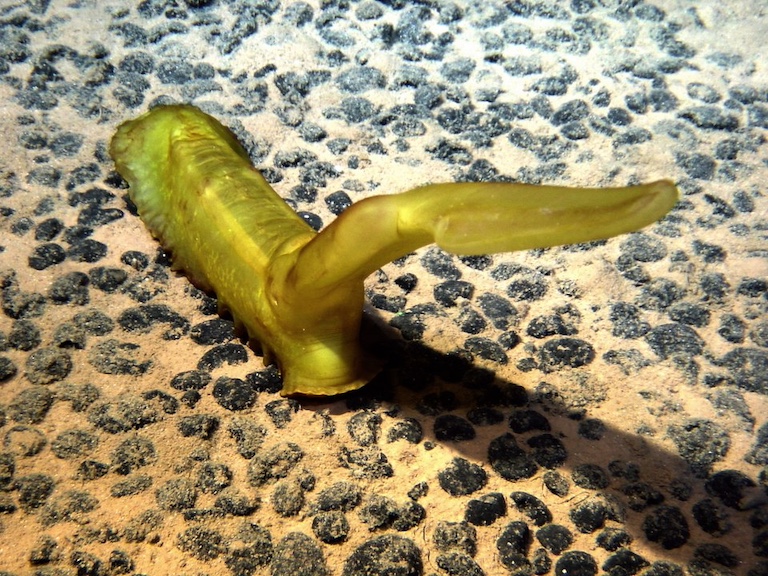
A recent Mongabay investigation by Elizabeth Claire Alberts and Andrés Alegría reveals that the Clarion-Clipperton Zone of the Pacific Ocean, a swath of deep sea regulated by the International Seabed Authority, has received a surge of claim applications filed with the United States for mineral exploration and exploitation.While the ISA, a U.N.-associated body, is responsible for granting seabed mining permits in international waters, the U.S. is challenging that authority by receiving and reviewing applications of some companies. In doing so, it’s citing U.S. laws, and not the United Nations Convention on the Law of the Sea (UNCLOS), under which the ISA was established — and which the U.S. has never ratified.Joining the Mongabay Newscast to explain the investigation into the overlapping claims and the potential legal complications and environmental fallout is senior staff writer Elizabeth Claire Alberts.“The U.S. doesn’t really see that they’re bypassing the authority of the ISA. The United States signed, but it did not ratify UNCLOS,” she says. “So they are not a party to that convention, and they are also not a member of the International Seabed Authority.”The legal implications are currently unknown, as the ISA itself is currently seeking outside legal counsel on what to do about areas it oversees that are now subject to U.S.-claims.“There’s a lot of unknowns about what will happen … a lot of fears. It’s not clear if the U.S. is going to be taken to court over the breaking of international law,” Alberts says.The situation is further complicated by unknowns about the polymetallic nodules that mining companies are after. These nodules, which look like burnt potatoes but contain minerals commonly used in tech products, are still being studied by scientists for their importance to ecosystems, with some saying they’re critical to the seabed environment and should be left where they are.“They have been there for millions of years, and there are species that depend on them,” Alberts says.“Critics are saying that we should just leave them alone, that they are an important part of the ecosystem that we are still struggling to understand. But the mining companies are saying that there are these resources that you just can scoop up and take up to shore, and we can use them for all of our mineral needs.”Mike DiGirolamo is the host & producer for the Mongabay Newscast based in Sydney. Find him on LinkedIn and Bluesky.Banner image: A Psychropotes dyscrita sea cucumber amid polymetallic nodules on the seafloor of the Clarion-Clipperton Zone, located in the northeast Pacific Ocean. Image courtesy of Geomar Bilddatenbank via Wikimedia Commons (CC BY-SA 3.0). TranscriptNotice: Transcripts are machine and human generated and lightly edited for accuracy. They may contain errors.Elizabeth Claire Alberts: I spoke to a few different sources during my reporting that, you know, expressed their concerns that if the US does go forward, even if, you know, not even just talking about overlapping claims, but just claiming parts of the seabed through DISMA, it, it could open up a lot of legal issues. And I guess it kind of begs the question, well, why do we have these multilateral systems, multilateral organizations that are meant to oversee places like the Clarion-Clipperton Zone if players like the US, they’re not going to obey those rules a-and just do, you know, go, go at it alone? So I think a lot of this is hypothetical now. We don’t know what is going to happen, but it definitely makes one wonder what power or what legitimacy the ISA might have going forward. Mike DiGirolamo: Welcome to the Mongabay Newscast. I’m your host, Mike DiGirolamo. Bring you weekly conversations with experts, authors, scientists and activists working on the front lines of conservation, shining a light on some of the most pressing issues facing our planet, and holding people in power to account. This podcast is edited on Gadigal Land. Today on the newscast, we speak with Mongabay senior staff writer Elizabeth Claire Alberts about her recent investigation with Andres Alegria, which looks at a large part of the international seabed in the Pacific Ocean that has been set aside for deep sea mining interests by the International Seabed Authority. This is a UN body responsible for managing mining activities on the seabed. However, this investigation reveals that many companies have already applied to the United States or have already been granted rights to areas of the seabed equal to about half the expanse already designated for mining activities by the ISA. This challenges the ISA’s authority to grant rights and raises unanswered questions of international law. And in today’s discussion, we talk about those legal questions, how and why the United States, which is not part of the International Seabed Authority, is justifying this process, which is in part due to an executive order issued by the current U.S. President Donald Trump, and why this has the international community, lawmakers, scientists, and environmentalists concerned. We also touch on the unknown environmental impacts of deep sea mining itself, which would remove polymetallic nodules, which scientists say are critical to marine ecosystems. Still, much remains unknown about them, and scientists argue the risk of removing them is simply too great. Meanwhile, the U.S. government is justifying its move by citing a need for minerals and national security. As of this recording, commercial deep sea mining has not begun in any part of the world, and the situation is rapidly changing. Elizabeth Claire Alberts, welcome to the Mongabay Newscast. It’s good to have you with us. Elizabeth: Thanks. Thanks for having me, Mike. Mike: So first, can you explain the context– Before we even dive into this investigation, can you explain the context of the International Seabed Authority and what they have control over and what they have the authority to say what companies can and cannot do on the international seabed? Elizabeth: Well, the International Seabed Authority comes out of UNCLOS, the UN Convention of the Law of the Sea, and any country who signed UNCLOS and signed and ratified it automatically becomes a member of the ISA. And any of those member states can then apply to the ISA for rights to the international seabed to explore it, to exploit it even, but no country has yet applied for an exploitation license. So it’s a hundred and seventy-two parties, including a hundred and seventy-one countries in the European Union. They have all ratified UNCLOS. And so they see the ISA is– as the regulator, the one who is in charge of the international seabed and makes the rules. And it’s not just the International Seabed Authority. It’s all of these countries coming together and agreeing to how the seabed should be managed, how activities should proceed. They are still debating over the rules that would allow exploitation. That means, like, the commercial mining stage to go forward. Those rules have not been finalized. And that is one of the reasons that mining companies have cited for going out of the convention and going to the United States, because the ISA has taken many years to come up with these rules. And I also just want to note that commercial mining has not started anywhere, so it is still something that is being discussed. And another thing that is important to note is that the ISA, while they are in charge of seabed mining, they’re also– one of their mandates is to protect the marine environment as well. So they have to make sure that the marine environment is not harmed if activities such as deep-sea mining ends up going forward. Mike: That is all really important to know. And for this investigation, you focused on what’s called the Clarion-Clipperton Zone. But for people who are not familiar with what this is, can you explain what the Clarion-Clipperton Zone is, why it is of so much interest and importance to mining companies? Elizabeth: Yeah. So the Clarion-Clipperton Zone is this patch of sea or seabed in the Pacific Ocean. I often say it’s like roughly between Hawaii and Mexico. And it is known as a mining hotspot because it hosts trillions of these polymetallic nodules on the seafloor. A lot of the seabed seascape are like these abyssal plains or these flat regions of the seabed where these nodules are present. So mining companies have been really focused on this area, and the ISA also oversees, you know, a large portfolio of License areas and reserve areas in the Clarion-Clipperton Zone for future mining. And there, there are a lot of license areas that have already been contracted to government agencies or to companies. And then there are many blocks that are reserved for future mining, and those are reserved for developing countries to make sure that there’s equitable access to the seabed into the future, to make sure it’s not just the Global North, countries from the Global North taking all of the potential riches or minerals from the seabed, and making sure that those minerals are equally distributed and any benefit is distributed equally. Mike: And now we get to the part where the US president has issued an executive order regarding mining. What is this executive order exactly, and how does it bypass the ISA’s authority? Elizabeth: the US doesn’t really see that they’re bypassing the authority of the ISA. The United States signed, but it did not ratify UNCLOS, so you know, the Law of the Sea. So they are not a party to that convention, and they also are not a member of the International Seabed Authority. They have observer status. They attend the meetings, but they cannot partake in any decision-making process. So the United States, when the Law of the Sea was being negotiated, before it came into effect, the United States came up with its own law called the Deep Seabed Hard Mineral Resources Act, and it was passed in 1980. It was supposed to serve as an interim measure, as something that actors in the United States who were interested in mining could use that until this international convention came into play. And there used to be a lot of interest in deep sea mining back in the 1980s. So that’s kind of been sitting there. I mean, the, the US did issue a few licenses, two of which are currently active, held by Lockheed Martin, but they don’t see themselves as needing to play by the ISA’s rules because the United States sees itself as a separate player, having their own law, their own federal law that allows them, US actors, US players, US companies to grab rights to the seabed. And it depends on who you ask. The United States will say, “Yes, they’re following the law, and we have this law in place. It’s been here since 1980.” But a lot of critics are saying that if the US does pursue mining on the international seabed, and the international seabed is outside of the jurisdiction of any one country, the United States technically should not have rights to the international seabed. But other people, other critics might say that the US is breaking international law, and that goes into this kind of gray area of what is legal and what is not. Mike: And we’re actually gonna get into that in just a little bit, but I wanna talk about what your analysis shows, which is that companies have either applied to the US or have already been granted rights to areas of the seabed equal to about half the expanse already designated for mining activities by the ISA. So that’s an astonishing chunk of land. Do we know if that all happened after the executive order? Elizabeth: if we’re talking about the licenses that were already granted, those are the two Lockheed Martin licenses that I referred to before. So those are the existing ones. Every other application that we tracked through this project came after the executive order. So there’s been a flurry of activity since the Trump administration issued that executive order, and things have been moving very fast. And the executive order, by the way, is directed the US government to kind of accelerate this deep sea mining industry. And it’s not just international waters. This investigation looked specifically at international waters, the international seabed, but the US is also moving very fast to try and license off patches of the seabed in federal waters, so in the waters of American Samoa or the waters of the Northern Mariana Islands. That’s outside of the scope of this investigation, but it’s something that is also happening and important to note. Mike: Something that I found really interesting about this story is that NOAA, the National Oceanic Atmospheric Administration in the United States, appears to have the authority to oversee these applications that are made to the US, and I found that very interesting. And we reached out to them, you reached out to them, and I found the responses that you got very peculiar. Can you please explain what NOAA’s response was to your questions? Elizabeth: So NOAA was very much saying that the US does have the authority to move forward and to issue exploration license, exploitation licenses because the authority that they’re drawing on is through DHSMRA. When I say DHSMRA, that’s the Deep Seabed Hard Minerals Act. I’m probably getting that wrong. I just call it DHSMRA. And this law, it is true that this law has been around for many years. I think one of the comments that Kim Doister made was that there have been forty-six years for critics to make their concerns known about this. And another thing that not only NOAA, but also mining companies tend to say is that a lot of critics of the industry say things are moving so fast and it’s accelerating so fast. They’re like, “Actually, no, it’s been moving very slowly over many years. Yes, there are, things are picking up now, but this has been around for decades.” So while, you know, the fact that the law is quite old, and that’s a valid point, I think those who are critical of the industry are looking at this acceleration of the industry with concern. And also another thing that Doister talks about is that the importance of pursuing this industry for the American people. One of the things that the Trump administration wrote in their executive order is that we need to seek out these minerals. We need to get them because we need critical minerals for our national security needs, okay? So we have to go to the deep sea. We have to take out these minerals for that. So NOAA is taking that mandate, and they are arguing that this is an important pursuit so that they can secure the national security needs of the American people. Mike: Yeah, it’s an interesting argument because they’ve given claims to such a giant portion of the land, which doesn’t really leave much for other countries who also have similar interests. What did critics have to say about the inequity of those claims? Elizabeth: Yes, I interview Arlo Hemphill from Greenpeace, and he talks about that, the fact that the US is not necessarily pursuing deep-sea mining with the view of making sure that there’s equitable access to the seabed for all players. They’re basically just going for it to secure minerals for the American people and really just to benefit companies, American companies or American subsidiaries of foreign companies. So there’s a very valid argument against what the US is doing because of that, because they are not pursuing it with equitable access in mind. Mike: Now, you did speak to some legal experts about the quite, I think it’s fair to say, unprecedented legal territory this throws everything into. How is it that a US company can get a claim on a piece of land that the ISA has already granted to someone else? ‘Cause effectively, that’s what this investigation shows, if I have that correct, right? Elizabeth: Yeah. Talking about the overlaps because there are- The overlaps … some, some overlaps- Yeah … but they’re not as substantial as… I think that the main thing the investigation is trying to show is just the size, the, f- footprint of the US claims. And, and it’s very important to say that NOAA has not approved these applications yet, with the exception of Lockheed Martin, so we don’t know exactly what NOAA’s going to do. They might not approve all of them, and this is a very fast-moving space. As we were working on this, the mapping, EcoMinerals, one of the companies that is applying to the US for exploration rights, their application went up on the Federal Register, and we suddenly had some geographic data that we had to incorporate into the map. So more and more companies are coming out of the woodwork, and this map, the map that’s in there, might change, and we plan on updating that as things move. Mike: So hypothetically speaking here, I guess the legal gray area this throws things into is, I believe you spoke to some legal experts who said that this is kind of unprecedented territory. If these legal claims were to go ahead, they would directly conflict with some of the ISA applications that have already been granted. If I have that correct, right? Elizabeth: Yeah. There is overlap between the US applications and the ISA contracts, and that is based on one company. That’s the Metals Company. They have existing exploration licenses through the ISA, and they have applied to the US for very much the similar area. So those are the overlaps that are coming across in that way. But there are overlaps between ISA reserve areas and US applications, and there is also one incident of an overlap between an ISA application. This is not one that has been granted yet. This is Impossible Metals Bahrain, and they are overlapping with one of the US applications. What is going to happen, I don’t know. I, think everyone is, is not sure what is going to happen because these are uncharted waters. The ISA is looking at how to deal with these potential conflicts, and NOAA has not given any kind of indication of what they might do. I did speak to one legal expert who said that DHSMRA would have this conflict avoidance provision, which should potentially prevent NOAA from issuing licenses to US applicants that overlap with ISA claims. But it’s very unclear what is going to happen. It’s changing every minute, and we’re just gonna have to wait and see. Mike: Hello, listeners, and thank you for tuning in. As I always like to mention, Mongabay is a nonprofit news organization. We rely on the funding from listeners like you. So if you’d like to support the podcast, go to patreon.com/mongabay. There, you can become a monthly sponsor of this show. I want to emphasize that even donating as little as a dollar per month makes a very big difference to us. So if you can, think about becoming a monthly donor by going to patreon.com/mongabay. If you want to read the investigation that’s mentioned in today’s discussion, please find a link in the show notes. I probably should have said this quote earlier, but I was referring to what Laurie Osmundson said. She said, “If NOAA goes ahead and starts issuing exploration licenses and then also proceeds to issue exploration permits, that is a direct affront to multilateral ocean governance and basically the entire international law system.” It’s quite a statement, so I just wanted to pick your brain a bit on that. and can you elucidate on what she means by that? Elizabeth: Yeah. I spoke to a few different sources during my reporting that, you know, expressed their concerns that if the US does go forward, even if, you know, not even just talking about overlapping claims, but just claiming parts of the seabed through DISHMA, it, it could open up a lot of legal issues. And I guess it kind of begs the question, well, why do we have these multilateral systems, multilateral organizations that are meant to oversee places like the Clarion-Clipperton Zone if players like the US, they’re not going to obey those rules and, and just do, you know, go at it alone. So I think a lot of this is hypothetical now. We don’t know what is going to happen, but it definitely makes one wonder what power or what legitimacy the ISA might have going forward. These were concerns expressed by people that I spoke to, and yeah, it’s… There’s a lot of unknowns, Mike. There’s a lot of unknowns about what will happen, so a lot of fears. It’s not clear if the US is going to be taken to court over the breaking of international law since they are not a party of UNCLOS. That, that might not– It’s unclear if that will happen, but it is very possible that the US, what is already happening, that the US will face litigation domestically through federal courts, and one lawsuit has already been issued to NOAA, not the metals company, but it’s for NOAA for certifying their application. Mike: One thing that we haven’t talked about yet, which is obviously important to talk about, is the environmental impact this could all have, and I think it’s worth discussing. What do we know right now about the negative potential environmental impacts, and crucially, what don’t we know? Elizabeth: the deep seabed or just the deep sea is a place that we still know very little about. Now, there has been a lot of research into the mining areas, and a lot of the research that is being done in these areas are being done on vessels that are being chartered by these deep sea mining companies, and that research is being supported by deep sea mining companies. So it’s– Even though there has been a lot of research that has been done, there are still a lot of unknowns, not just about the deep sea, about the biodiversity there. It seems like scientists are co-constantly finding new species and trying to figure out what they do, what their ecological roles are. But there’s also a lot of unknowns about the impacts of mining. There have only been a handful of mining tests, so we don’t know the full impact of what is going to happen. There’s a lot of speculation what will happen when commercial mining does go forward, if it goes forward. But you know, what has been published and the research that is out there shows that mining could have a very Substantial impact on species. Even the mining companies will acknowledge that, yes, we are gonna have an impact on species. There might even be extinctions locally. And there’s also a lot of research on the plumes that could be generated. They’re gonna be sending these, these large machines down there to collect nodules. And yes, different companies are, are developing different types of technologies that would do that. Some companies are trying to do things that are– perhaps have less of an impact on the seabed and produce little to no plumes, so they say. But other companies are doing something different. And so there could be plumes that are generated mid-water, at the top of the water, at the very bottom. And mining companies will say that impacts are gonna be very minimal. They’re gonna stay very localized. But critics and, you know, some science is showing that these plumes and these impacts are gonna travel further afield, you know, they’re not just gonna stay localized. As I said before, there are a lot of unknowns. And one thing that, yeah, hasn’t been taken into account with some of these tests that look into mining impacts is just how much mining would take place. If commercial mining went forward, these machines would be operating constantly every day of the week. And it’s also quite unreasonable to believe that something is not going to go wrong. You’re gonna be sending these machines down below and something might malfunction, something might go wrong. So even if these companies might, you know, they, they might have a very solid plan, there’s a lot of unknowns about what will happen if their mining operation does go forward. Mike: I wanted to ask about the polymetallic nodules themselves, and I don’t know how much you know about them per se, but I think it’s worth discussing what scientists know about them and their function in the ecosystem and what they’re still trying to learn. Can you explain that to our audience? Elizabeth: Yeah. polymetallic nodules, they’re these funny little rock formations. In the Clarion-Clipperton Zone, you’ll see pictures of them that look, they look a bit lumpy. When I was in the Cook Islands, I actually got to hold a polymetallic nodule in my hand, and it was more, it was more like a golf ball. It was– So there are different shapes. And actually, I saw one cracked open too, and it looked like a shark tooth in the middle, which is fascinating. So it starts off with something like a shark tooth, and these minerals kind of accumulate around this, this tooth, and it gathers all of these commercially valuable minerals such as manganese and iron and nickel and copper and cobalt. So they have been there for millions of years, and there are species that depend on them. I am not a scientist, so I’m not sure if I can fully speak to their function and why they’re important, but I know that scientists are saying they are important. But I think we’re also trying to figure out fully what their function is. So I’m not sure if I’m, I’m the best person to ask about that. But yeah, critics are saying that we should just leave them alone, that they are an important part of the ecosystem that we are still struggling to understand. But the mining companies are saying that there are these, these resources that you just can scoop up and take up to shore, and we can use them for all of our mineral needs. Mike: I think it’s worth pausing here to examine, like, what do you know about the ISA’s opinion on this? Because it seems like it would be a good idea to move slowly if we don’t really truly know what the ecosystem function of these polymetallic nodules are. Because once you take them out, you can’t just, like, put them back. and you’ve harmed an environment in an unknowable way. So is that part of the reason– I would assume that’s part of the reason why the ISA is moving slowly on deep sea mining. Elizabeth: I’m sure that scientific observers and people who f- closely follow the proceedings of the ISA would, would agree with you that there needs to be more research done. There are a lot of countries who are calling for a moratorium on or precautionary pause. When I say countries, I mean, like, member states of the ISA. But there are different reasons for that. I think a big reason that is put forward for I’m not sure if it’s correct to say that they’re advocating for a slow approach. I think there’s a lot of focus on the rules, and countries are saying we cannot go forward unless these rules are in place. And those rules would talk about how mining activities would go forward, but also talk about how the environment would be protected. And there, there are no rules now. There’s, there’s nothing. There, there’s a draft, but nothing has been finalized. There is no mining code. And that’s– I think that’s a big reason why things have not moved forward. Mike: Is there anything about this story that I haven’t talked about that you really want listeners to understand and know? Elizabeth: Yes. I do really hope that listeners go to the story and they go to see the maps that we did. Our colleague, Andres, did this amazing job with this interactive map, and it’s just, you can zoom in, you can look at the US areas, you can look at the IS areas, you can look at the overlaps. And each square will have information about whether it’s an ISA license, who holds the license, or the US applicant. And we hope that this visually shows just how ambitious the US is in pursuing this industry. And we also know that this is a fast-moving space. As I mentioned before, EcoMinerals had just had their application uploaded to the US Federal Register while we were in the final stages of this investigation, and we had to update that map. And this is not gonna be the last time that we show this map. We’re planning to continue to update it with new information, you know, if there are new applicants or a-as NOAA possibly approves any applications or if areas are refined or changed by the companies. So it’s something that we should definitely keep our eye on, and it’s the deep sea and the Clarion-Clipperton Zone might seem very far away from our everyday lives, but it’s going to affect all of us in various ways if this industry goes forward. And the graph just showing how quickly it’s advancing. And I also just want to draw the attention to the fact that what we present here with the map and with this graph is likely an underestimate of US ambitions. There might be other companies that have applied to NOAA that we don’t know about yet. We note that we actually don’t even include one of the known applications from Deep Sea Minerals Corp that they’ve applied to NOAA to explore nearly a hundred and fifty thousand square kilometers of the Clarion-Clipperton Zone. But we chose not to include them because we didn’t have the geographic data about the areas that they’re applying to. So we don’t know if their area’s overlapping with ISA areas or where they’re going. So it’s very much we’re acknowledging this is probably an underestimate. So hopefully this gives stakeholders some visuals into how quickly things are moving on the US side, and it’s something that we should all keep our eye on. Mike: Well, on that note, Elizabeth, what are you keeping your eye on next, and what do you plan on looking into after the publication of this story? Elizabeth: The deep sea mining industry is, is– things are happening all the time. As we publish this investigation, the US is progressing with its plans to auction off parts of the Am-American Samoan waters, so that is supposed to take place mid-November. There are groups in the US that are trying to block that sale, so it’s unclear if that will go forward. But yeah, there will be a lot to keep track on because it’s not just happening in the international waters, it’s happening, as I said before, it’s happening in federal waters. That’s also a very important part of this story because representatives from these small island states that are under US rule, I guess you could say, they’re, they’re feeling like they’re, they have not been consulted, and they’re seeing this as a, another form of colonialism, a colonial takeover by the US, where they’re saying– Like, for instance, like American Samoa says, “We don’t want deep sea mining. We’re having a moratorium on deep sea mining.” Yet the US is just going forward. They’re ignoring concerns from the government. They’re ignoring concerns from the public. There were many comments to the announcement of the potential lease sale of their waters, yet that is just being ignored. So there’s so much going on, Mike. There’s also, the US has announced that they want to hold lease sales for the waters of Alaska and for the waters of Virginia, and there’s also exploration expeditions that NOAA is going to be overseeing exploration expeditions to the outlying islands of the US past Hawaii. It’s, uh, the-these islands that have been reserves for nature and have been there to– that, have been very protected for years, and they’re even exploring those areas for potential minerals. So it’s happening everywhere, and it’s quite overwhelming in some ways. And at the same time, it hasn’t happened yet. So deep sea mining has not started, and in some ways, it almost feels like it won’t start because there’s just always delays. So who knows what will happen. It’s an interesting space, for sure. Mike: Well, Elizabeth Claire Alberts, it has been a pleasure speaking with you. Thank you for joining me today. I will put a link of the investigation in the show notes. Elizabeth: Thanks, Mike. Mike: As always, if you are enjoying the Mongabay Newscast and you want to help us out, we encourage you to spread the word about the work we’re doing by telling a friend and leaving a review. Word of mouth is among the best ways to help expand our reach. You can also support us by becoming a monthly sponsor at our Patreon page at patreon.com/mongabay. But I also encourage you to read our news and inspiration from nature’s frontline at mongabay.com, or you can follow us on social media. Find Mongabay on LinkedIn at Mongabay News and on Instagram, Threads, BlueSky, Mastodon, and Facebook, where our handle is @mongabay, and on YouTube at MongabayTV. Thank you as always for listening
US stakes competing claims to Pacific seabed mining areas, challenging UN authority
Full Article
Original Source
Read the full article at News →KhanList aggregates and links to publicly available news content. We do not host full articles from third-party sources. Always verify important information with original sources.