
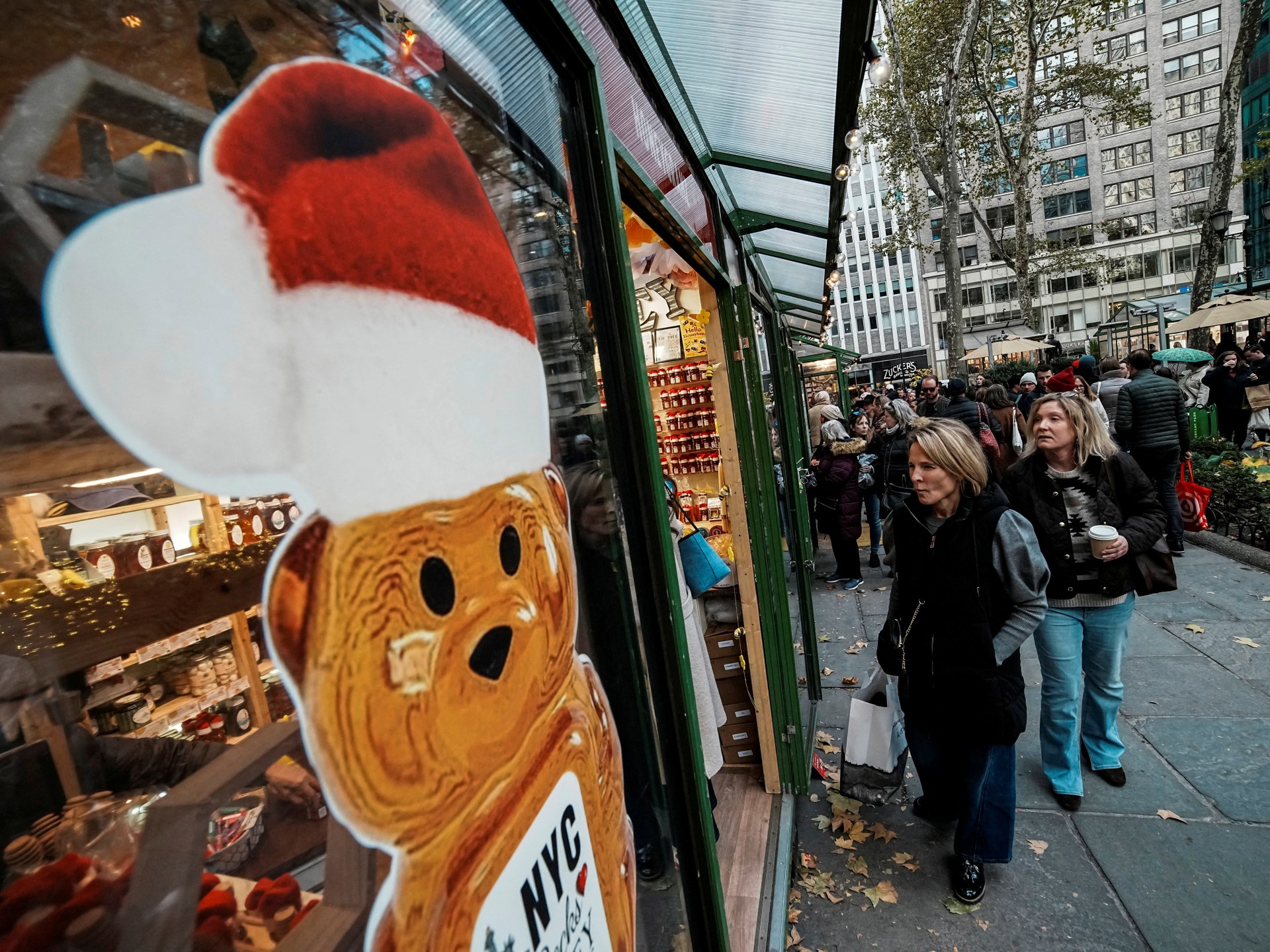
Across the United States, retailers are gearing up for some of their biggest sales of the year on Black Friday and Cyber Monday, enticing bargain hunters with slashed prices and promises of hefty savings.For some shoppers, the Thanksgiving leftovers will barely have made it into the fridge before they bundle up in their coats and head to big-box store car parks, queuing in the predawn darkness in hopes of snapping up a bargain on a pair of jeans, a doll, a toy truck or a new laptop.Recommended Stories list of 4 itemslist 1 of 4The rising cost of Thanksgivinglist 2 of 4Storms push Macy’s Thanksgiving Day Parade in New York City to Saturdaylist 3 of 4Thanksgiving and National Day of Mourning: What is the history?list 4 of 4Thanksgiving dinner costs rise, putting pressure on US householdsend of listThe day after Thanksgiving has become known as Black Friday and is the unofficial start of the holiday shopping season, though many retailers began rolling out their discounts weeks ago.This year, however, the annual shopping frenzy comes against a backdrop of economic uncertainty. Household budgets are increasingly stretched and Americans have to weigh their holiday wish lists against the rising cost of everyday necessities.So, how did Black Friday evolve into a global retail phenomenon, how much are shoppers expected to spend this year and are the bargains really as good as they seem?What is the history of Black Friday?The marriage of Thanksgiving and holiday shopping in the United States stretches back more than a century. In 1924, Macy’s launched its Thanksgiving Day Parade, transforming the streets of Midtown Manhattan into a spectacle of festive fanfare to entice shoppers into its department store. This year is the 100th edition of the parade, which was suspended during World War II. However, inclement weather forced the retailer to postpone this year’s festivities until Saturday, the first time in 55 years.By 1939, the Christmas shopping season had become so economically significant that President Franklin D Roosevelt moved Thanksgiving from November 30 to November 23. That gave retailers an extra week to ring up sales and stimulate consumer spending amid an economic downturn. The change, however, was short-lived. In 1941, Congress established the fourth Thursday of November as the permanent date for the Thanksgiving holiday.But the term Black Friday has considerably darker origins, dating back to the 1860s, when it had nothing to do with shopping or the Thanksgiving holiday. In September 1869, financiers Jay Gould and James Fisk attempted to corner the US gold market. Their scheme unravelled spectacularly, sending gold prices tumbling and plunging Wall Street into financial turmoil.The term resurfaced in the 1950s, this time on the streets of Philadelphia, Pennsylvania. Police officers began using it to describe the gridlocked streets and general chaos brought on by the hordes of shoppers and football fans descending on the City of Brotherly Love following Thanksgiving, ahead of the annual Army-Navy football game.By the 1980s, retailers had found a way to turn the once-unflattering moniker into a marketing tool. In accounting, being “in the black” means turning a profit. Retailers capitalised on that association, recasting Black Friday as a lucrative shopping event and distancing it from its more chaotic origins.While Black Friday is a distinctly US invention, the shopping frenzy has long since transcended US borders, becoming a global phenomenon at shopping centres and digital storefronts around the world.How has Cyber Monday fared against Black Friday?Despite the rise of Cyber Monday – when online retailers slash prices – Black Friday remains the main event. Some 126 million Americans are expected to shop on Friday, compared with 66.1 million on Monday, according to the National Retail Federation (NRF).After years of shoppers swapping crowded malls and long checkout lines for virtual shopping baskets, the pendulum appears to be swinging somewhat back in favour of physical retail. While online shopping remains the most popular option for holiday shoppers, 53 percent say they plan to shop online this season, the lowest proportion since 2015.Americans also expect to complete 52 percent of their holiday shopping online, down from 56 percent last year and a pandemic-era peak of 60 percent in 2020.While the bustle of malls and festive window displays are regaining some of their appeal, the digital marketplace is far from losing its dominance among consumers. Some 55 percent of holiday shopping will be online, compared with 45 percent in physical stores, according to accountancy firm Deloitte.What is the projected holiday spending this year?Brightly wrapped gifts may look much the same this holiday season, but behind the holiday cheer Americans are keeping a closer eye on their wallets. A tighter economy is forcing consumers to be more selective about what goes into their shopping baskets.A survey by research firm Gartner found that nearly 60 percent of Americans have less money to spend on the holidays this year than last. To stretch their budgets, many got a head start on ticking off their gift lists, with 57 percent of consumers doing at least some of their holiday shopping in October or earlier.Americans are not abandoning the tradition of gift-giving altogether, however. Spending on presents is expected to dip by just 2 percent from last year, with millennials making the deepest cuts of any generation, scaling back by 10 percent, according to an analysis by PwC.Some retailers began Black Friday and Cyber Monday sales earlier this month [File:Mike Blake/Reuters]Meanwhile, the National Retail Federation expects overall holiday spending to surpass $1 trillion.How much consumers spend may largely depend on the size of their paycheques. The Conference Board forecasts that consumers earning less than $125,000 a year will rein in their spending on gifts, while those earning more than that plan to spend 3.6 percent more.A sliver of that holiday spending may be fuelled by the growing popularity of buy now, pay later (BNPL) services offered by financial technology companies such as Klarna and Affirm. The proportion of US consumers using those services climbed from 10 percent in 2020 to 16 percent in 2025, according to the Federal Reserve.As shoppers fill their virtual baskets, a growing share of those purchases will be paid for in instalments. Nearly $2bn in online purchases will be financed through buy now, pay later services on Black Friday and Cyber Monday alone, Adobe Analytics forecasts.Do Black Friday and Cyber Monday really spell bargains?Not always. A recent investigation by the economic think tank Groundwork Collaborative found that, over the past two years, nearly 10 percent of the products Amazon advertised as “deals” during its Black Friday and Cyber Monday sales actually carried higher price tags than in the month before those promotions began.Amazon kicked off this year’s Black Friday sales on November 19, dangling discounts of up to 40 percent on some toys, including Lego sets, 35 percent on select electronics and 50 percent on Levi’s clothing.An analysis of Walmart’s early Black Friday sales this month by Walsight, a Walmart market intelligence platform, found that 23 percent of products advertised at a discount offered little or no meaningful savings compared with their typical selling prices.But that does not mean bargain hunters will come away empty-handed. Adobe Analytics forecasts that seasonal discounts at major online retailers could reach 30 percent.For parents on the hunt for toys, discounts are expected to peak at 29 percent on Black Friday, while shoppers eyeing the latest gadgets may be better off waiting until Cyber Monday, when discounts on electronics are forecast to reach 30 percent.
US shoppers get ready for Black Friday and Cyber Monday
Full Article
Original Source
Read the full article at Aljazeera →KhanList aggregates and links to publicly available news content. We do not host full articles from third-party sources. Always verify important information with original sources.