
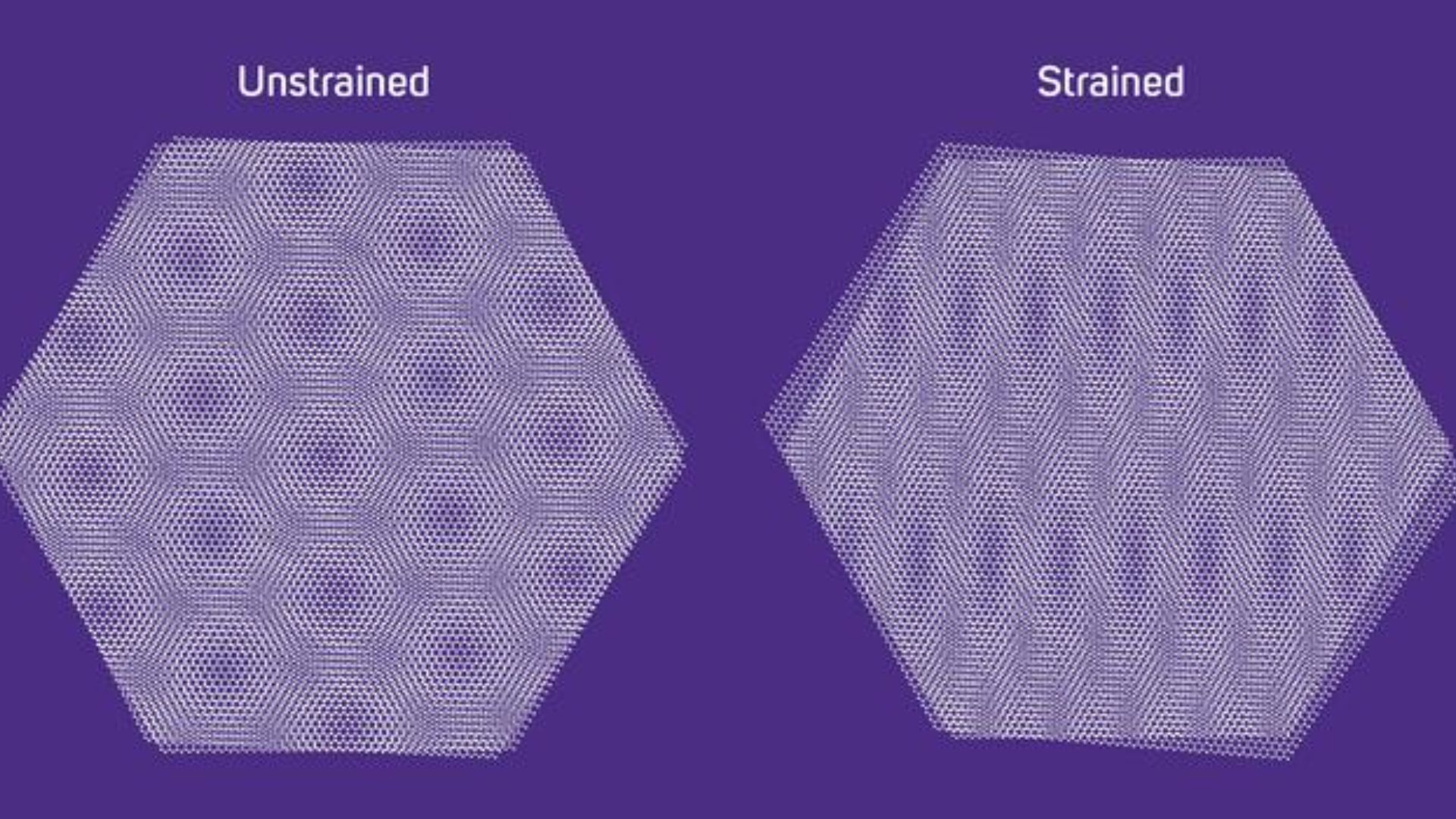
Key TakeawaysThe moire pattern is made using tiny robotic manipulators to lay sheets of single-atom-thin carbon sheets upon each other.By adjusting temperature, voltage, and magnetic fields, moiré patterns can dynamically cycle between metallic, insulating, and superconducting states.UW researchers added strain as a controlling factor, solving a common material science challenge. Scientists at the University of Washington (UW) have developed a new approach to switch the properties of a magic material, the moiré pattern. Made out of graphene, the moiré pattern can switch states from being a superconductor to an insulator. Interestingly, UW researchers also found that adjusting the strain on the material changed its resistance by a factor of 100. The moiré pattern is made using tiny robotic manipulators to lay single-atom-thin carbon sheets on top of each other. As the top sheet rotates, the identical atomic lattices twist together to form a complex moiré pattern that expands and contracts with the changing angle. In 2018, researchers at MIT showed that when the top layer is rotated to an angle of 1.1 degrees and cooled to temperatures near absolute zero, the material becomes superconducting. In this state, the material allows electrons to flow freely and can be used to develop superconducting materials for computing, energy, and quantum sensing applications. From superconductors to insulators Further research in this area has allowed scientists to move to elements away from carbon and create atomically thin moiré patterns. These patterns can be tweaked with external factors like temperature, voltage, and magnetic fields to switch them from superconductors to insulators, bringing the flow of electrons to an almost complete stop. “By turning these knobs, we can cycle through different states of matter in very predictable and repeatable ways,” said Matthew Yankowitz, associate professor of physics and materials science at UW. “You can go from a metal, to an insulator, then back to a metal, then to an insulator, then to a superconductor. This allows us to use one device to stand in for a whole family of materials, so we can see how superconductivity relates to the states around it in a single sample.” Working with Jiun-Haw Chu, also a professor of physics at UW, the team added strain as another new factor that could help these materials make this switch. Solving a common lab problem Building a moiré pattern, though commonly done in materials science laboratories, is not straightforward. Working with atomically thin sheets of material and then placing them on top of each other often leads to one or both of them distorting and warping. In real-world scenarios, moiré patterns are not as picturesque as in the image but much messier. The UW researchers wondered if they could change this by controlling the stretch of the material they were working with. The team applied the material to a device that expands and contracts with changes in applied voltage and found that they could control the strain on the lattices. By adjusting the strain, the team succeeded in changing the material’s resistance more than 100 times when compared to ordinary metal. This change could be further improved by treating the sample at ultra-low temperatures. “What is remarkable about this giant response to strain is that it also appears in other exotic materials, including high-temperature superconductors, one of the great unsolved problems in physics,” said Chu in a press release. “This common link brings us a step closer to understanding what underlies these fascinating and complex phenomena.” The team is now working to simplify the experiment so other researchers can replicate these results with other materials. The research findings were published in the journal Science. Get the latest in engineering, tech, space & science - delivered daily to your inbox.Ameya is a science writer based in Hyderabad, India. A Molecular Biologist at heart, he traded the micropipette to write about science during the pandemic and does not want to go back. He likes to write about genetics, microbes, technology, and public policy.
US scientists crack code to turn ‘magic material’ from superconductor to insulator
Full Article
Original Source
Read the full article at Interestingengineering →KhanList aggregates and links to publicly available news content. We do not host full articles from third-party sources. Always verify important information with original sources.