
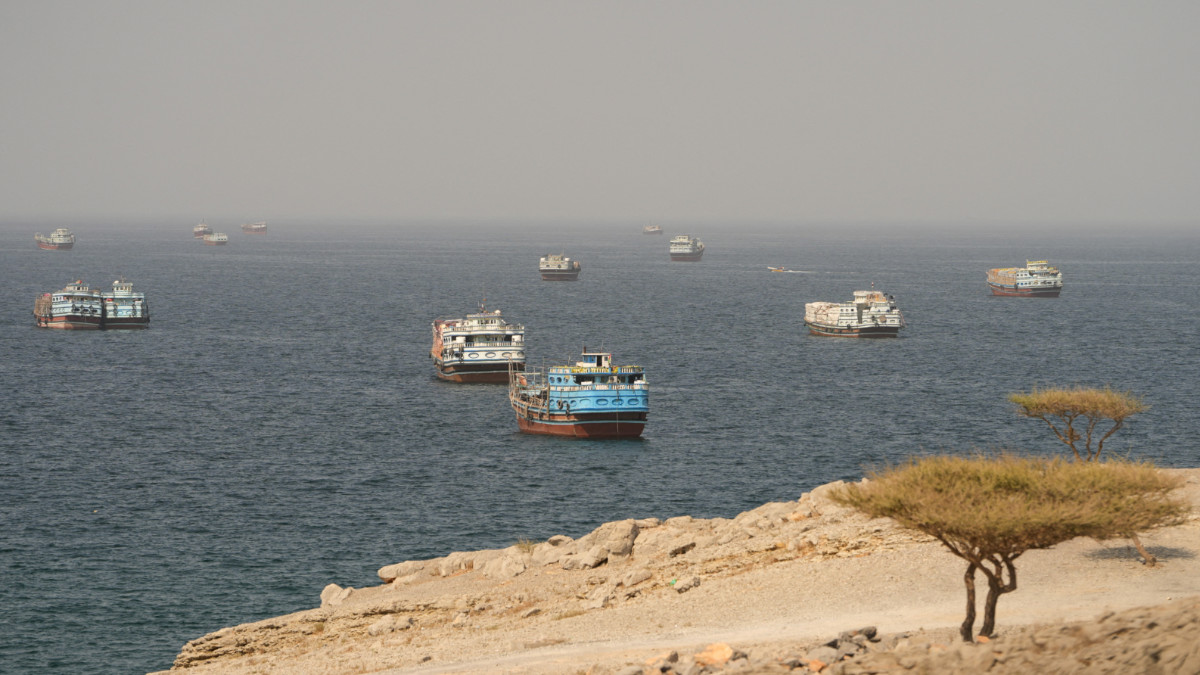
Secretary of State Marco Rubio says the US is happy to continue the status quo, with the economic pressure 'working so well' Vessels are seen at the Strait of Hormuz from Musandam, Oman, on 19 October 2026 (Stringer/Reuters) Published date: 10 November 2026 20:25 GMT | Last update: 4 sec ago The US is downplaying the chances of a fresh attack against Iran even as it characterises Tehran’s conditions for a political settlement as “absurd”. US President Donald Trump said on Monday after meeting Qatar’s prime minister at the White House that the war was “effectively over” and that there was “momentum” to end the conflict. Trump has used deescalatory language since the Republican Party was badly defeated in US midterm elections on 3 November by the Democrats, who campaigned against the war and rising energy prices. But Trump’s characterisation of ongoing talks was directly disputed by Mohsen Rezaei, a former Islamic Revolutionary Guard Corps (IRGC) commander who is secretary of Iran’s Supreme National Security Council. “We are not currently conducting any negotiations with the Americans, and there are no negotiations between us and Washington at present," he said, speaking in a television interview. New MEE newsletter: Jerusalem Dispatch Sign up to get the latest insights and analysis on Israel-Palestine, alongside Turkey Unpacked and other MEE newsletters Rezaei said Iran was standing by its seven-point proposal from the summer, which would allow for the reopening of the Strait of Hormuz. The IRGC said on Tuesday that two oil tankers had caught on fire after they hit mines in the Strait of Hormuz. "We have communicated our conditions to the American side, but their initial response was insufficient and deceptive, and we are still awaiting an explicit and clear response," Rezeai said. But US Secretary of State Marco Rubio on Tuesday appeared to give a straightforward answer to Iran’s terms, calling them “absurd” and “not serious”. “Iran is demanding reparations. They should be the ones paying reparations because they’re the ones that have destabilised the region for long periods of time. They’re demanding pallets of cash, which the president’s made clear is not going to happen,” Rubio said, speaking to reporters at a meeting of G7 foreign ministers in Paris. 'Iranian oil not getting out' The US and Iran are at loggerheads over the Islamic Republic’s nuclear programme and control over the Strait of Hormuz. But financial considerations were a key factor in the negotiations that led to a June memorandum of understanding to establish a framework for a final settlement. That deal eventually fell apart over Iran’s bid to control traffic through the Strait of Hormuz, which would allow it to potentially impose a fee. Rubio said that while the Trump administration is not looking to restart major combat operations, it is in no hurry to strike a deal because it believes it has the upper hand in the Strait of Hormuz. The US and Iran have imposed competing blockades in the waterway. While Iran has successfully attacked commercial ships linked to the US’s Gulf allies, the US is providing military escorts for vessels to exit the waterway, a costly and time-consuming operation. Rubio acknowledged that Iran has been striking vessels, but characterised those strikes as a nuisance as opposed to a battlefield success that would force the US to concede to Iran’s seven terms. “On some nights it’s 80, 85 percent of what was getting out pre-conflict,” he said, regarding oil and petroleum product flows through the strait. “The reason why it’s not 100 percent is because the Iranian oil is not getting out. The only oil that’s not getting out consistently, through the Straits of Hormuz, is Iranian oil,” he said. GCC to establish joint forward-command centre in Kuwait Read More » Oil prices plunged after the Democrats took back Congress, expecting Trump would be constrained from launching a fresh attack. Brent, the international benchmark, was down almost 15 percent the past week. Brent was at $91.37 per barrel on Tuesday. US gas prices, which consumers feel, have been down only four percent in the last week. Meanwhile, the US’s Gulf partners say they are bracing for an uncertain environment in which the status quo of sporadic strikes without a settlement to the war persists. This could deter their investment plans. Saudi Arabia is also facing intense missile and drone attacks from Yemen’s Houthis. Rubio dismissed that Gulf states were facing an economic crunch, despite GDP numbers showing this. He said Iran was suffering the most and that the US’s approach to the conflict was to wage an economic war on Tehran. “The economic pressure on Iran is so devastating and is working so well that the president’s concluded that, for the time being, there’s no need for major combat operations because we’re achieving the same objective through economic means,” he said. Middle East Eye delivers independent and unrivalled coverage and analysis of the Middle East, North Africa and beyond. To learn more about republishing this content and the associated fees, please fill out this form. More about MEE can be found here.
US says no need for new attacks but calls Iran's peace terms 'absurd'
Full Article
Original Source
Read the full article at Middleeasteye →KhanList aggregates and links to publicly available news content. We do not host full articles from third-party sources. Always verify important information with original sources.