
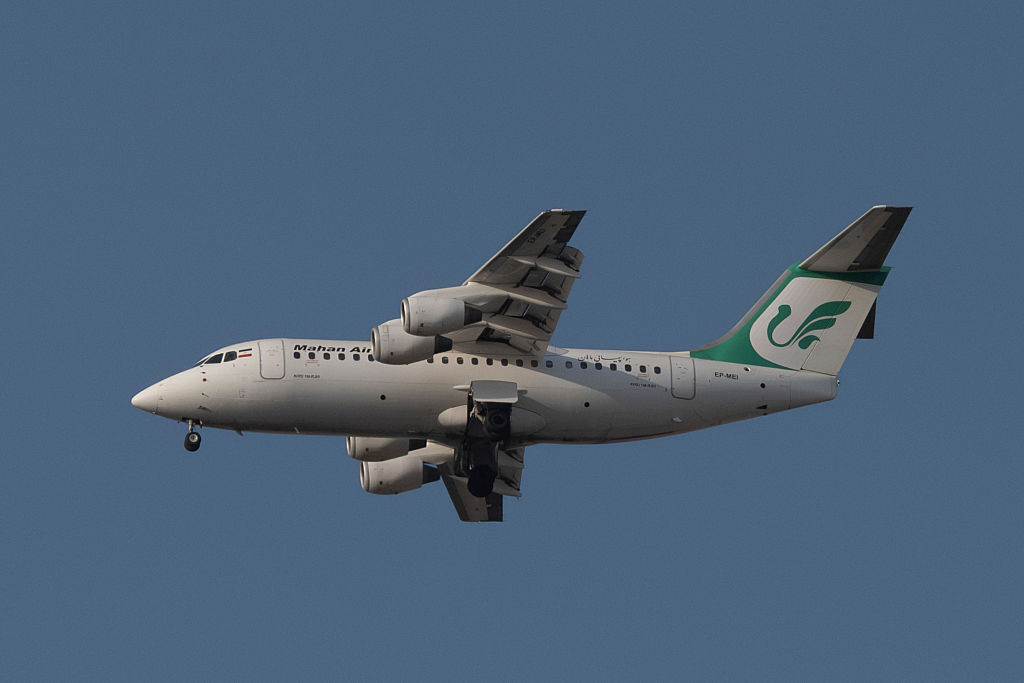
Washington first tightened the chokehold on Tehran at sea and is now extending it to the skies. On September 8, the U.S. Department of the Treasury sanctioned all 27 remaining active Iranian airlines along with third-country firms servicing Mahan Air. It also suspended General License J-1, which let foreign airlines fly U.S.-made aircraft, or aircraft with significant U.S. content, into Iran without case-by-case approval. Treasury suspended rules allowing U.S.-registered aircraft to pay Iran overflight and emergency-landing fees, with a wind-down that ends September 23. Refueling, emergency repairs, and aviation-safety transactions now require case-by-case licensing. Likewise, Treasury’s Financial Crimes Enforcement Network (FinCEN) urged banks to report aviation-linked procurement. Washington is pairing its maritime blockade of Iranian ports with measures that make foreign banks and businesses increasingly reluctant to deal with an aviation sector that Tehran exploits for military purposes. The designations push aviation service providers to derisk under threat of secondary sanctions, while the license suspensions immediately restrict foreign carriers from using U.S.-content aircraft on regional routes into Iran. Regime Exploits Civilian Airlines To Transport Personnel and Weapons Since 2006, Iran Air has moved military equipment for the Islamic Revolutionary Guard Corps (IRGC) disguised as what Treasury describes as “medicine and generic spare parts.” Yas Air transported IRGC-Quds Force personnel and weapons to Syria under humanitarian cover before being renamed Pouya Air in 2012, its third rebrand after earlier operating as Pars Air, a unit of UN-sanctioned Pars Aviation Services. Mahan Air secretly ferried Quds Force officers and commanders, despite UN travel bans, while also concealing weapons shipments for Hezbollah. Qeshm Fars Air, a commercial cargo carrier controlled by Mahan Air, resumed operations in 2017 and ran cargo flights to Damascus carrying weapons, with Mahan Air staff in its management. Pouya Air had transported Iranian drones to Russia for the IRGC Aerospace Force, including shipments intended for Russia’s Alabuga drone-production complex. Iran Uses Its Aviation Sector To Feed Its Drone and Missile Supply Chains Iran Aviation Industries Organization, a Defense Ministry subsidiary, oversees manufacturers of the Shahed drone family, while separate Iranian firms have procured parts for the IRGC’s drone program. A Turkish procurement agent, sanctioned in 2023, sought European-origin engines suitable for both drones and missiles for Iranian firms and sold drone accessories to companies that likely transshipped them to Iran. In 2024 and 2025, businesses in Hong Kong purchased U.S.-origin engines and parts for suppliers to Iran’s drone and missile programs, then shifted purchases through new companies after earlier fronts were sanctioned. In 2025, an Iranian trading company used intermediaries in the United Arab Emirates and a Chinese motor manufacturer to supply Iran’s drone makers, while prosecutors charged the company and its executives with scheming to procure U.S. technology for Iranian drones. In July 2026, an Iranian aircraft-services company involved in drone production was working with intermediaries in Nigeria, Italy, and Russia to procure weapons for the IRGC. By September 2026, Mahan Air’s overseas cargo network used a Turkish logistics provider to ship drone components. Washington Should Move From Sanctioning Airlines To Isolating Their Operations Washington should press partners to bar sanctioned Iranian carriers from landing or crossing their airspace. America should also seek forfeiture of U.S.-built aircraft that reached Iranian carriers in violation of export controls when they land in cooperative jurisdictions, as with the former Mahan Air 747 grounded in Argentina and forfeited to the United States in 2024. Similarly, Washington can target ground handlers, maintenance firms, ticketing agents, fuel suppliers and banks processing airport payments, while also formally designating Iranian airports and aviation authorities to put their foreign service providers on notice. Moreover, Washington can push foreign airlines to end codeshare agreements, which allow two carriers to sell seats on the same flight under their own flight numbers, to keep Iranian airlines from preserving international access through foreign partners. Finally, the Department of Commerce can expand its existing temporary denial orders, which bar airlines and facilitators from transactions involving U.S.-origin aircraft and parts, while the U.S. and its allies can require no-reexport-to-Iran clauses and tighter end-user checks to prevent aviation and dual-use components from reaching Iran through third countries. Janatan Sayeh is a research analyst at the Foundation for Defense of Democracies (FDD), where he focuses on Iranian domestic affairs and the Islamic Republic’s regional malign influence. For more analysis from the author and FDD, please subscribe HERE. Follow FDD on X @FDD and @FDD_Iran. Follow Janatan on X @JanatanSayeh. FDD is a Washington, DC-based, nonpartisan research institute focusing on national security and foreign policy.
U.S. Sanctions on Iranian Aviation Should Be Followed by Operational Isolation
Full Article
Original Source
Read the full article at Fdd →KhanList aggregates and links to publicly available news content. We do not host full articles from third-party sources. Always verify important information with original sources.