
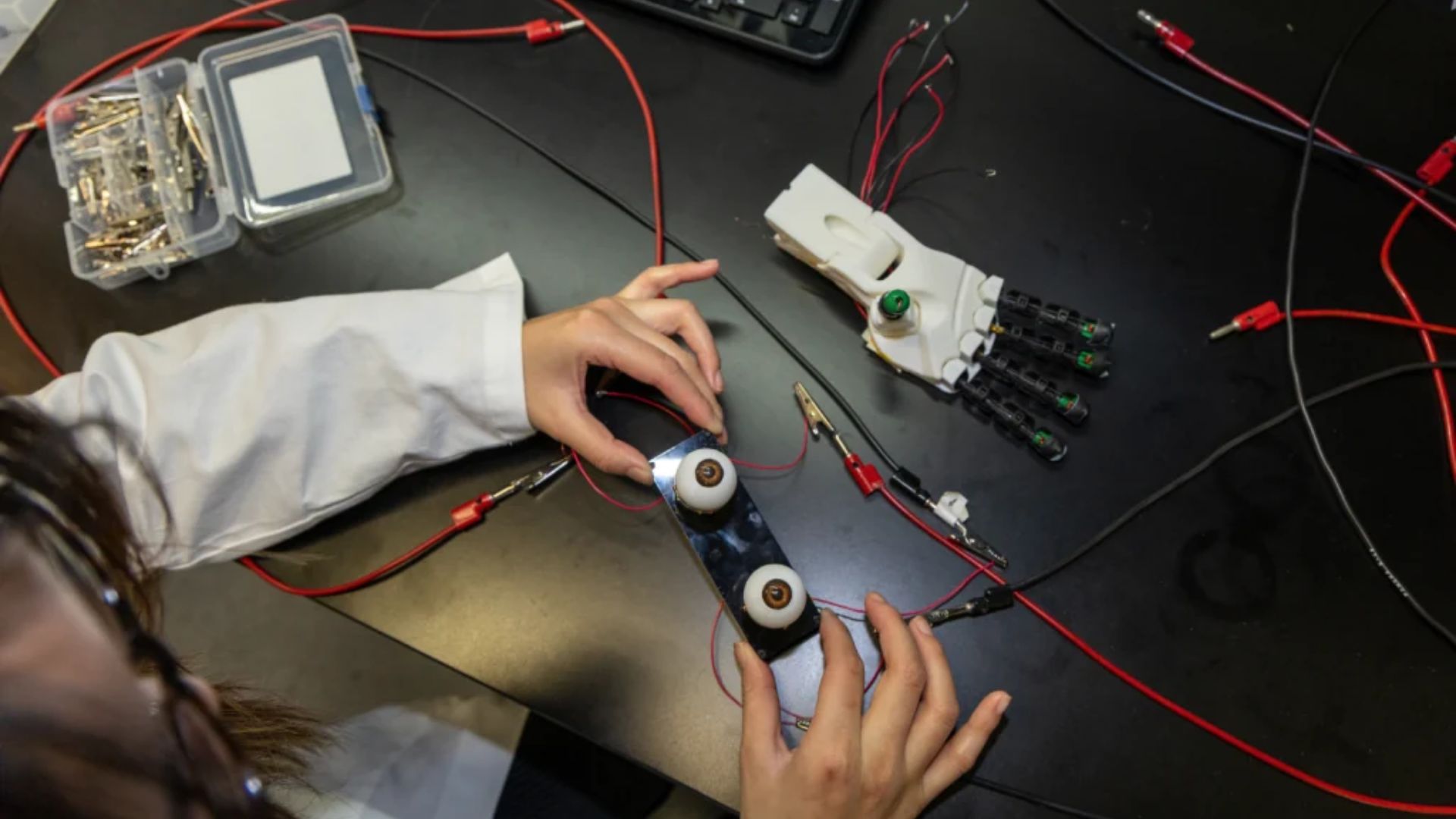
Researchers at the University of Pennsylvania have developed artificial muscles that give soft robots more precise control over their movements. Inspired by small muscles in human hands and eyes, the technology can produce controlled movements, hold intermediate positions, and coordinate with other artificial muscles. The muscles combine liquid crystal elastomers, graphene, and an embedded copper coil to convert electrical signals into muscle-like motion. Demonstrations include a robotic finger pressing individual piano keys and artificial eyes shifting their gaze through controlled movements, highlighting the technology’s potential for fine motor skills in soft robotics. Robots gain muscle Artificial muscles let soft robots perform precise movements by combining flexible materials with built-in sensing and feedback control. The technology, called CoilLCE, draws inspiration from the small muscles responsible for delicate movements in human fingers and eyes. It combines liquid crystal elastomers (LCEs), graphene, and an ultrathin embedded copper coil to create artificial muscle fibers that convert electrical signals into controlled mechanical motion. The team developed the artificial muscles to address a limitation in conventional soft robotic actuators. While traditional robotic motors can provide precise movement, they often require bulky components and complex mechanical arrangements that make it difficult to replicate the flexibility and compactness of biological muscles. The researchers drew inspiration from the small muscles in human fingers and eyes to design the systems. LCEs offer a potential alternative because they change shape when heated. However, controlling their movement presents a challenge. As the material heats up, it contracts, while cooling causes it to return toward its original shape. This makes it difficult to maintain a specific intermediate position without continuous monitoring and adjustment. “This is the first time that feedback control has been demonstrated on an LCE actuator and it is a necessary step for these sorts of artificial muscles to be able to be used in future robotic applications,” said Cynthia Sung, Associate Professor in Mechanical Engineering and Applied Mechanics (MEAM) at Penn Engineering, in a statement. Precision muscle control To improve their performance, the researchers combined LCEs with graphene. The graphene makes the resulting material softer and tougher, allowing it to stretch while withstanding the mechanical forces generated when artificial muscles work against one another. The researchers then embedded an ultrathin copper coil inside the LCE-graphene fibers. The coil performs two functions: it generates heat to activate the artificial muscle and acts as a sensor by measuring changes in electrical resistance as the material moves. These resistance measurements provide feedback about the muscle’s state, allowing the control system to adjust heating power in real time. By keeping the electrical resistance near a predetermined target, the system can regulate contraction and maintain intermediate positions for extended periods. This closed-loop approach eliminates the need for a separate position sensor, reducing the number of components required to control the artificial muscles. The researchers also demonstrated feedback control with an LCE actuator, addressing an important challenge in making these materials suitable for practical robotic applications. The team demonstrated the technology using an artificial hand and a pair of robotic eyes. In the hand, artificial fingers pressed individual piano keys, paused, and moved to subsequent notes. The robotic eyes used four pairs of opposing actuators to reproduce controlled gaze movements. The arrangement mimics biological muscles, where opposing muscle groups work together to move. When one artificial muscle contracts, its counterpart stretches, allowing the system to control movement without actively driving every muscle at once. This configuration can also reduce the number of control inputs needed. The researchers see potential applications in humanoid robots, particularly artificial faces that require numerous small actuators working together to reproduce natural expressions. However, integrating larger numbers of artificial muscles into coordinated systems remains a challenge. The team plans to explore AI and computer vision to manage more complex movements and interactions.Get the latest in engineering, tech, space & science - delivered daily to your inbox.Jijo is an automotive and business journalist based in India. Armed with a BA in History (Honors) from St. Stephen's College, Delhi University, and a PG diploma in Journalism from the Indian Institute of Mass Communication, Delhi, he has worked for news agencies, national newspapers, and automotive magazines. In his spare time, he likes to go off-roading, engage in political discourse, travel, and teach languages.
US: Robots play piano and mimic movements of human eyes with artificial muscles
Full Article
Original Source
Read the full article at Interestingengineering →KhanList aggregates and links to publicly available news content. We do not host full articles from third-party sources. Always verify important information with original sources.