
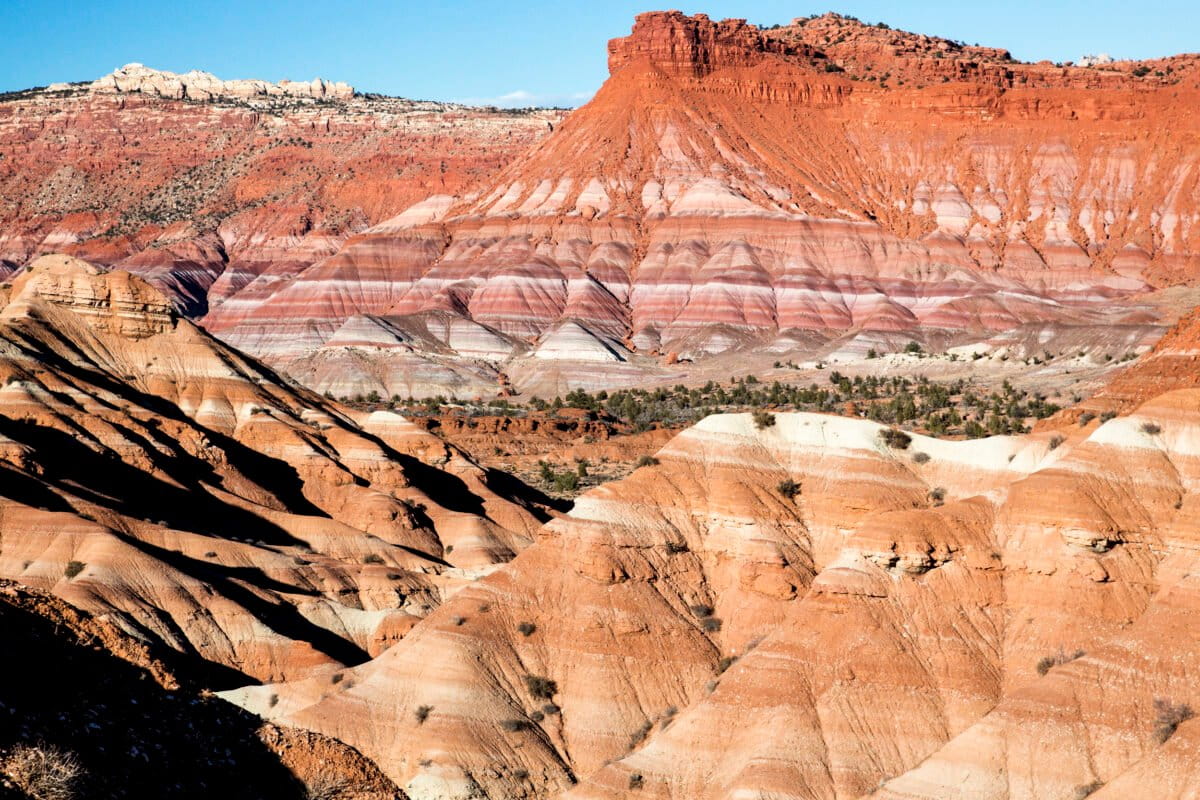
In his second term as the U.S. president, Donald Trump has taken actions to remove protections from at least 34.8 million hectares (86 million acres) of public lands, according to the advocacy group Center for American Progress. The nonprofit Conservation Lands Foundation (CLF) recently catalogued 12 such policy actions in its newly released Public Lands Attack Tracker. The tracker examines the myriad ways public lands have been reduced and weakened, from encouraging extractive industries to sidelining public participation, over the last nearly two years. These actions by the Trump administration include expanding oil and gas drilling “to encourage energy exploration and production on Federal lands and waters” and repealing the public lands rule, which requires that conservation be considered equally important as extractive industries. The administration has also moved to rescind the roadless rule that currently bans road construction across millions of acres of national forest land and weakened provisions of the Endangered Species Act, which grants protection to species in decline. On its Public Lands Attack Tracker website, the CLF argues that the combined effects of such actions could be greater than the sum of their individual impacts. “This Attack Tracker connects the dots,” the website notes. It lays out eight impacts of the “attacks on public land” including stripping “protections to allow destructive uses” and eliminating “tribal engagement” which “results in lasting damage.” One of the most high-profile reductions in public land protection can be found in Utah’s Bears Ears and Grand Staircase-Escalante national monuments. In July 2026, Trump issued two proclamations shrinking the size of each of the monuments by roughly 90%. The move paves the way for the monument areas to “be put to a higher-priority use” noting that the region “contains several resources … which include critical minerals such as silver, copper, molybdenum, lead, uranium, vanadium, and zinc.” The two national monuments are home to several Native American tribes including, the Navajo Nation for which Davina Smith-Idjesa is a representative. She is also co-chair for the Bears Ears Inter-Tribal Coalition. “It’s still mind-boggling that we went from 1.36 million acres [550,000 hectares] to now just a little over 121,000 acres [49,000 hectares],” Smith-Idjesa told Mongabay in a video call. That cut was just for Bears Ears. Trump cut Grand Staircase-Escalante from more than 728,000 hectares (1.8 million acres) to 73,450 hectares (181,500 acres.) Smith-Idjesa said that the proclamations, which are being challenged in court, could potentially cut native peoples off from the “living cultural landscape,” including water, land, plants and animals that are crucial for their physical and spiritual sustenance. “Much of what we call public lands today, particularly across the West is a part of the ancestral homelands of Indigenous Peoples,” she said. Adding that changes to public and tribal lands can have profound impacts on Indigenous communities. “That’s why tribal nations need to be part of these conversations and not simply consulted after decisions have already been made.” Banner image: Grand Staircase-Escalante National Monument. Image courtesy of the city of Panguitch, UT, U.S. Credits Topics
US public lands tracker highlights the collective impact of Trump policies
Full Article
Original Source
Read the full article at News →KhanList aggregates and links to publicly available news content. We do not host full articles from third-party sources. Always verify important information with original sources.