
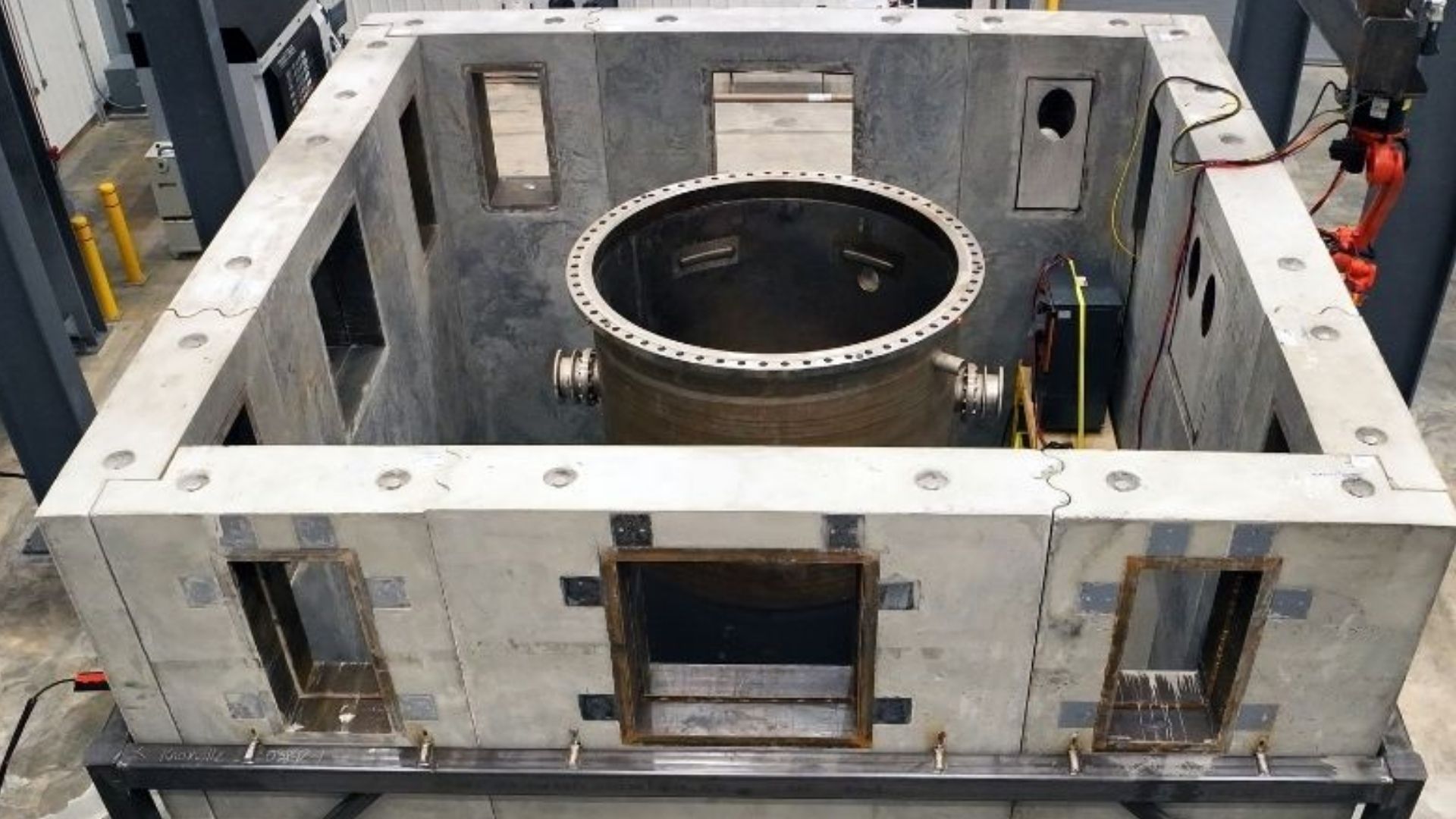
Kairos Power has completed the first phase of testing on a non-nuclear mockup of the reactor cavity planned for its Hermes 2 demonstration plant in Tennessee, testing modular radiation shielding and remote maintenance systems that could eventually be standardized across its commercial reactors. The test was carried out at Engineering Test Unit 3 (ETU 3) in Oak Ridge, Tennessee, as part of Kairos Power’s iterative development program for its fluoride salt-cooled high-temperature reactor (KP-FHR). Rather than operating a nuclear reactor, ETU 3 provides a non-hazardous environment where the company can test how the equipment and structures around the reactor will be built, operated, and maintained. Testing the reactor cavity before the reactor For the first phase, Kairos constructed a reduced-scale mockup of the Hermes 2 reactor cavity. It consists of a reactor vessel surrounded by a precast concrete shielding structure supported by steel frames. The company installed 12 modular wall elements using four different designs, including stepped and sinusoidal joint geometries intended to prevent radiation from leaking through the seams between panels. The modular approach is important because a reactor cavity cannot simply be treated as a solid concrete box. Pipes and other process lines need to pass between the reactor and other parts of the plant, creating openings through the shielding that must still provide adequate protection. Kairos used the ETU 3 mockup to test different shielding plug designs for these openings. The company also tested systems for connecting and disconnecting the process lines remotely, reducing the need for workers to enter areas where radiation could be present during future reactor operations. 3D-printed forms help build the shielding The concrete shielding panels themselves incorporate another manufacturing experiment. Kairos worked with Oak Ridge National Laboratory’s Manufacturing Demonstration Facility to develop and produce 3D-printed polymer-composite forms used to manufacture the precast panels. The panels were then fabricated by Tindall Corporation in South Carolina before being installed at ETU 3 by Barnard Construction. The approach is part of Kairos’ broader effort to develop construction and manufacturing methods that can be repeated across future reactor projects. Instead of waiting until a complete nuclear plant is being built to discover construction problems, the company is using successive engineering test units to identify and address them earlier. Kairos co-founder and Chief Technology Officer Ed Blandford said the latest demonstration will help the company develop a sustainable maintenance approach for its future reactor fleet. The tests of shielding interfaces and remote handling tools are intended to help establish design features that can eventually be standardized across commercial KP-FHR plants. Building reactors by learning from prototypes ETU 3 is the third major engineering test unit in Kairos’ development program. The first, ETU 1.0, was a full-scale electrically heated prototype of the Hermes reactor. It completed more than 2,000 hours of pumped molten-salt operations. It allowed Kairos to test major reactor systems, develop its supply chain, and establish the production of high-purity fluoride-lithium-beryllium, or FLiBe, salt coolant. ETU 2.0 followed as a non-power unit focused on modular construction methods. ETU 3 then moved the program towards civil construction, reactor maintenance, and remote handling, while also providing a future training platform for operators. The approach is intended to reduce uncertainty before Kairos deploys its commercial-scale technology. That next step is already underway. Kairos broke ground on the Hermes 2 Demonstration Plant in Oak Ridge in April 2026. The plant is planned as the company’s first commercial-scale KP-FHR deployment and will build on lessons from the Hermes low-power demonstration reactor, which is also under construction at the site. Hermes 2 is designed to generate electricity for the Tennessee Valley Authority grid. The ETU 3 demonstration will now feed into further iterations of the Hermes 2 reactor cavity design. In addition to testing the hardware, the facility is expected to serve as a training environment for future operators, giving Kairos another opportunity to work out how the reactor will be maintained before those procedures have to be performed on an operating nuclear plant. Get the latest in engineering, tech, space & science - delivered daily to your inbox.Kaif Shaikh is a journalist and writer passionate about turning complex information into clear, impactful stories. His writing covers technology, sustainability, geopolitics, and occasionally fiction. A graduate in Journalism and Mass Communication, his work has appeared in the Times of India and beyond. After a near-fatal experience, Kaif began seeing both stories and silences differently. Outside work, he juggles far too many projects and passions, but always makes time to read, reflect, and hold onto the thread of wonder.
US nuclear reactor prototype completes 2,000 hours of testing before full build
Full Article
Original Source
Read the full article at Interestingengineering →KhanList aggregates and links to publicly available news content. We do not host full articles from third-party sources. Always verify important information with original sources.