
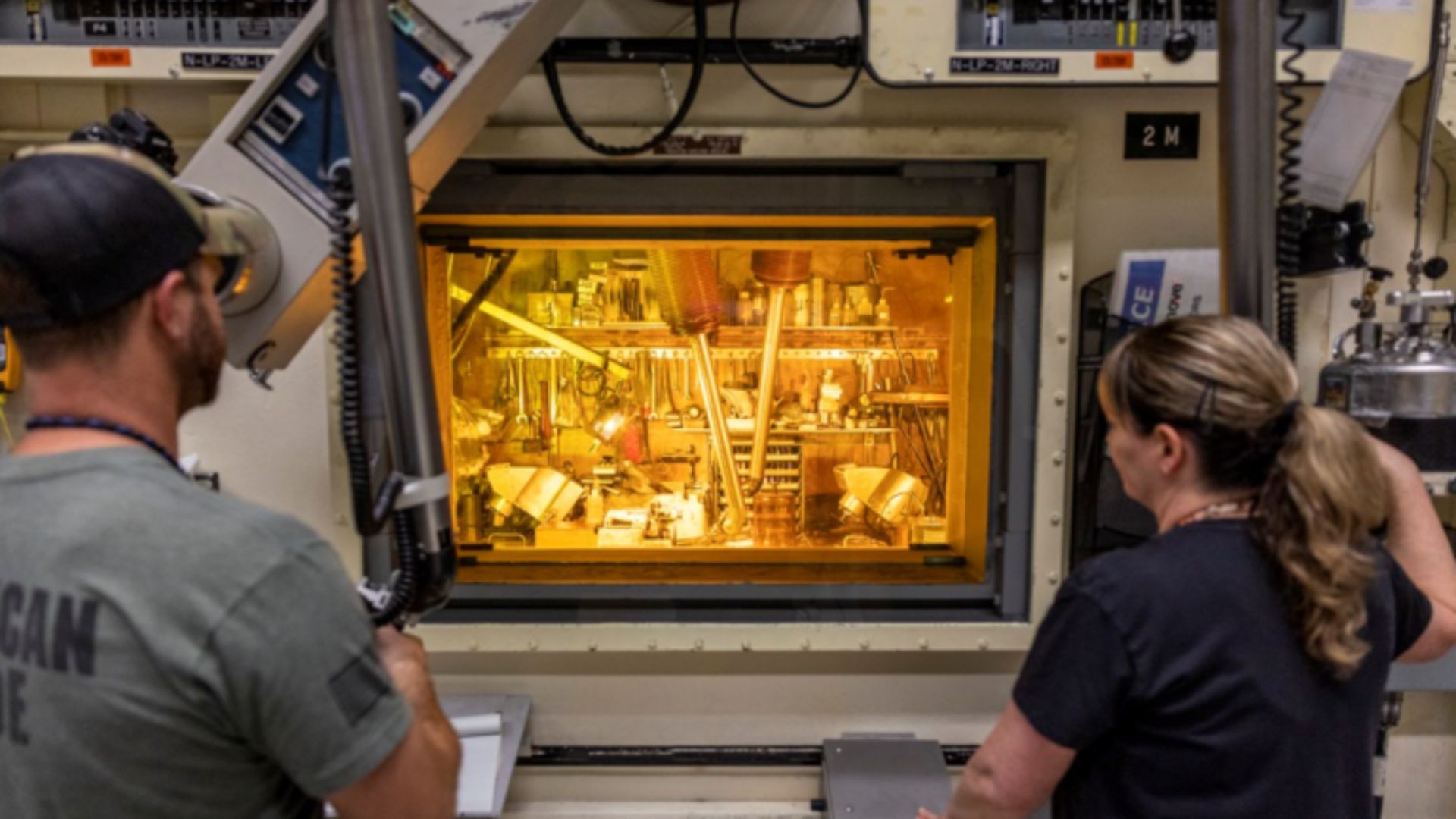
The Hot Fuel Examination Facility (HFEF), located at Idaho National Laboratory’s (INL) Materials and Fuels Complex (MFC), has been designated as the American Nuclear Society’s 10th Nuclear Historic Landmark. Established in 1975, HFEF remains a premier post-irradiation examination facility, advancing next-generation reactors, commercial fuels, and national energy security. This massive research hub proves that solving the future clean energy crisis often requires building on the foundations of the past. “HFEF proved to be an extremely versatile facility capable of examining the effects of irradiation on large components as well as reducing samples for microscopic evaluation,” stated Leon Walters, retired director of engineering at Argonne National Laboratory. “As the capability of HFEF expanded, the expertise of the supporting staff grew in parallel.” Main hot cell Initially instrumental in studying radiation-induced void swelling and creep for reactors like EBR-II and the Fast Flux Test Facility, HFEF shaped reactor safety, reliability, and longevity. Over five decades, HFEF evolved to research molten salt processing, commercial light water reactor fuels, particle fuel, and research reactor fuels. “HFEF’s flexibility and continued adaptation to changing needs over 50 years is remarkable,” said Doug Crawford, MFC reactors chief technologist. The facility houses the largest argon-filled hot cell in the United States. It measures 30 feet wide, 70 feet long, and 25 feet high. Inside it, the air is completely replaced with inert argon gas, surrounded by four-foot-thick concrete walls and heavy leaded glass windows. This impenetrable vault gives a safe peek inside the radioactive heart of heavily irradiated fuels without ever coming into contact with deadly radiation. Through 15 specialized workstations, technicians manipulate mechanical arms to slice, measure, and analyze fuel rods with pinpoint precision. Directly beneath this massive structure lies another tech: the Neutron Radiography Reactor (NRAD). On Feb. 18, 2026, the NRAD marked its 5,000th run by testing a cutting-edge digital neutron imaging system. Operating since 1977, the 250-kilowatt TRIGA (Training, Research, Isotopes, General Atomics) reactor shoots neutrons straight through solid metal and irradiated samples to capture high-resolution imagery of internal fuel structures. Cleaning out the past to fuel the future To meet surging demand, expanding nuclear facility space at HFEF has become a top priority. But cleaning up these environments remains a painstaking, unpredictable process. To make room for modern experiments, engineers spent the summer of 2024 carrying out a cleanup project. Working behind the cell’s famous 9M window, teams removed more than 10,000 pounds of legacy equipment, untangling mountains of radioactive cables and jack plates. The cleared 9M window space is now set to support new sodium test loop work at the Transient Reactor Test Facility (TREAT), similar to 970s and 1980s experiments that tested advanced fuel behavior under accident conditions. Recognizing its five decades of foundational research, the Hot Fuel Examination Facility will be dedicated later this year as the American Nuclear Society’s 10th Nuclear Historic Landmark at Idaho National Laboratory. It joins operational sites like TREAT and the Advanced Test Reactor.From evaluating TRISO particle fuels to conducting zero-power criticality tests on modern micro-reactors, this powerhouse remains the engine of next-generation nuclear research.Get the latest in engineering, tech, space & science - delivered daily to your inbox.Mrigakshi is a science journalist who enjoys writing about space exploration, biology, and technological innovations. Her work has been featured in well-known publications including Nature India, Supercluster, The Weather Channel and Astronomy magazine. If you have pitches in mind, please do not hesitate to email her.
US nuclear reactor hot cell clears 10,000 pounds of legacy gear for advanced testing
Full Article
Original Source
Read the full article at Interestingengineering →KhanList aggregates and links to publicly available news content. We do not host full articles from third-party sources. Always verify important information with original sources.