
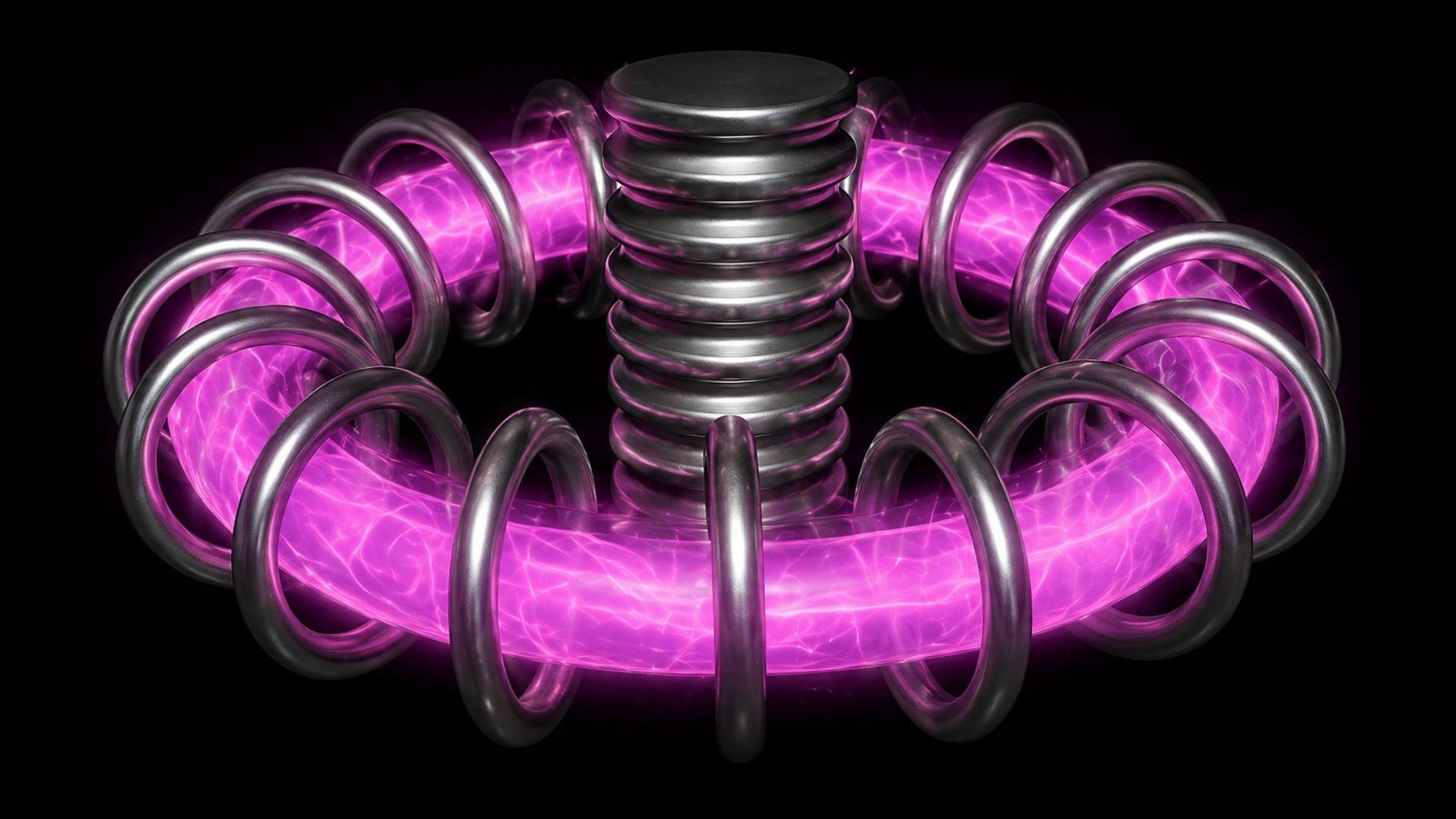
A new portable vacuum vessel has arrived at American Fusion’s assembly site, clearing the way for a fresh round of plasma experiments. The hardware will support the testing programme for the company’s Texatron Fusion Engine, which explores an alternative path to nuclear fusion. The Texatron platform is being developed as a family of modular systems with planned configurations ranging from approximately 1 megawatt (MW) to 500 MW, according to the company. The team is testing the extreme physics needed for deuterium–helium-3 (D–³He) reactions. Unlike mainstream fusion projects such as tokamaks, the Texatron does not rely on giant superconducting magnets to hold a thin gas in place for long periods. Instead, it uses short, intense bursts of electromagnetic energy to compress a dense column of plasma in microsecond pulses. Recent trials showed that the device could repeatedly squeeze plasma to internal pressures of 100,000 atmospheres. In magnetic terms, holding that much pressure at a plasma beta of one equals a field strength of roughly 160 Tesla. The Texatron produces this powerful field dynamically during the pulse itself, avoiding the need for massive static coils. Modeling two different chamber sizes To understand how the hardware might scale up, engineers modeled two different chamber sizes under identical test conditions. Both setups were calculated using a target temperature of 700 million Kelvin (60 keV), a pressure of 100,000 atmospheres, and a confinement time of one microsecond. The smaller prototype uses an 11-inch chamber with a 25.4-millimetre plasma column, designed for a 500-kilowatt unit. This setup holds an active plasma volume of 445 cubic centimetres and roughly 1.88 × 10²⁰ fuel ions. Under these conditions, the model projects about 1.3 × 10¹⁵ fusion reactions per pulse. That equates to 3.9 kilojoules of gross thermal energy, or an instantaneous burst of 3.9 gigawatts during the single microsecond. The larger design expands the chamber to 23 inches with a 50.8-millimetre plasma column, planned for a 5-megawatt device. The larger dimensions increase the plasma volume more than eightfold to 3,720 cubic centimetres, accommodating 1.57 × 10²¹ fuel ions. Because fusion output scales directly with volume under equal conditions, the calculated yield jumps to 1.1 × 10¹⁶ reactions per pulse. This larger reaction releases an estimated 32.6 kilojoules of gross energy, generating a peak power rate of 32.6 gigawatts during the pulse window. To test plasma behavior across temperature range American Fusion points out that these numbers are theoretical models of gross energy, not evidence of net electricity production. True net power requires meeting the Lawson criterion. The plasma’s combined density, temperature, and confinement time must reach a tipping point where self-heating overcomes major losses, such as bremsstrahlung radiation. “Fusion is ultimately determined by the complete plasma condition — not by any single measurement — and that is exactly why our testing program is progressing methodically from one milestone to the next,” said Dr. John E. Brandenburg, Chief Technology Officer of American Fusion, who led the team. The team will use the newly installed vacuum system to test plasma behavior across temperatures ranging from 50 to 200 keV. These upcoming trials will measure whether pulsed magnetic compression can remain stable enough to approach self-sustaining fusion conditions. “Achieving repeatable high-pressure pulsed plasma conditions is an important part of the path we have laid out for the Texatron,” concluded Dr. Brandenburg. Get the latest in engineering, tech, space & science - delivered daily to your inbox.An active and versatile journalist and news editor. He has covered regular and breaking news for several leading publications and news media, including The Hindu, Economic Times, Tomorrow Makers, and many more. Aman holds expertise in politics, travel, and tech news, especially in AI, advanced algorithms, and blockchain, with a strong curiosity about all things that fall under science and tech.
US nuclear fusion firm tests 100,000-atmosphere plasma pulses to advance Texatron engine
Full Article
Original Source
Read the full article at Interestingengineering →KhanList aggregates and links to publicly available news content. We do not host full articles from third-party sources. Always verify important information with original sources.