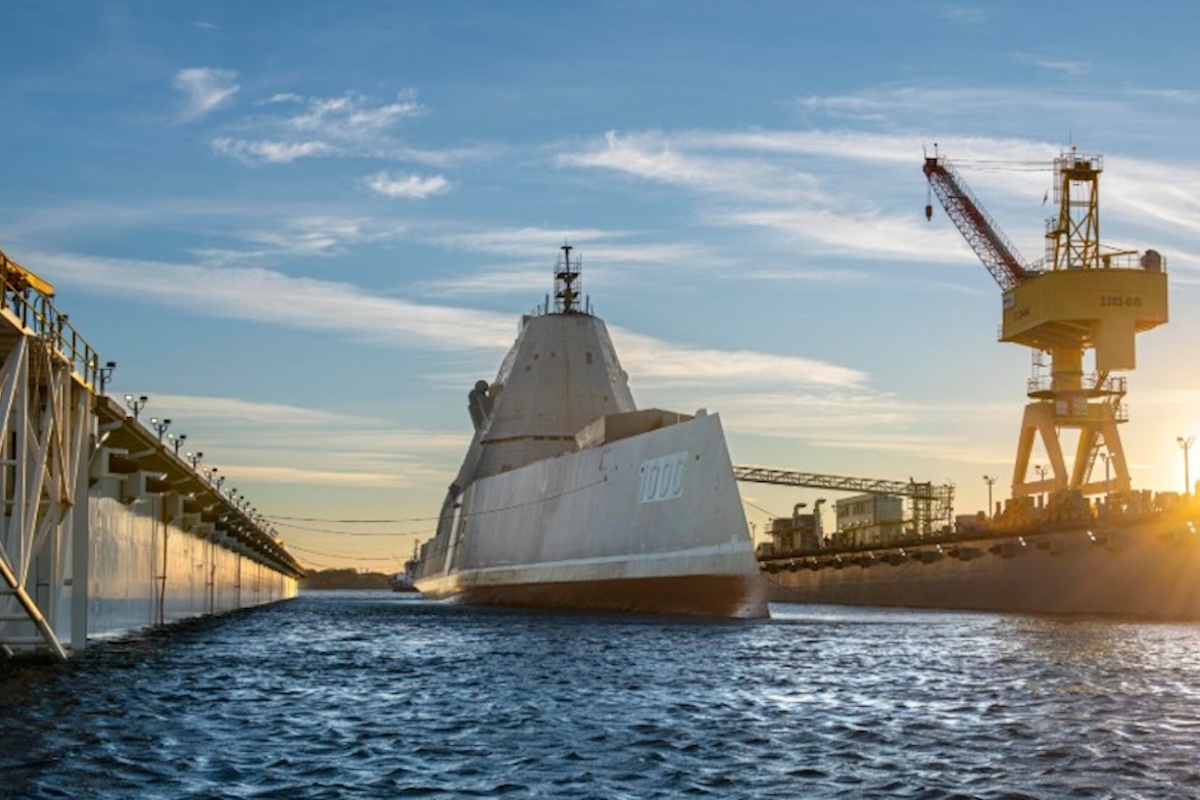
The US Navy’s delayed effort to equip its troubled Zumwalt-class destroyers with hypersonic missiles is testing whether the ships can finally gain a credible combat role without repeating their history of shifting missions, immature technologies and mounting costs. This month, the US Government Accountability Office (GAO) reported that the US Navy is 24 months behind schedule in equipping its three Zumwalt-class destroyers with Conventional Prompt Strike (CPS) hypersonic missiles, citing shipyard overruns, testing setbacks, funding constraints and production problems. The first ship, USS Zumwalt, was 94% through modernization as of January 2026, but its yard period has slipped by 10 months to late fiscal 2026 after Huntington Ingalls added 230,000 labor hours, at a cost of US$20 million, for unexpected cabling, electrical-system failures and other work. The US Navy had planned to begin shipboard flight tests in 2025 but now targets the third quarter of fiscal 2027 after anomalies involving missile production, fire-control software and an Army launcher. It has also adopted incremental testing to reduce risks to the ship and crew. Officials nevertheless called the revised timetable optimistic and dependent on successful development and testing. Lockheed Martin’s production facility can build only six to seven rounds annually, compared with the 12 needed to stabilize output, because the missile requires more labor than expected and has encountered coating, quality-control and work-instruction problems. GAO said fragmented Navy and Army investment decisions were contributing to delays and urged the US Department of Defense (DoD) to adopt a joint strategy for an effort expected to cost at least US$50 billion. The setbacks raise a broader question: can the Zumwalt class become a credible hypersonic strike platform, or will the refit reproduce the same design, cost and mission problems that have followed the ships from their inception? The CPS delay is the latest setback for a class repeatedly reshaped by changing requirements and technological risk. Kevin Eyer wrote in an April 2026 Proceedings article that shifting priorities, cost growth and reliance on unproven technologies undermined the class. Eyer wrote that the Zumwalt class was initially conceived as an air-defense warship before cost limits drove its redesign as a coastal land-attack vessel centered on the Advanced Gun System (AGS). He added that when the AGS’s specialized ammunition rose to about US$1 million per round, the US Navy canceled procurement, leaving the roughly $4 billion ship without its intended primary weapon and without a clear mission for nearly a decade. Eyer argued that experimental designs carry substantial financial risk, that critical technologies should be tested before being incorporated into a ship design and that new classes require a clearly defined operational purpose. The delays come as China and Russia expand their high-speed strike arsenals, increasing pressure on the US to field comparable capabilities. Michael White argued in a February 2026 Atlantic Council report that China and Russia had established a substantial lead by fielding hundreds of high-speed and hypersonic weapons while US systems were only approaching operational deployment. White cited Russia’s operational Kinzhal, Tsirkon and nuclear-armed Avangard systems, including weapons used in Ukraine, as well as China’s DF-17 hypersonic glide weapon and its broader DF-21 and DF-26 high-speed missile forces threatening regional bases and aircraft carriers. White noted that the US has pursued systems including Dark Eagle, CPS and the Air-Launched Rapid Response Weapon (ARRW), while the Hypersonic Air-breathing Weapon Concept (HAWC) served as a technology-demonstration program. However, he argued that affordability, production capacity and delayed fielding continue to limit the scale and readiness of the US arsenal. Equipping the Zumwalt class with CPS could allow the ships to strike time-sensitive, heavily defended targets from long range. But concentrating a small number of costly missiles aboard three distinctive surface ships could make the vessels priority targets for enemy surveillance and attack. Hypersonic weapons also depend on a broader network of sensors, communications, targeting systems and command authorities, creating potential points of failure beyond the launch platform itself. An adversary could therefore neutralize the capability indirectly, using drones, anti-ship missiles, mines, torpedoes, electronic warfare or cyberattacks against its launch platforms, sensor networks and command-and-control nodes before the hypersonic missile is fired. Those vulnerabilities raise a second question: even if the launch network survives, will the weapons themselves deliver the decisive effects their advocates promise? Yet combat experience also suggests that hypersonic weapons are neither uniformly decisive nor impossible to defend against. Bill Christopher Arputharaj and Amit Mukherjee argued in a February 2026 Journal of Strategic Studies article that Russia’s Kinzhal and Tsirkon weapons produced some tactical advantages in Ukraine but became increasingly vulnerable to Western-supplied air defenses. They estimated interception rates of 37.5% for Kinzhal and 28.5% for Tsirkon, although wartime claims about launches and interceptions remain difficult to verify independently. They identified Russia’s Oreshnik missile as a potentially more consequential development because of its use of multiple reentry vehicles and its apparent ability to complicate Ukrainian defenses, although its battlefield effectiveness remains difficult to assess from limited combat use. The physical demands of sustained hypersonic flight may also limit claims that such weapons are uniquely fast, stealthy or difficult to intercept. In a March 2024 Bulletin of the Atomic Scientists article, David Wright and Cameron Tracy challenged claims that hypersonic weapons are uniquely transformative, arguing that the surrounding hype risks distorting defense priorities. They argued that atmospheric drag and extreme heating reduce the speed and range advantages of hypersonic glide vehicles, particularly when compared with ballistic missiles over similar distances. They also noted that hypersonic boost-glide vehicles generate infrared signatures that may be detected by space-based sensors, potentially allowing terminal defenses to engage them. Their analysis suggests that large hypersonic investments should be weighed against more mature and potentially more cost-effective strike and defensive capabilities. Strategic-stability concerns may also have contributed to the US’s more cautious approach. Carrie Lee wrote in a September 2022 Texas National Security Review article that proponents see hypersonic weapons as a means of rapidly threatening defended, high-value targets without a large visible force buildup. Conversely, Lee wrote that skeptics argue these weapons may offer limited additional value to already powerful militaries while increasing instability. Lee warned that compressed decision times and uncertainty over a missile’s target or warhead could encourage rapid escalation during a crisis, particularly between nuclear-armed states. The next test for the US is whether it can integrate hypersonic weapons into a resilient joint strike network rather than allowing technological urgency to redefine platforms and missions around an unproven capability. That will require selective procurement, survivable sensor and command networks, distributed launch options and realistic operational testing; otherwise, the US may narrow the numerical gap without securing a durable battlefield advantage.
US Navy’s Zumwalt destroyer falling behind the hypersonic times
Full Article
Original Source
Read the full article at Asiatimes →KhanList aggregates and links to publicly available news content. We do not host full articles from third-party sources. Always verify important information with original sources.