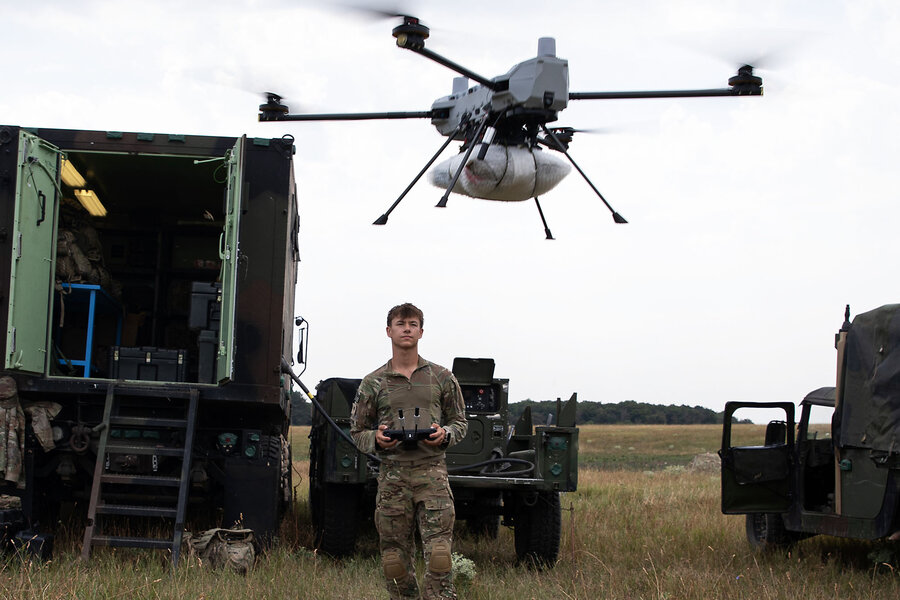
In a war game last spring, Col. Richard Ryan Bell, a brigade commander for the U.S. Army’s 101st Airborne Division, ordered one of his captains to breach a trench line with robots.The captain’s company created an unmanned “mother ship,” modifying it to drop smaller drones that took out electronic warfare jammers. They then sent 25 one-way attack drones to destroy bunkers and machine gun nests.Another drone created a smoke screen while still more blasted through triple-layered barbed wire. Meanwhile, an unmanned vehicle detonated land mines. Why We Wrote This Cheap, mass-produced drones are changing modern warfare by exposing vulnerabilities in the field. The U.S. military is taking notes, and transforming the way American troops train and fight. By the time the operation was complete, the company – part of the premier air assault division that distinguished itself during World War II – had used about 35 drones and “a little over 100 pounds of C4” explosives. The cost? Less expensive than three artillery barrages, Colonel Bell said during a June roundtable discussion with reporters. Iranian Army/WANA/Reuters In an image provided by the Iranian military, drones are displayed at an undisclosed location during a ceremony integrating them into the army's combat fleet, Jan. 13, 2025. “I’m sending robots in front of my riflemen,” he said. “That is how I see robots being used in the future.”In training centers throughout the United States and Europe, commanders are taking the lessons of fast-moving drone technology used in the wars in Ukraine and the Middle East, fundamentally transforming how American forces fight.BreakthroughsBreaking through fortified front lines has long been one of the toughest jobs infantry troops face in conventional warfare. Now, the Pentagon is experimenting with sending fleets of robots into harm’s way first, to blunt the risk typically borne by soldiers.Adapting to the new technology involves creating a new culture, they say, in which young troops build and test drones on mock battlefields, learn what works and what doesn’t, and adjust parts on 3D printers out in the field.Based on what officials have seen on Ukraine’s battlefields, this is all expected to happen even as U.S. troops are being hunted by their enemy’s own legions of drones and robotic ground vehicles. Duane Blank, operational manager for Firestorm, holds a 3D-printed drone made aboard the USS Essex. The drone was produced using onboard printers during a military exercise in Hawaii, July 10, 2026. But while the U.S. was ahead of the curve in developing drones for its wars in Iraq and Afghanistan, for example, it has since struggled to field cheaper ones. Pentagon acquisition processes tend to favor “exquisite” – and expensive – systems.To address this, the Pentagon put some $1 billion into a “Drone Dominance Initiative” in late 2025 to buy more than 200,000 small, low-cost “consumable” drones by 2027. By way of comparison, Ukraine produces roughly 500,000 small attack drones per month, Travis Metz, who runs the program, told Reuters.In the meantime, defense officials, concerned about potential spying, have banned the inexpensive Chinese components that many drone manufacturers use to keep costs low. This has increased security but has also driven up costs for would-be drone providers to the U.S. military.Reality checksSome have criticized U.S. military training exercises for being unrealistic and lax. This is in part because the U.S. and some European countries regulate operations that could, for example, interfere with GPS for airlines and citizens, says Stacie Pettyjohn, director of the defense program at the Center for a New American Security, a nonpartisan think tank.Earlier this year, the Federal Aviation Administration issued a temporary flight ban over Fort Hancock, Texas, for “special security reasons,” it said. The affected area was about 50 miles from Fort Bliss, a U.S. Army post near El Paso that conducts counterdrone operations as part of its training mission. Smoke rises from a burning warehouse after a reported Ukrainian drone attack in Saint Petersburg, Russia, July 24, 2026. “From what we’ve heard from Ukrainians who have gone into NATO and Germany or other places to train with U.S. and Western militaries, they felt that the training wasn’t reflective of the real conditions on the battlefield,” she adds.Colonel Bell’s brigade was chosen three years ago to be the Army’s “lead experimental unit,” tasked with testing the U.S. military’s latest capabilities and then reporting back.His troops arrived at the Joint Readiness Training Center at Louisiana’s Fort Polk in April with 500 drones – including more than 225 one-way attack systems, many of which soldiers had built themselves – and learned some things along the way.The Army, for starters, needs more of them, Colonel Bell said. In the war game, troops treated drones like ammunition, using at least 20 each day. At that pace, the brigade would need some 1,500 per week in “sustained combat operations,” he estimated. “If there are just one or two, or if they are extremely expensive, they won’t use them.”The drones also need to be simple to operate, Colonel Bell added, “particularly in combat when you have a 19-year-old private who is trying to fly a drone and has been awake for 48 hours.” A Ukrainian soldier of the Khartia brigade controls a ground drone during a mission in the Kharkiv region, Ukraine, July 25, 2026. When AI helps – and when it doesn’tThe brigade came up against the limits of artificial intelligence, too, when it fed their training and doctrine manuals into AI systems — including some 25,000 reports from drone sensors to generate a picture of a battlefield.The result: AI didn’t “really understand three-dimensional space,” so it wasn’t good at planning missions. But it did help the brigade “red team” – an exercise that involves simulating adversaries to find blind spots – with some of its operations, said Colonel Bell, who spent the previous year at Duke University, researching links between AI and “lethal autonomous systems.”Power was also an issue. Drones are vulnerable to jamming and require constant recharging, which, because of their thermal signatures, electromagnetic signals, and charging noises, can give away troop positions.To answer the need for infrastructure that could evade enemy detection, Colonel Bell’s companies set up command posts that consisted of five Humvees and a tarp “in miserable locations, buried in gulches, hidden by terrain, covered by trees and camouflage, jumping locations every 18 to 30 hours,” he said.They used no Wi-Fi. Their motto became “silent, violent, silent,” he added, as they practiced keeping communications to a minimum.They also made particular use of a small drone called the A101, which costs about $750 to make, with a fuse, warhead, and frame all 3D-printed on-site.Once flagged for having a foreign-made processing chip, the A101 is now on the Pentagon’s approved list, Colonel Bell said.“Transformation isn’t just happening in a lab,” he added. “It’s happening in the field.”
US military is taking drone lessons from wars in Ukraine, Middle East
Full Article
Original Source
Read the full article at Csmonitor →KhanList aggregates and links to publicly available news content. We do not host full articles from third-party sources. Always verify important information with original sources.