
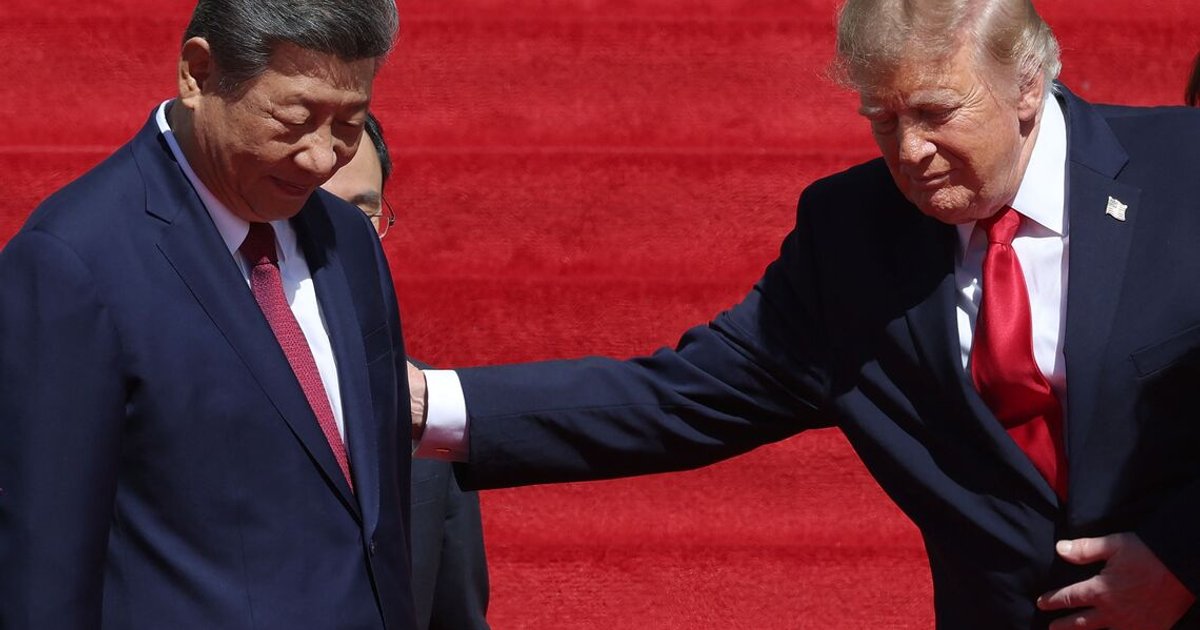
BEIJING – The Democrats’ sweeping victory in the US midterm elections could complicate US President Donald Trump’s efforts to strike further deals with China, as analysts warned that greater congressional pressure over Taiwan and technology restrictions is likely.As a weakened Trump faces less political room for manoeuvre on the domestic front, questions have been raised over whether he will largely keep a current bilateral truce or adopt a tougher stance toward China in the second half of his presidency.For now, analysts believe the rapprochement between Trump and Chinese President Xi Jinping could still hold, as both leaders have incentives to maintain diplomatic momentum ahead of their expected third meeting in 2026.The Nov 3 elections, where Democrats flipped both the House of Representatives and the Senate, dealt a major blow to Trump’s Republican Party and sets the stage for a divided US government when the new Congress takes office in January 2027.The Democratic Party will have greater power to scrutinise the administration, although Trump retains broad authority over foreign policy.For Beijing, the implications are far from straightforward, said Sun Chenghao, a senior fellow at Tsinghua University’s Center for International Security and Strategy (CISS) in Beijing.“Democratic control of both chambers will change how Washington makes China policy more than its underlying competitive direction,” said Sun.Stronger congressional oversight could constrain some of Trump’s more disruptive initiatives, particularly those requiring funding or legislation, but it could also make it harder for the administration to offer concessions to Beijing or implement negotiated agreements, he said.“I doubt Beijing would regard this as a straightforward victory. Its interest is in a US counterpart capable of sustaining dialogue and delivering on commitments,” he added.A politically weakened Trump could become more interested in securing agreements with China, while simultaneously facing greater pressure to demonstrate toughness, said Sun, who studies US-China relations.“Both tendencies could coexist, making the relationship more vulnerable to conflicting signals from Washington,” he said.The election comes amid a period of relative stability in China-US relations, following two meetings between Trump and Xi this year, first in Beijing in May and then in Washington in September.Both sides had traded blows over tariffs in 2025.The leaders’ latest summit produced an extension of a trade truce and a commitment to deepen economic engagement and establish dialogue on artificial intelligence (AI), although longstanding issues such as advanced technology, economic security and Taiwan remain unresolved.The two leaders are expected to meet again at the Asia-Pacific Economic Cooperation (APEC) Leaders’ Summit in Shenzhen on Nov 18 and 19, offering an early test of whether the shift in the US political environment will affect their efforts to stabilise ties.Sun said Beijing would likely continue working with Trump while seeking clearer implementation schedules, but will ultimately assess any new promises against his ability to deliver on them.At a regular press briefing on Nov 4, Chinese Foreign Ministry spokeswoman Mao Ning said the midterm elections are the internal affairs of the US.She said that China was willing to continue working with the US to uphold and implement the consensus reached by the two heads of state, enhance communication, manage differences and expand cooperation, while building what both sides have described as a constructive strategic stability based on respect, fairness and reciprocity.Chinese stocks rallied sharply on Nov 4 as investors digested the US midterm election results alongside fresh domestic policy support from Beijing, with Shanghai’s benchmark index closing 2.16 per cent higher.The US midterm elections were a trending topic on Chinese social media platform Weibo on Nov 4, with Chinese netizens expressing mixed reactions, including some mocking Trump’s electoral setback while others debated whether Trump’s political setback would benefit or backfire on Beijing.Analysts said Taiwan and advanced technology restrictions are two areas where a Democrat-controlled Congress could create more friction between Washington and Beijing.George Chen, partner and chair of digital practice at the Washington-based consultancy The Asia Group, said Taiwan enjoys strong support among many Democrats, particularly because of relationships built during the administration of former Taiwan President Tsai Ing-wen.“If Congress pushes Trump’s administration to accelerate or expand arms sales to Taiwan, the strategic stability that Trump and Xi have sought to maintain could come under strain, given Beijing’s strong opposition to any moves in Washington that it perceives as supporting Taiwan,” said Chen.Democrats may also take a tougher stance on export controls, particularly in areas related to artificial intelligence and advanced technologies, said Chen.He cited previous calls by Democratic lawmakers for greater scrutiny of Nvidia’s chief executive Jensen Huang and his company’s business activities involving China.Nvidia’s advanced chips are widely used to develop AI models but Washington has restricted exports of some of its most powerful processors to China over concerns that the technology could strengthen Beijing’s capabilities.Zhang Yun, an international relations professor at Nanjing University, said despite these potential flashpoints, the uncertainty surrounding China-US relations remains manageable as the underlying economic interests driving Washington and Beijing towards greater stability would not fundamentally change because of the election.American voters remained primarily concerned about economic and livelihood issues, while Trump would continue to see value in stabilising relations with China to benefit the US economy, said Zhang.Zhang also pointed to Trump’s desire to secure a diplomatic legacy during the remainder of his presidency, including progress on conflicts involving Iran and Ukraine, as well as stability on the Korean Peninsula.“Without stable China-US relations or a thaw in US-Russia ties, none of these goals would be attainable. This is why Trump has been so proactive in pursuing a trilateral summit with Xi and Russia President Vladimir Putin in Shenzhen’s Apec summit,” he said.China’s foreign ministry said on Nov 4 that Beijing is in communication with Moscow and Washington over a potential meeting involving the three leaders, although no summit has been confirmed.
US midterms: Will Trump take a tougher stance on China after his election setback?
Full Article
Original Source
Read the full article at Straitstimes →KhanList aggregates and links to publicly available news content. We do not host full articles from third-party sources. Always verify important information with original sources.