
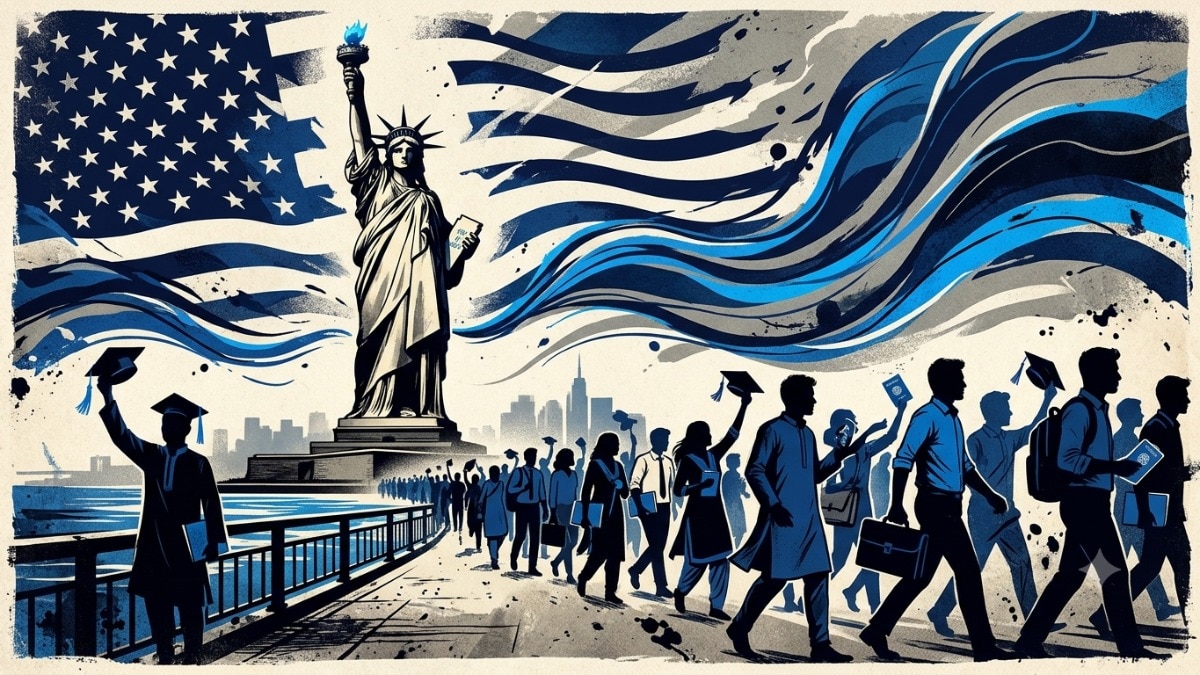
The Democratic Party's sweeping victory in the 2026 US midterm elections has opened a new political chapter for Indian students and professionals hoping to study, work and settle in America. After more than a year of immigration uncertainty, stricter visa policies and concerns over post-study employment, the big question is whether the US is becoming attractive to Indian talent again.Democrats have won control of both the US House of Representatives and the Senate, dealing a major setback to President Donald Trump and his Republican Party. The victory gives Democrats greater power to scrutinise the administration's policies, conduct investigations and challenge its legislative agenda.For India, the implications could be considerable. From Optional Practical Training (OPT) and H-1B visas to green cards, university admissions and employment opportunities, the political shift could influence how Indian families view the American dream.But there is a catch. A Democratic victory does not automatically mean easier visas or an immediate reversal of immigration restrictions. WILL THE US BECOME ATTRACTIVE TO INDIAN STUDENTS AGAIN?The uncertainty of the past year has already affected how Indian students view America.According to the Institute of International Education's Spring 2026 Snapshot survey, 61 per cent of responding US institutions reported a decline in applications from India. The survey covered 585 American colleges and universities. Saurabh Arora, Founder and CEO of University Living, believes the election could offer some reassurance, but restoring confidence will require more than a change in political leadership."The election may encourage some families to reconsider the US, but a sustained recovery in sentiment will require clearer and more predictable student and employment immigration policies," he says. (Photo: Getty Images) Sagar Bahadur, Senior Vice President, Strategic Partnerships and Growth at Manifest Global, makes a similar point."What students have questioned over the last year is not the quality of its universities, but the certainty of the opportunity that follows," he says."America doesn't need to rediscover the value of international students. It needs to demonstrate it again."OPT, STEM OPT AND H-1B: THE BIG QUESTION FOR INDIANSFor Indian students, the ability to work in America after graduation is often as important as the degree itself.OPT allows eligible international students on F-1 visas to work in jobs related to their field of study, generally for up to 12 months. Students with qualifying STEM degrees can apply for an additional 24-month extension.A Democratic-controlled Congress could put greater pressure on the administration to review restrictive immigration measures. It can conduct hearings, question officials, scrutinise agency decisions and push for legislative changes. However, OPT and STEM OPT are administered through federal regulations, and the executive branch retains considerable authority over them.Arora cautions students against expecting an immediate change."Even a positive shift in the debate would not necessarily translate into immediate changes to work authorisation," he says.The bigger challenge comes when students try to move from OPT to an H-1B visa, which allows US employers to hire foreign professionals in specialised occupations.The Trump administration's changes to the H-1B selection process, including a weighted system that generally favours higher-paid and higher-skilled applicants, are among the policies students will be watching. (AI-generated image) Bahadur says students must understand the difference between finding employment and securing permission to work."We should be careful not to confuse getting a job with getting a visa," he says."Even a highly qualified graduate from a leading American university can face considerable uncertainty in the H-1B process."He believes a Democratic Congress could create pressure for a more balanced approach, but the structural challenges will not disappear overnight.Green cards are another concern, particularly for Indian professionals facing lengthy employment-based immigration queues. Any meaningful reform would require changes to the immigration framework, not simply a change in congressional leadership.WILL AMERICAN UNIVERSITIES CHANGE THEIR APPROACH?The political shift could also give universities greater room to advocate for international students.American institutions depend on international talent for research, innovation and academic diversity. They also have a financial interest in attracting students who contribute to their campuses.Arora believes universities could use the changed political balance to raise concerns about unpredictable immigration policies. But he says practical support matters just as much as public statements.Institutions need to provide clear visa guidance, timely updates, international student advisers and realistic career counselling.Bahadur puts the responsibility even more directly: "An admission letter is a promise of opportunity, and universities must take that promise seriously."There is another education-related development worth watching. Book bans have become a major controversy in American schools. PEN America recorded 11,982 instances of book bans during the 2025-26 academic year, the highest annual figure since it began tracking the issue.A Democratic political resurgence could strengthen opposition to restrictive school policies. However, book bans are largely driven by state laws and local school boards. A change in control of Congress alone cannot reverse them.Similarly, AI policies in American classrooms will depend on a mix of state decisions, school district rules and federal guidance. A Democratic Congress may scrutinise questions around student privacy, access and responsible AI use, but a wholesale rollback of AI integration cannot be assumed.SHOULD INDIAN STUDENTS APPLY TO THE US FOR 2027?For students considering the 2027 intake, the election results could be a reason to revisit American universities, particularly if they had put their plans on hold.But experts advise against making expensive decisions based on political optimism alone.Arora recommends keeping the US on the shortlist while comparing it with the UK, Canada, Australia and Germany.Bahadur agrees, advising students to assess universities on programme quality, affordability and actual career opportunities rather than the political mood."Apply with ambition, but make the financial commitment with your eyes open," he says. (AI-generated image) He also recommends watching three developments over the next six months: changes to OPT and STEM OPT, the H-1B framework and the predictability of visa processing.Arora adds that students should distinguish between a political announcement, a proposed regulation and a rule that has actually come into effect. Official updates from USCIS, the US Department of State and the Department of Homeland Security should guide decisions about applications and education loans.For Indian families, the Democratic victory is an encouraging political development, but it is not yet an immigration breakthrough.As Bahadur puts it, "The smartest students will choose based on the quality of the programme, affordability and career opportunities, not just the political mood of the moment."The next six months could determine whether America's political shift translates into something Indian students have been waiting for: greater certainty about their future after graduation.- Ends
US midterm blue wave: Could Indian students and workers get a fairer deal right now?
Full Article
Original Source
Read the full article at Indiatoday →KhanList aggregates and links to publicly available news content. We do not host full articles from third-party sources. Always verify important information with original sources.