
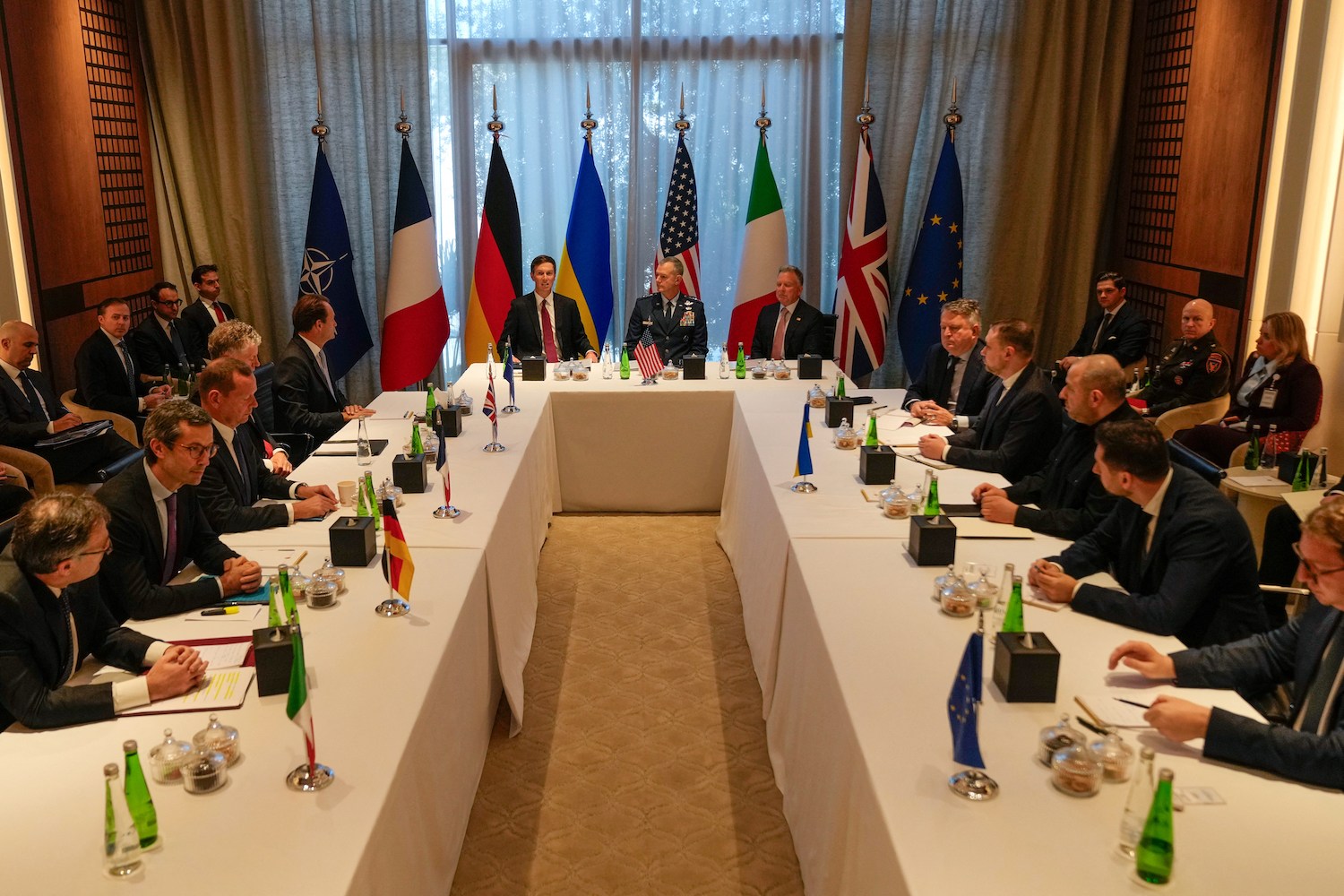
Welcome back to World Brief, where we’re looking at the sticking points in Russia-Ukraine peace talks, impeachment proceedings against U.S. Defense Secretary Pete Hegseth, and Israeli efforts to form a new government. Big Optimism, Little Progress Russia, Ukraine, and the United States kicked off trilateral peace talks in the United Arab Emirates on Tuesday for the first time in roughly nine months. Day 1 of the two-day conference largely focused on security guarantees for Kyiv in what U.S. negotiator Jared Kushner characterized as an initial step toward building momentum for future dialogue. Welcome back to World Brief, where we’re looking at the sticking points in Russia-Ukraine peace talks, impeachment proceedings against U.S. Defense Secretary Pete Hegseth, and Israeli efforts to form a new government. Big Optimism, Little Progress Russia, Ukraine, and the United States kicked off trilateral peace talks in the United Arab Emirates on Tuesday for the first time in roughly nine months. Day 1 of the two-day conference largely focused on security guarantees for Kyiv in what U.S. negotiator Jared Kushner characterized as an initial step toward building momentum for future dialogue. Tuesday’s conversations were “constructive and quite substantive,” Ukrainian President Volodymyr Zelensky, who did not attend the talks, wrote on Telegram. Lead Russian negotiator Vladimir Medinsky similarly expressed hope that this week’s dialogue will “allow us to advance on the path towards peace in the interests of the people of Russia and the people of Ukraine.” But while negotiators are projecting cautious optimism, neither side appears willing to make concessions, and significant breakthroughs remain out of reach. Two key sticking points continue to hamper the ongoing peace talks. Ukraine and its European allies insist on an immediate cease-fire before negotiating a wider settlement; Russia, however, rejects such a truce, with Foreign Minister Sergey Lavrov arguing that Brussels is just trying to “buy time” for Kyiv. Ukraine also opposes any demands for it to cede territory to Russia, whereas Moscow wants Kyiv to withdraw from the four Russian-occupied regions of the Donbas. “Nobody believes that [Russian President Vladimir] Putin will stop if we leave the Donbas,” Zelensky wrote on Telegram on Tuesday. “He will pause. And then he will return in a year, two, or five years. And who will be to blame?” Battle lines have not changed substantially in recent months, and just hours before negotiations began in Abu Dhabi, Russia launched overnight attacks on Ukraine’s energy infrastructure, causing outages in six regions. Moscow has repeatedly targeted Kyiv’s power grid in an effort to freeze Ukraine into submission ahead of what is expected to be another cold winter. But outside pressures could force Moscow and Kyiv to ramp up peacemaking efforts. Prolonged fighting has strained Russia’s wartime economy, Ukraine’s weapons arsenal remains dangerously low on U.S.-made interceptors, and European nations appear increasingly focused on addressing Black Sea security concerns. On Tuesday, European Commission President Ursula von der Leyen pledged $56 million to help Bulgaria and Romania launch a Black Sea maritime security hub in the face of deadly drone attacks on cargo ships. Despite these influences, the likelihood of an imminent peace deal appears to be slim. “There’s a lot of work to be done in that regard,” U.S. Secretary of State Marco Rubio said on Tuesday during the G-7 foreign ministers’ meeting in Paris. “It’s not like something that’s on the verge of being solved in the next 24 hours or anything like that.” Today’s Most Read The Experts Are Taking Their Revenge Again by David Milne Hegseth’s Leadership Has Damaged the Pentagon by Kori Schake Who Will Succeed Xi Jinping? by Deng Yuwen What We’re Following Hegseth fights back. U.S. Defense Secretary Pete Hegseth delivered a defiant rebuttal on Tuesday of bipartisan efforts to impeach him for “high crimes and misdemeanors” related to his execution of the Iran war, deadly strikes on alleged drug boats, and capture of then-Venezuelan President Nicolás Maduro. “What one disgruntled and defeated congressman is attempting is not oversight, and it’s not accountability. It’s a political spectacle, a personal manifesto driven by ego and resentment,” Hegseth said, referring to outgoing Republican Rep. Thomas Massie, who has led the impeachment push against him on the grounds that Hegseth has abused his power and endangered members of the armed forces. The defense secretary went on to defend his policy decisions, champion military recruitment, and characterize the proceedings as a direct attack on the armed forces. “These resolutions are a farce,” Hegseth said. “They mock the Constitution. They attack the chain of command, and they criminalize the warfighters who execute lawful orders.” The comments, made during Hegseth’s first news conference at the Pentagon in six months, came just hours before the House of Representatives was scheduled to hold an initial procedural vote on the impeachment articles. Still, the Trump administration is not shying away from the fight. “Pete Hegseth gets an ‘A’ PLUS, PLUS, PLUS for his defense against a disgruntled, angry, defeated, former Congressman, Thomas Massie, a TOTAL LOSER!” Trump wrote on Truth Social on Tuesday. Deadlocked coalition talks. The Israeli Knesset swore in its new lawmakers on Tuesday, just days after President Isaac Herzog tasked opposition leader Gadi Eisenkot with forming a new government. “You must do everything to avoid a repeat election,” Herzog told lawmakers during the swearing-in ceremony. But with coalition-building efforts still deadlocked, Israel’s incoming parliamentary term could be cut short if both Eisenkot and Prime Minister Benjamin Netanyahu fail to form a governing bloc. Eisenkot’s fragmented opposition has the backing of 67 members in the 120-seat Knesset, compared to Netanyahu’s 46 supporters. However, Eisenkot’s path to power remains uncertain, as many of his mainstream Jewish partners have balked at the idea of entering into a formal alliance with Arab-led parties. Without the latter group’s 19 seats, Eisenkot’s bloc lacks the 61-seat majority that it needs to solidly oppose Netanyahu. But with them, Eisenkot could be risking his long-term political future; the only time that an Israeli governing coalition has included an Arab-led party, the alliance held together for just a little more than a year. In the meantime, Eisenkot has already vowed to replace the Knesset’s speaker, Amir Ohana. Ohana is a Netanyahu loyalist, so removing him would deal a significant blow to the right wing’s legislative agenda. The opposition hopes to replace him with Matan Kahana, a senior figure in Eisenkot’s party, but the date for such a vote has yet to be determined. Spotty record. The United Nations Human Rights Council (HRC) agreed on Tuesday to further delay a regular review of the United States’ human rights record after Washington was set to become the first U.N. member to fully reject it. The process will now reconvene in January. Every four to five years, the world’s top human rights body examines the records of all 193 U.N. member states to determine whether governments are adhering to international human rights standards. According to a new report by the office of the U.N. high commissioner for human rights, the United States appears to have violated several of these norms, from targeting civilian infrastructure in Iran to imposing sanctions on the International Criminal Court that “could undermine accountability for war crimes and crimes against humanity.” The White House pulled out of the council last year, alleging anti-U.S. and anti-Israel bias, and it has repeatedly skipped its HRC review appointments. “[W]e give no credibility to the agency,” a State Department spokesperson told The Associated Press, calling the council an “irredeemable body” that “makes a mockery of human rights through consistent failures to uphold its own ‘values.’” Odds and Ends The Booker Prize for fiction was awarded on Monday to The End of Everything, a dystopian satirical novel by British writer M. John Harrison that explores how difficult it is to understand a deteriorating world when you are right in the middle of it. This was the first time that the prestigious award went to a bona fide science fiction writer, though Harrison maintains that the recognition signals how the era of “genres as fences and boxes, pigeonholes, is over.” British fantasy and science fiction is having something of a moment in literary prizes, FP’s James Palmer told World Brief. Harrison’s disciple, China Miéville, recently won the prestigious Goldsmiths Prize for his more than 1,200-page paranormal Cold War epic The Rouse.
U.S.-Mediated Russia-Ukraine Talks Make Little Headway
Full Article
Original Source
Read the full article at Foreignpolicy →KhanList aggregates and links to publicly available news content. We do not host full articles from third-party sources. Always verify important information with original sources.