
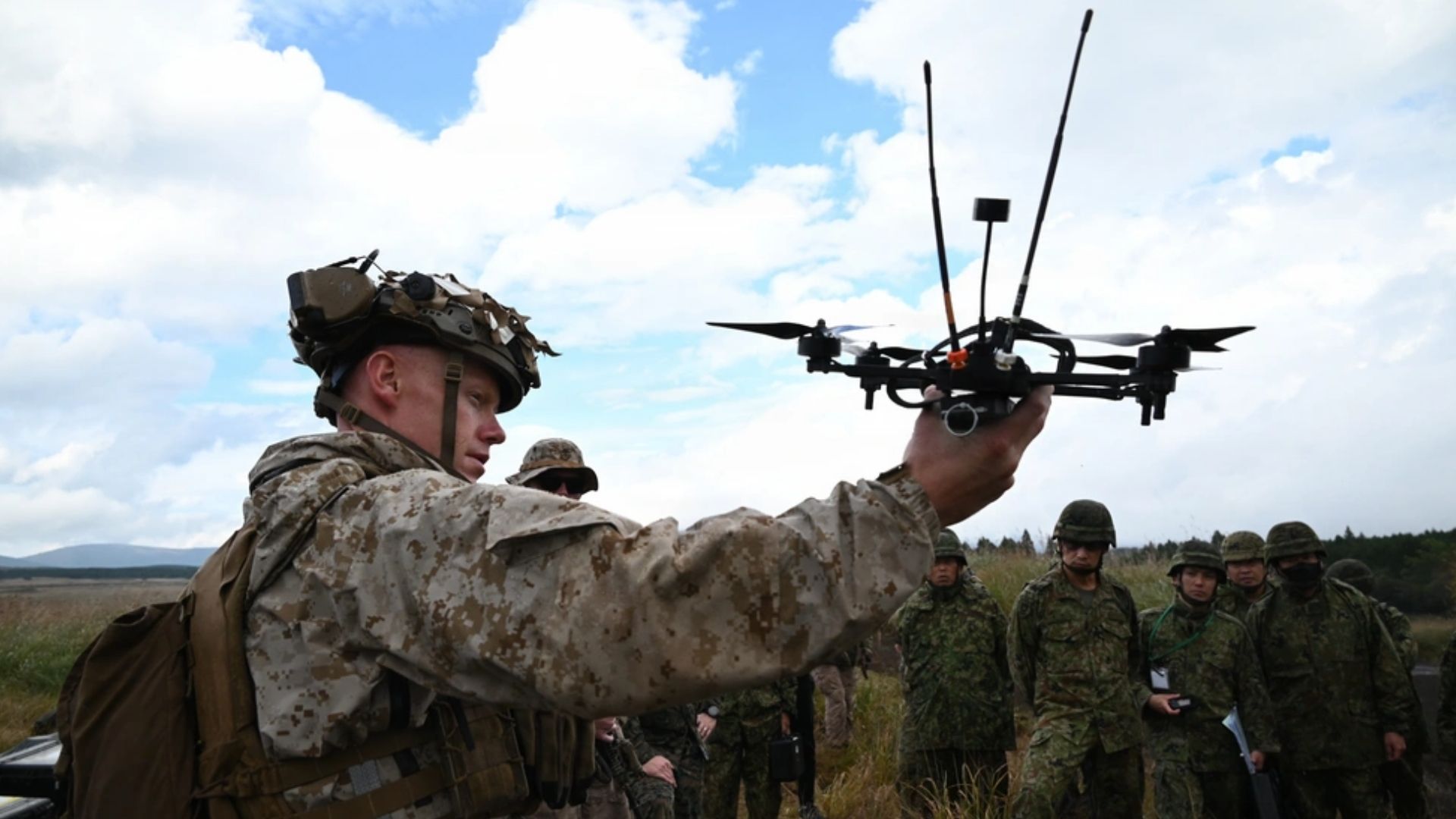
The US Marine Corps is continuing to integrate small first-person-view (FPV) attack drones into infantry training, with Marines recently operating the Neros Archer system during a battalion field exercise at Twentynine Palms, California. Official imagery released through the Defense Visual Information Distribution Service (DVIDS) on November 8 shows Marines from the 2nd Battalion, 7th Marine Regiment, 1st Marine Division, inspecting and preparing the small unmanned aircraft during training held on October 20. The exercise placed the drones within a broader infantry training environment, where Marines practiced making tactical decisions against an opposing force. The latest activity follows a series of live-fire demonstrations and training events in the Indo-Pacific, as the Marine Corps works to give smaller units an additional precision-strike capability without relying exclusively on artillery, aircraft, or other supporting weapons. A small drone designed for infantry strike missions The Neros Archer is a compact FPV aircraft controlled by an operator using a live video feed from the drone. Unlike conventional reconnaissance quadcopters, the Archer is designed to carry modular payloads, including explosive warheads, for one-way attack missions. Its intended role is to give infantry formations the ability to engage targets beyond the range of many weapons normally available to small units. The aircraft can be used against vehicles, equipment, and personnel, depending on its payload configuration. The Marine Corps demonstrated the system’s reach at its Air-Ground Combat Center in Twentynine Palms in March 2025. According to the service, the Archer conducted a ground strike at a distance exceeding 20 kilometers (12.4 miles) and an aerial interception at 10 kilometers (6.2 miles). The aircraft also integrated real-time video and position data during the demonstration. Those figures illustrate the potential reach of the platform, rather than establishing the effective range of every mission or payload configuration. The Marine Corps has since expanded its practical employment of the drone. In August 2026, Marines from the 4th Marine Regiment, 3rd Marine Division, completed the service’s first series of live-fire FPV attack-drone flights in South Korea. The exercises involved the 3rd Light Armored Reconnaissance Battalion and the 3rd Battalion, 7th Marine Regiment, which used Archer drones for precision anti-armor and antipersonnel strikes. The Marine Corps described the system as a way to extend precision fires down to small-unit formations, potentially allowing Marines to engage targets while remaining farther from hostile positions. From operator training to distributed strike capabilities The Archer is also being incorporated into more complex employment concepts. During an October 20 exercise at Camp Fuji, Japan, Marines from Battalion Landing Team 1/1, 31st Marine Expeditionary Unit, conducted two live-fire drone missions. One scenario simulated an anti-armor ambush, while another tested the aircraft against ground communications infrastructure. The exercise was designed around the Marine Corps’ hunter-killer team concept, in which reconnaissance assets identify and track targets before passing information to an FPV drone operator for engagement. This approach connects surveillance and strike capabilities within smaller formations, potentially reducing the time between detecting a target and engaging it. It also gives infantry commanders another option when larger supporting weapons are unavailable or unsuitable. The service is building a standardized training structure to support this expansion. A December 2025 Marine Corps directive established pilot courses and certification requirements for small unmanned aircraft operators, including personnel employing attack drones such as the Neros Archer. The framework is intended to develop operator skills, safety procedures, and consistent training across different units. The effort reflects lessons from conflicts such as the war in Ukraine, where inexpensive FPV drones have become widely used for reconnaissance and attacks against vehicles, personnel, and defensive positions. Their battlefield effectiveness has also highlighted vulnerabilities to electronic warfare, communications disruption, and air defenses. For the Marine Corps, the challenge is not simply acquiring drones but developing the personnel, tactics, and logistics needed to use them in conventional infantry operations. The latest training at Twentynine Palms is another step in that process, as the service works to make small unmanned strike systems a more routine part of its ground combat capabilities. Get the latest in engineering, tech, space & science - delivered daily to your inbox.Kaif Shaikh is a journalist and writer passionate about turning complex information into clear, impactful stories. His writing covers technology, sustainability, geopolitics, and occasionally fiction. A graduate in Journalism and Mass Communication, his work has appeared in the Times of India and beyond. After a near-fatal experience, Kaif began seeing both stories and silences differently. Outside work, he juggles far too many projects and passions, but always makes time to read, reflect, and hold onto the thread of wonder.
US Marines test deadly 12-mile-reach Neros Archer drones in California drills
Full Article
Original Source
Read the full article at Interestingengineering →KhanList aggregates and links to publicly available news content. We do not host full articles from third-party sources. Always verify important information with original sources.