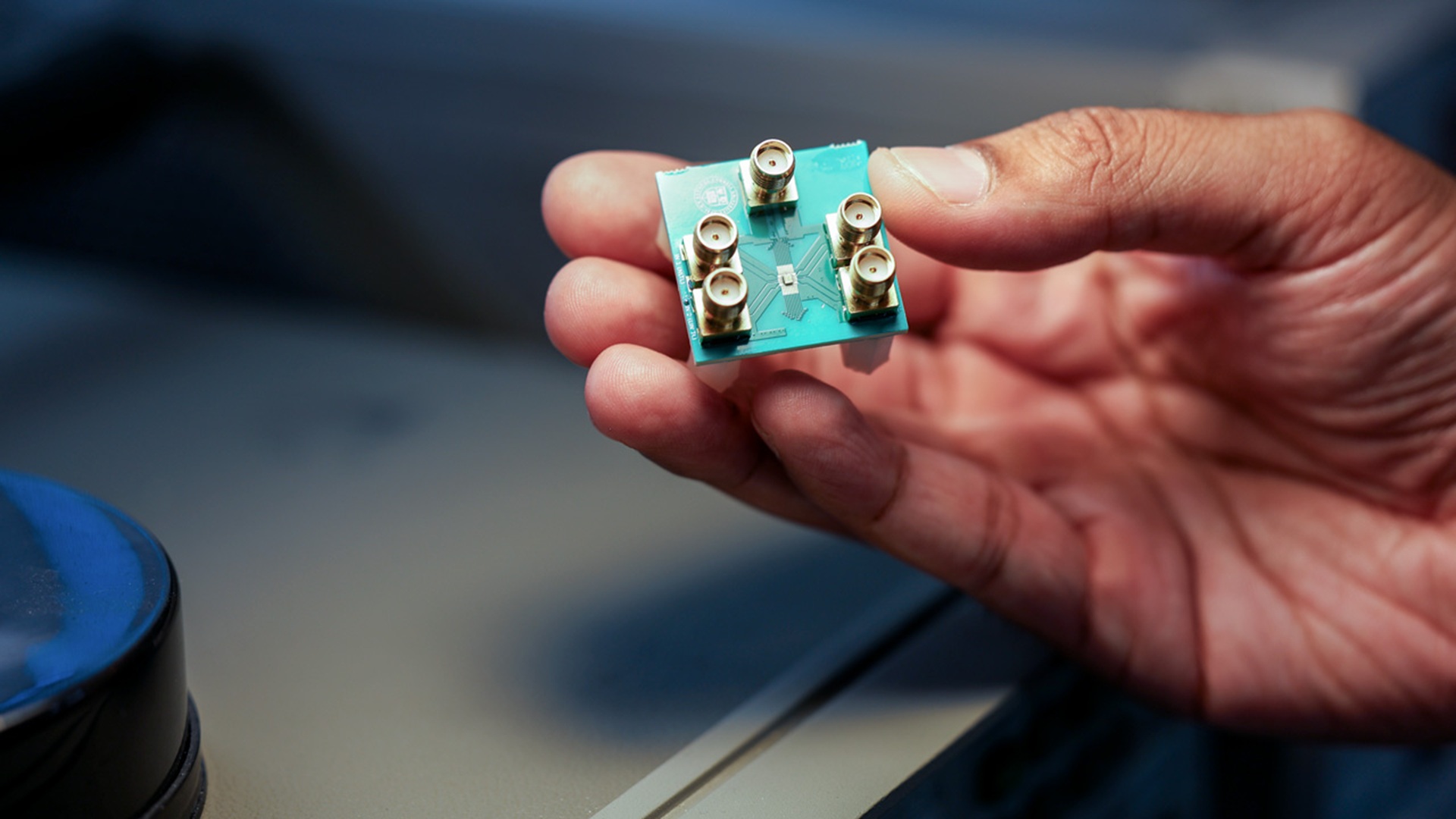
A first-of-its-kind ‘microwave brain’ microchip capable of computing on ultrafast data and wireless signals while using less than 200 milliwatts (mW) of power has recently learned its very own language. Developed by scientists at Cornell University, the chip can now utilize microwave token embeddings in order to encode messages into radio signals and compress data. These are similar to the tokens used in large language models. The chip is the world’s first processor to compute on both ultrafast data signals and wireless communication signals by harnessing the physics of microwaves. It allows information to be processed almost immediately. According to the researchers, this could reduce the amount of data satellites need to transmit, while enabling faster, more secure wireless communications. “You could have one microwave neural network send messages that only another of the same kind could understand,” Bal Govind, a PhD student at Cornell, stated. Encoding radio signals Govind who built the technology in the lab of Alyssa Apsel, PhD, an IBM professor of engineering in Cornell’s School of Electrical and Computer Engineering, proved that the chip can generate microwave token embeddings. The concept is inspired by the tokens used in large language models. Instead of transmitting long streams of digital instructions, the system represents data as a small number of microwave pulse tokens that preserve the relationships between different pieces of data. Bal Govind, PhD student, and Alyssa Apsel, PhD, developed the microwave neural network that is fully integrated on a silicon microchip.Credit: Charissa King-O’Brien / Cornell Engineering “I like to think of it as establishing a microwave lexicon,” Govind explained. Since the data remains in the microwave domain throughout processing, the approach eliminates several computational steps from traditional communication systems, This lowers bandwidth requirements and energy use, and addresses two major limitations for satellites, drones as well as edge devices. “Instead of transmitting something like a line of computer code, those instructions could be represented by just a few microwave pulses that another microwave neural network could immediately interpret,” Govind added. For the project, the team fed gigabit-per-second data streams into the chip. This naturally generated probabilistic bits, or p-bits which aren’t fixed as zeros or ones, but fluctuate according to incoming data. This makes them useful for probabilistic computing. The researchers used the chip to reconstruct a satellite image of a tropical storm while transmitting only about one-eighth of the original data. The reconstructed image preserved many of the storm’s key features. This capability could be particularly valuable for small satellites, which struggle to send large image files back to Earth because of limited onboard power and strict bandwidth regulations imposed by the US Federal Communications Commission. “They often have to transmit simple things like GPS coordinates that are going to lose a lot of the main features, and that’s something we think our chip can help with,” Govind concluded in a press release. The researchers believe the technology could introduce a fresh layer of hardware-based cybersecurity. They have also filed a patent application for the technology and are advancing it towards commercialization through the university’s Ignite Innovation Acceleration program.The study has been published in the journal Nature Communications.Recommended ArticlesGet the latest in engineering, tech, space & science - delivered daily to your inbox.Based in Skopje, North Macedonia. Her work has appeared in Daily Mail, Mirror, Daily Star, Yahoo, NationalWorld, Newsweek, Press Gazette and others. She covers stories on batteries, wind energy, sustainable shipping and new discoveries. When she's not chasing the next big science story, she's traveling, exploring new cultures, or enjoying good food with even better wine.
US-made world’s first ‘microwave brain’ chip learns language to slash satellite data by 8x
Full Article
Original Source
Read the full article at Interestingengineering →KhanList aggregates and links to publicly available news content. We do not host full articles from third-party sources. Always verify important information with original sources.