
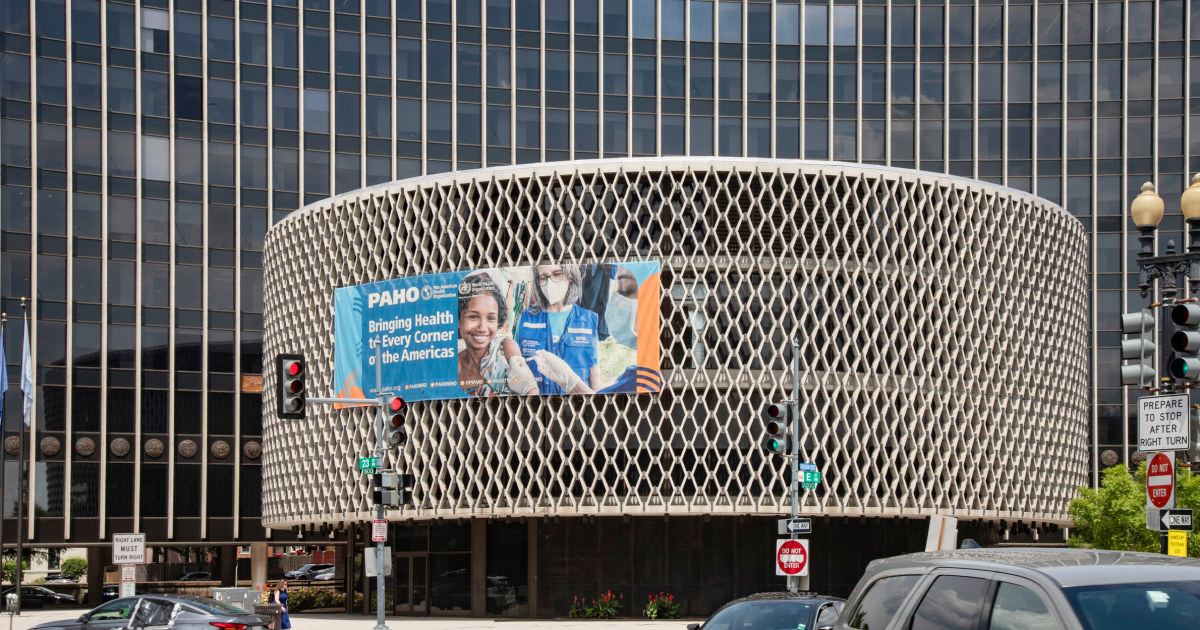
Nov. 17, 2026, 12:41 AM UTCMeasles OutbreakThe Pan American Health Organization determined that the virus has circulated nonstop for more than a year, costing the U.S. the elimination status it first earned in 2000.The Pan American Health Organization in Washington, D.C. UCG / Universal Images Group via GettyMeasles is no longer eliminated in the United States, reversing one of the country’s greatest public health achievements this century.An independent commission of the Pan American Health Organization (PAHO), a group within the World Health Organization, revoked the U.S.’s measles-elimination status, according to sources familiar with the vote, after determining that the virus has circulated nonstop for more than a year. The U.S. earned the designation in 2000. Now, measles is once again endemic.PAHO is expected to officially announce its decision on Tuesday.“The United States has an extraordinary measles problem. We’ve had more measles cases in the last 18 months than we’ve had in the previous 25 years combined,” said Noel Brewer, a public health professor at the University of North Carolina at Chapel Hill.Upwards of 5,400 cases have been recorded this year — more than double last year’s count and the highest since 1991. Ten people have died, according to state health departments.PAHO determines whether countries in the Americas meet the requirements for measles elimination. The group deliberated for four days last week in Washington, D.C., to assess whether transmission in the U.S. had been sustained for at least 12 months. A commission made up of eight public health experts evaluated genetic data from “homegrown” cases (those not related to international travel) to figure out whether outbreaks across states were linked.The commission also weighed the level of vaccination coverage in the U.S., the quality of measles surveillance and whether the U.S. has a strategy and resources to respond to outbreaks.As in many countries, vaccination rates in the U.S. have declined in recent years: 92% of kindergarteners had been vaccinated for measles as of the 2025-26 school year, down from 95% — the threshold needed to prevent outbreaks — in the 2019-20 school year.Nationwide among kindergarteners, 75% of counties and jurisdictions with measles vaccine data fall below the 95% rate, according to an NBC News investigation.Endemic measles poses a serious risk to people who are unvaccinated, said Walter Orenstein, former director of the U.S. Immunization Program at the Centers for Disease Control and Prevention. The risk is especially pronounced for infants, who are not typically eligible for the first dose of the vaccine until they turn 1, as well as those who cannot get the shot because they are immunocompromised. “People can go into a supermarket and get infected,” he said.At least four of the measles deaths this year were in babies too young to be vaccinated.Some health departments in outbreak zones are now recommending an early dose for infants as young as 6 months.Measles is among the most contagious viruses known to humans: One infected person can spread the virus to 9 out of 10 others in close proximity. It can linger in the air for up to two hours. Infections in unvaccinated people can lead to deadly complications like pneumonia or swelling of the brain.Brewer said the U.S. desperately needs a strategy for tackling measles.“The lack of action to address the growing outbreak is clear negligence,” he said.Under past presidential administrations, the CDC has responded to measles outbreaks with media briefings and vaccination campaigns, but the agency has not done so this year.A spokesperson for the Health and Human Services Department said the CDC has “mounted an aggressive response to measles outbreaks,” including allocating $100 million in additional funding in October and deploying experts to support state responses. Health Secretary Robert F. Kennedy Jr. and CDC Director Dr. Erica Schwartz “continue to recommend MMR vaccination as the most effective way to prevent measles,” the spokesperson said.“We know where transmission is occurring and we’re working with state and local health departments to reach those communities,” Schwartz said in a separate statement. “Losing a designation doesn’t mean we abandon an evidence-based approach. It means we remain focused on stopping outbreaks.”Since taking office, Kennedy has questioned the safety and effectiveness of measles vaccines and touted unproven remedies like inhaled steroids. President Donald Trump, meanwhile, falsely suggested in August that the combined measles shot could be “quite lethal,” despite decades of evidence demonstrating its safety.“We have seen frequent and damaging public comments that have been shaking the confidence of parents about vaccination,” Brewer said.Since 2019, 82% of counties and jurisdictions across the U.S. have reported declines in measles vaccination rates. Three small, rural counties — Catron County, New Mexico, and Adams and Custer counties in Idaho — have rates for kindergarteners below 50%.A measles, mumps and rubella vaccine is displayed at Pennsylvania Department of Health measles vaccination clinic in Lancaster County on Oct. 20.Matt Rourke / APThe pandemic accelerated the downward vaccination trend. Some parents avoided taking their children to the pediatrician, which meant delaying routine shots. An onslaught of misinformation about the Covid vaccines also reignited debunked theories, including the false notion that measles shots are linked to autism.Even before the pandemic, the World Health Organization warned that vaccine hesitancy was contributing to a global resurgence of measles.“It’s not just a U.S. problem, and it’s not just this administration,” Brewer said.Last year, Canada’s status was revoked following an outbreak that led to more than 5,000 cases.“It wasn’t for a lack of effort in Canada. There was a political commitment at the highest level to sustain measles elimination and to stop that outbreak. That was for me the sad part of the story, because they really did try,” said Jon Andrus, a global health professor at George Washington University and the chair of the PAHO commission that determines measles elimination status.It could take years, experts say, for the U.S. to reclaim that designation.
U.S. loses measles-elimination status, erasing decades of progress
Full Article
Original Source
Read the full article at Nbcnews →KhanList aggregates and links to publicly available news content. We do not host full articles from third-party sources. Always verify important information with original sources.