
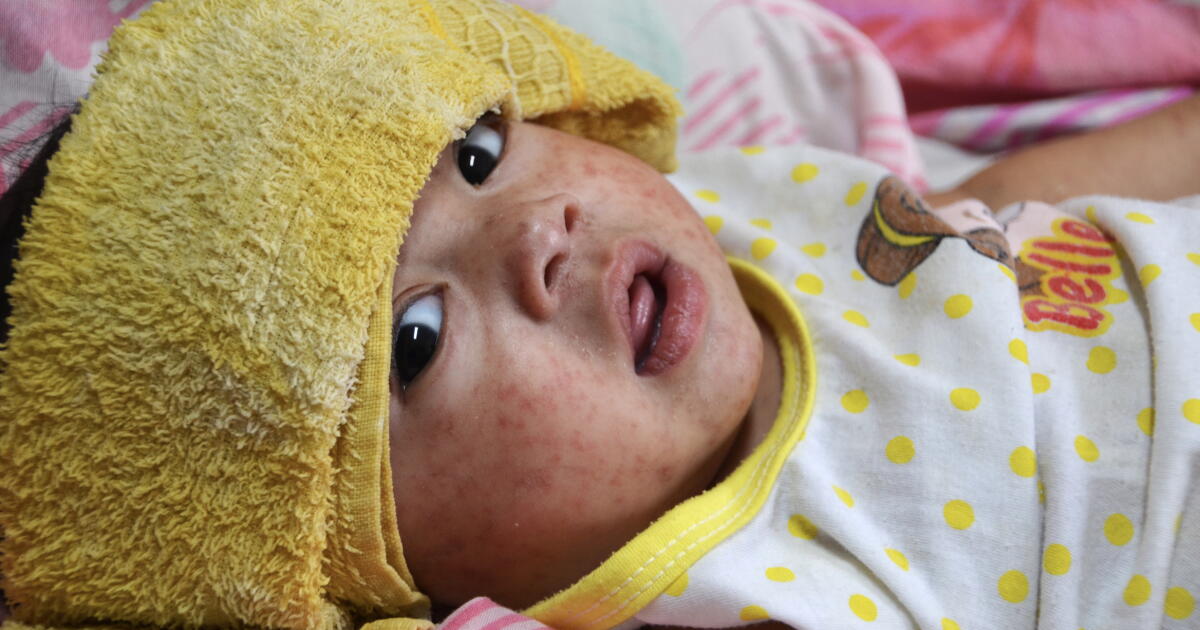
A baby hospitalized with measles. (Jim Goodson/Jim Goodson, MPH) Click here to listen to this article See more from the L.A. Times in Google Search. Set us as preferred In 2000, the U.S. became the first country in the world to officially eliminate measles, a public-health triumph that took decades of work and set a new standard for disease prevention efforts worldwide.Maintaining that status turned out to be a harder challenge than the nation was willing to take on.On Tuesday, the Pan American Health Organization, an offshoot of the World Health Organization, confirmed that measles is once again endemic in the U.S.Elimination means that a disease has become rare enough, and immunity to it widespread enough, that local transmission dwindles quickly if a case or two emerges.That is no longer the case here.The Pan American Health Organization confirmed that the same virus strain was able to circulate uninterrupted in the U.S. for at least 12 months since it was first recorded in west Texas on Jan. 20, 2025, a sign that herd immunity is no longer sufficient to guard against a disease that once killed hundreds of people and hospitalized thousands each year.The organization stripped Bolivia and Mexico of elimination status at the same time.According to the CDC, there were fewer than 4,500 confirmed measles cases in the U.S. in the 25 years in which measles was eliminated. There were more than 2200 cases in 2025, the highest annual case count since the early 1990s, and more than 5,400 cases so far this year.This is a developing story. More to Read Sign up for Climate | Health | Science A weekly round-up of the latest in science, health and the environment. By continuing, you agree to our Terms of Service, which include arbitration and a class action waiver. You agree that we and our third-party vendors may collect and use your information, including through cookies, pixels and similar technologies, for the purposes set forth in our Privacy Policy such as personalizing your experience and ads. Corinne Purtill is a science and medicine reporter for the Los Angeles Times. Her writing on science and human behavior has appeared in the New Yorker, the New York Times, Time Magazine, the BBC and elsewhere. Before joining The Times, she worked as the senior London correspondent for GlobalPost (now PRI) and as a reporter and assignment editor at the Cambodia Daily in Phnom Penh. She is a native of Southern California and a graduate of Stanford University. More From the Los Angeles Times
U.S. loses measles elimination status after first eradicating the disease 26 years ago
Full Article
Original Source
Read the full article at Latimes →KhanList aggregates and links to publicly available news content. We do not host full articles from third-party sources. Always verify important information with original sources.